


Applied Materials Inc shares on Thursday surged 10 percent in late trading after delivering a surprisingly upbeat sales forecast, signaling that demand for artificial intelligence (AI) and memory chips is fueling equipment purchases.
The company, which is the largest US supplier of chipmaking gear, expects revenue of about US$7.65 billion in the fiscal second quarter. Analysts had estimated US$7.03 billion on average for the period, which runs through April.
“The acceleration of industry investments in AI computing” is powering the company’s results, Applied Materials chief executive officer Gary Dickerson said in a statement.
Photo: Reuters
Applied Materials is bouncing back from a slowdown spurred by export restrictions on China, the biggest market for chips. Demand for memorychip machinery should be a particular bright spot — customers such as Samsung Electronics Co and Micron Technology Inc are scaling up manufacturing to cope with shortages in that market.
The shares rose as high as US$365.79 after the results were released. They had been up 28 percent this year, closing at US$328.39.
Dickerson cited the need for high-bandwidth memory — a variety used by AI computing systems — as a key driver.
“We expect to grow our semiconductor equipment business over 20 percent this calendar year,” he said.
The etching and deposition tools used to make dynamic random access memory “are set to expand due to strong demand from AI-chip customers,” Bloomberg Intelligence reported.
The company also just resolved a high-profile regulatory issue. Earlier this week, Applied Materials announced plans to pay US$252.5 million to settle a US Department of Commerce investigation into improper exports to China, ending a years-long saga.
Second-quarter earnings per share would be about US$2.64, excluding some items, Applied Materials said.
That compares with a projection of US$2.29.
Though revenue fell 2 percent to US$7.01 billion in the first quarter, that was a far less steep a drop than anticipated. Analysts had estimated US$6.86 billion, data compiled by Bloomberg showed.
Profit per shares was US$2.38 in the period, which ended on Jan. 25, versus a US$2.21 projection.
The commerce department settlement resolved allegations that certain shipments to China between November 2020 and July 2022 did not comply with export regulations. The US Department of Justice and the US Securities and Exchange Commission also closed related probes into the matter without taking action, Applied Materials said.
Separately, stricter export regulations have taken a toll on the company.
Applied Materials in October last year said that an expansion of US curbs on China would cost it US$600 million in lost revenue this fiscal year. The Santa Clara, California-based company also announced plans to cut 4 percent of its global workforce.

Cairo’s new monorail slices across the city skyline, running above the familiar chaos of blaring horns and aging buses’ exhaust fumes that mark rush hour below. The US$4.5 billion monorail, opened this month, is among Egypt’s most prominent new transport projects, part of a debt-funded infrastructure drive criticized for sapping state finances while bringing limited benefits to most of the country’s 109 million people. “It feels like you’re in a different country,” said Ramy Sayed, a restaurant manager, aboard a driverless Innovia 300 train. “No noise, no traffic, we’re not used to this.” The eastern line runs 56km from the bustling middle-class
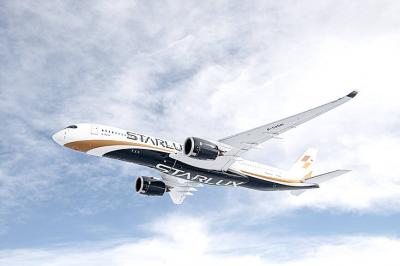
Starlux Airlines Co (星宇航空) today unveiled a long-haul network expansion plan at a shareholders’ meeting in Taipei, including direct flights to Barcelona, Spain, and Zurich, Switzerland, as well as a service connecting Taipei, Sydney and New Zealand. Starlux is to become the first Taiwanese carrier to offer non-stop services to the two European cities, while the inaugural oceanic route is expected to expand transit opportunities within the Australia-New Zealand market, Starlux said. Flight services to Chicago, Dallas, Washington and New York are under evaluation, the airline added. Prior to the shareholders’ meeting, the airline earlier this year announced that it would be

Taiwanese firms have increased investment in the Philippines in recent years as Manila’s ties with Washington deepen and global supply chains continue to shift away from China, an expert at the Chung-Hua Institution for Economic Research (CIER, 中華經濟研究院) said yesterday. The Philippines had not been among Taiwanese investors’ top choices in Southeast Asia, CIER Taiwan ASEAN Studies Center director Kristy Hsu (徐遵慈) said at a seminar in Taipei. However, Taiwan’s investment in the country has grown significantly since the COVID-19 pandemic, reaching US $257 million last year, a high in recent years, she said. Although Taiwan’s total investment in the Philippines still lags

Intel Corp regards Taiwan Semiconductor Manufacturing Co (TSMC, 台積電) as a longstanding partner, as the US chipmaker would continue outsourcing production of advanced chips to TSMC, Intel chief executive officer Lip-Bu Tan (陳立武) said yesterday. “I don’t look at people as competitors. I look at the collaboration... Nvidia is also, you know, a good friend,” Tan told a news conference following his keynote speech at the Computex trade show in Taipei. “It’s a very trusted partnership for us... We are a big, top customer for them, and we’re going to continue doing that,” he said, referring to TSMC, the world’s largest foundry


 RSS
RSS