


A Dutch court on Wednesday ordered a formal investigation into chipmaker Nexperia BV and upheld an earlier order suspending its Chinese chief executive officer Zhang Xuezheng (張學政), citing doubts about the company’s policies and conduct.
The written decision by the Enterprise Chamber of the Amsterdam Court of Appeal is the latest step in a saga swirling around the Dutch-based semiconductor company that sent shock waves through the global auto industry.
Nexperia makes the basic, standardized chips that are essential for controlling numerous automotive functions, such as operating headlights, airbag systems or anti-lock brakes.
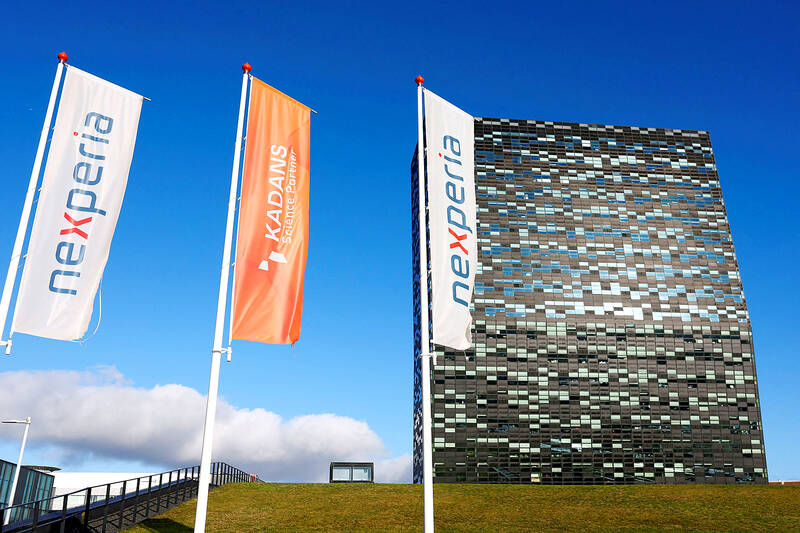
Photo: Reuters
The dispute made world headlines last year when the Dutch government said it took the extraordinary step of effectively seizing control of the company. It acted on fears that corporate governance concerns at the company, under its Chinese ownership, would result in the loss of technological capabilities vital to Dutch and European economic security.
The dispute also highlighted how Europe is caught between the US and China in their global battle over trade and technology dominance. US officials had told the Dutch government Zhang should be replaced to avoid trade restrictions, a court filing last year showed.
Zhang, who is also founder of Nexperia’s Chinese parent Wingtech Technology Co (聞泰科技), was suspended by the enterprise chamber in October last year following claims of mismanagement.
Wingtech in a statement said that it “regrets that the Court has not fully restored our shareholder rights by its decision, and instead kept previous extraordinary interim measures in place pending further inquiry.”
At a court hearing last month, lawyers for Zhang and Wingtech painted him as a successful businessman trying to guide Nexperia through troubled geopolitical waters. They urged the court not to order an investigation and said Wingtech had been blindsided by the Dutch government move. Zhang was not in court for the hearing.
However, Nexperia lawyer Jeroen van der Schriek told the three-judge panel that the behavior of Wingtech and Hong Kong-based holding company Yuching Holding Ltd (裕成控股) since October last year “makes it clear that they are willing to subordinate Nexperia’s interests to other interests.”
An English statement issued by the court on Wednesday’s ruling said the chamber found that “a conflict of interest has been handled without due care” at Nexperia.
It added that there are “indications that the director of Nexperia changed the strategy without internal consultation under the threat of upcoming sanctions.”
It said that agreements with the Dutch Ministry of Economic Affairs “were no longer adhered to, the powers of European managers were restricted and their dismissal was announced.”
The court statement said that it could not definitively say how long the investigation would take, but added that such probes can take more than six months.
The court would use the findings to assess “whether there has been mismanagement at Nexperia and whether definitive measures need to be taken,” it said.
Nexperia in a statement posted online said that it “welcomes and respects” the ruling, and is “committed to fully complying” with the investigation.
Wingtech said it is confident that “a full, fair and impartial inquiry” would show its actions were “appropriate and in the best interests of the company and its stakeholders.”
It bemoaned the decision to continue Zhang’s suspension, saying that it prolongs “significant uncertainty.”

Netherlands-based semiconductor equipment supplier ASML Holding NV yesterday said that it is planning to hire an additional 1,000 people in Taiwan this year in response to growing demand from clients. ASML had previously planned to recruit 600 people this year, but that the plan has been adjusted upward, ASML vice president and ASML Taiwan general manager Grace Wang (汪佳慧) told reporters. ASML has a workforce of more than 4,500 in Taiwan, accounting for about 10 percent of its global total, Wang said. This year’s recruitment campaign would focus on adding people in the customer support, manufacturing and supply chain domains to assist ASML

UNDER MICROSCOPE: Taiwan detained three people who allegedly conspired to buy servers in Taiwan and export them using fraudulent documentation, prosecutors said Nvidia Corp chief executive officer Jensen Huang (黃仁勳) on Saturday urged Super Micro Computer Inc to tighten up on compliance after Taiwan detained three people this week for allegedly making fraudulent declarations about artificial intelligence (AI) servers made by its US partner. The development marked the nation’s first crackdown on semiconductor smuggling, which grew after the US slapped restrictions on exports of high-end chips such as Nvidia AI accelerators to China. Nvidia is “rigorous” in explaining regulations to all of its partners, Huang told reporters after arriving in Taipei. “Ultimately Super Micro has to run their own company,” he said in response to

Nvidia Corp yesterday announced that CEO Jensen Huang (黃仁勳) would attend an employee meeting in Taipei tomorrow to celebrate the launch of the company’s Taiwan headquarters project. Huang would attend a gathering at the site of Nvidia’s planned headquarters in Beitou Shilin Technology Park (北投士林科技園區), the company said in a statement. After arriving in Taiwan on Saturday last week, Huang told reporters that he plans to meet with Quanta Computer Inc (廣達) chairman Barry Lam (林百里) and Taiwan Semiconductor Manufacturing Co (TSMC, 台積電) chairman C.C. Wei (魏哲家), and would attend the groundbreaking ceremony for Nvidia’s Taiwan headquarters tomorrow. Nvidia has not yet applied
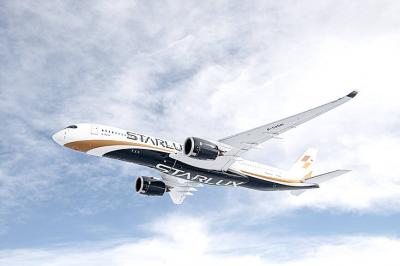
Starlux Airlines Co (星宇航空) today unveiled a long-haul network expansion plan at a shareholders’ meeting in Taipei, including direct flights to Barcelona, Spain, and Zurich, Switzerland, as well as a service connecting Taipei, Sydney and New Zealand. Starlux is to become the first Taiwanese carrier to offer non-stop services to the two European cities, while the inaugural oceanic route is expected to expand transit opportunities within the Australia-New Zealand market, Starlux said. Flight services to Chicago, Dallas, Washington and New York are under evaluation, the airline added. Prior to the shareholders’ meeting, the airline earlier this year announced that it would be


 RSS
RSS