


Winbond Electronics Corp (華邦電) yesterday said it is planning record capital expenditure (capex) of NT$42.1 billion (US$1.33 billion) this year as the demand for memory chips continues to rise amid the artificial intelligence (AI) boom.
This year’s capital outlay, a spike from NT$5.5 billion last year, aims to boost Winbond’s DRAM shipments by about 100 percent, and its NOR and NAND flash memory shipments by 30 percent to 40 percent year-on-year, the company said at an earnings conference in Taipei.
“Our capacities have been fully booked this year and next year, including DRAM, NOR and NAND,” Winbond president James Chen (陳沛銘) said. “The industry’s upcycle should last for quite a long time.”
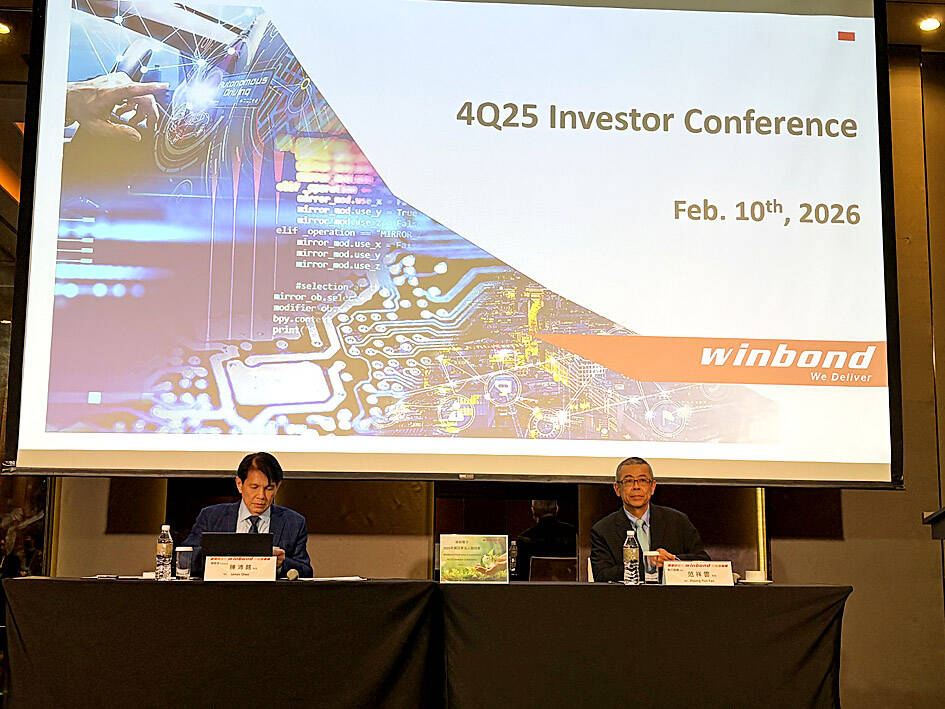
Photo: Lisa Wang, Taipei Times
The memory industry’s upturn is expected to persist before global AI infrastructure deployment reaches a scaling phase, Chen said.
AI infrastructure deployments help the company tap into new business areas such as chips used in enterprise solid-state drives, he said.
To meet demand, Winbond and its peers are embarking on massive investment sprees, and the company does not expect the supply-demand gap to narrow in the short term, Chen said, given that major industry players are allocating capacities to produce higher-margin DDR5 DRAM chips and high-bandwidth memory chips used in AI servers.
Besides, AI servers consume a much larger number of memory chips than PCs, he said.
An AI server rack based on Nvidia Corp’s GB200 chips requires more than 120 NOR flash chips, equal to the consumption of 120 PCs, Chen said.
Even general purpose servers are consuming more and higher-density memory chips to handle less complex AI tasks, he said.
Winbond expects memory prices to rise more than 30 percent this quarter, following a similar hike last quarter, due to persistent supply constraints, which would further prop up the company’s gross margin, Chen said.
Gross margin this quarter is predicted to climb above the 43 percent in the fourth quarter of last year, and even exceed the 51 percent registered in the third quarter of last year, he said.
Winbond’s net profit last quarter surged 479 percent to NT$3.42 billion from NT$2.94 billion the previous quarter. That was a spike from losses of NT$648 million in the fourth quarter of 2024.
For the whole of last year, net profit soared to NT$3.96 billion, from NT$601 million in 2024.
Earnings per share rose to NT$0.88 from NT$0.14 and gross margin improved to 35 percent from 29 percent.
Revenue expanded 9.6 percent year-on-year to NT$89.41 billion last year, with 35 percent from the flash memory business and 29 percent from the DRAM business. Logic chips contributed about 34 percent, the company said.


Taiwanese firms have increased investment in the Philippines in recent years as Manila’s ties with Washington deepen and global supply chains continue to shift away from China, an expert at the Chung-Hua Institution for Economic Research (CIER, 中華經濟研究院) said yesterday. The Philippines had not been among Taiwanese investors’ top choices in Southeast Asia, CIER Taiwan ASEAN Studies Center director Kristy Hsu (徐遵慈) said at a seminar in Taipei. However, Taiwan’s investment in the country has grown significantly since the COVID-19 pandemic, reaching US $257 million last year, a high in recent years, she said. Although Taiwan’s total investment in the Philippines still lags

Intel Corp regards Taiwan Semiconductor Manufacturing Co (TSMC, 台積電) as a longstanding partner, as the US chipmaker would continue outsourcing production of advanced chips to TSMC, Intel chief executive officer Lip-Bu Tan (陳立武) said yesterday. “I don’t look at people as competitors. I look at the collaboration... Nvidia is also, you know, a good friend,” Tan told a news conference following his keynote speech at the Computex trade show in Taipei. “It’s a very trusted partnership for us... We are a big, top customer for them, and we’re going to continue doing that,” he said, referring to TSMC, the world’s largest foundry

Hon Hai Precision Industry Co (鴻海精密) yesterday said it would work with US chipmaker Intel Corp to jointly develop and deploy next-generation artificial intelligence (AI) infrastructure and intelligent computing platforms in a move to capture booming demand for AI computing systems. Hon Hai, also known as Foxconn Technology Group (富士康), said in a statement that the partnership would combine its global manufacturing scale, system integration expertise and AI data center deployment capabilities with Intel’s strengths in processor architecture, silicon technologies and software ecosystem. The companies said they plan to work on equipment used in AI data centers, including server racks powered by

Artificial intelligence (AI) agents would supplant smartphones as the center of people’s digital lives, fundamentally reshaping personal devices and driving a major computing upgrade cycle, Qualcomm Inc CEO Cristiano Amon said yesterday. In his keynote speech for this year’s Computex trade show in Taipei, Amon said that the rise of "agentic AI" — AI systems capable of reasoning, planning and carrying out tasks autonomously — would transform how people interact with technology across phones, PCs, vehicles and wearable devices. Describing the technology as the next major evolution in computing, Amon said that "2026 is the year of agents.” For decades, smartphones have sat


 RSS
RSS