


Investor reaction to Japan’s election signals at least a temporary reprieve for Japanese Prime Minister Sanae Takaichi from market ructions that have threatened to undermine her spending plans.
Japanese equities yesterday surged to fresh record highs after Takaichi’s Liberal Democratic Party (LDP) achieved the biggest post-war victory for a single party in a general election. The yen and government bonds stayed noticeably calmer than many had feared following weeks of volatility fueled by concerns about fiscal sustainability.
The response from investors suggested that they are willing to give Takaichi and the LDP the benefit of the doubt, betting that her super majority would allow for policy clarity and reduce the risk of worst-case fiscal scenarios.
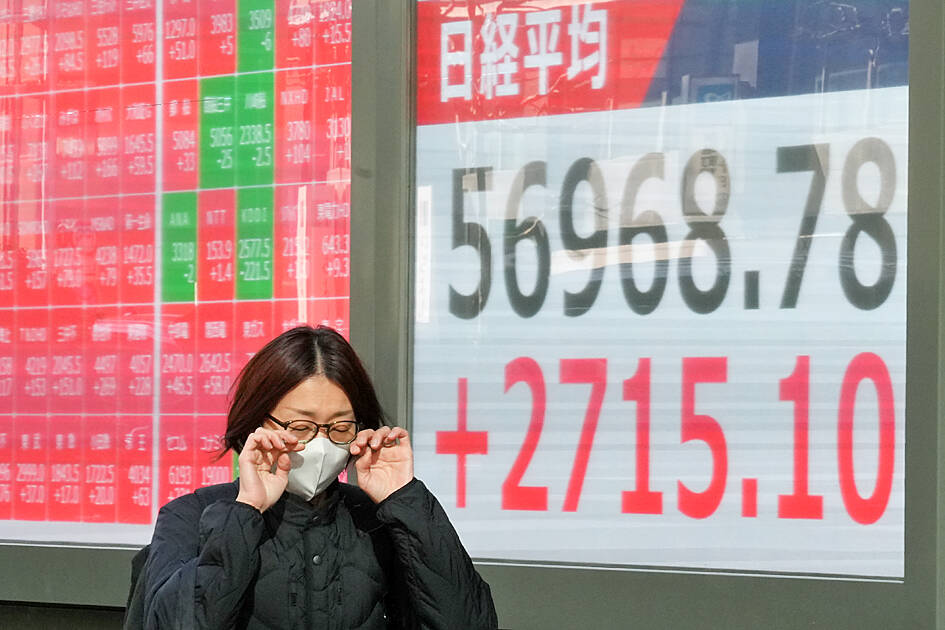
Photo: AP
“The big election win by the LDP will put wind in the sails of equity markets,” HSBC Holdings PLC chief Asia economist Frederic Neumann said, pointing to Takaichi’s mandate to pursue structural reforms that could lift productivity and corporate profits.
“Importantly, a large governing majority should also ensure that fiscal spending remains more restrained, reducing the risk of bond market jitters,” he added.
That view is gaining traction among investors who see the outcome as reducing political noise rather than unleashing an immediate spending spree. While longer-tenor Japanese bond yields initially jumped yesterday, they quickly pulled back, easing concerns of a disorderly selloff that fueled a bond rout early this year.
The yen also strengthened as much as 0.6 percent to 156.22 against the greenback, moving further away from the 160-per-dollar zone that had drawn Japanese authorities to intervene in the market.
Reassurances from policymakers helped steady sentiment.
Japanese Minister of Finance Satsuki Katayama said a proposed consumption tax cut would be limited to two years, apply only to food and would not be funded through additional debt issuance.
Meanwhile, Takaichi said she would conduct a responsible and proactive fiscal policy.
“The LDP landslide victory does not give Takaichi free rein to just spend,” Aberdeen Investments senior research economist Sree Kochugovindan said. “The LDP is fiscally conservative and Takaichi has been very mindful of bond investors.”
The fact that opposition parties did not gain any ground at all in the election means “a permanent consumption tax cut is practically off the table now, and that’s a huge relief for the bond market, and supportive for the yen,” Phillip Securities Japan Ltd research head Kazuhiro Sasaki said.
Bulls are taking notice. Post-election, JPMorgan Chase & Co strategists lifted their year-end target for the Nikkei 225 Stock Average to 61,000, citing expectations of more political stability. The measure added as much as 5.7 percent to 57,337.07 in Tokyo.
Sectors such as defense and semiconductors that are likely to benefit from Takaichi’s spending plans might get another leg up, analysts said.
“From the stock market’s point of view, the LDP’s resounding win was highly desirable as it removed much of the political uncertainty that has been dogging the ruling party ever since [former Japanese prime minister Shinzo] Abe’s assassination,” Asymmetric Advisors Ltd equity strategist Amir Anvarzadeh said.
Still, traders are keenly aware that Japan’s room for maneuver on fiscal and monetary policy has narrowed, and that bond and currency markets would respond quickly if spending plans begin to look unfunded or inflationary pressures intensify.
Looking ahead, markets would be watching how quickly election momentum translates into policy action. An extraordinary National Diet session is expected as early as this month to begin deliberations on this year’s budget.
As details of her fiscal expansion plans unfold, “there’s a possibility that volatility in the bond market could rise again,” Schroder Investment Management Japan Ltd equities head Kazuhiro Toyoda said. “I don’t think we’re going to see a straightforward, one-way climb from here in stocks.”
Attention would also focus on US-Japan relations. Takaichi is set to meet with US President Donald Trump at the White House on March 19, where discussions could range from defense outlays to investment commitments under Japan’s pledged US$550 billion package.
For now at least the market has found solace.
“Takaichi’s decision to call an early snap election has clearly paid off,” Invesco Ltd global market strategist for Asia Pacific David Chao said. “The combination of political stability, policy continuity and reform optionality is likely to be viewed positively by markets, reinforcing the constructive outlook I continue to have for Japanese risk assets.”

Cairo’s new monorail slices across the city skyline, running above the familiar chaos of blaring horns and aging buses’ exhaust fumes that mark rush hour below. The US$4.5 billion monorail, opened this month, is among Egypt’s most prominent new transport projects, part of a debt-funded infrastructure drive criticized for sapping state finances while bringing limited benefits to most of the country’s 109 million people. “It feels like you’re in a different country,” said Ramy Sayed, a restaurant manager, aboard a driverless Innovia 300 train. “No noise, no traffic, we’re not used to this.” The eastern line runs 56km from the bustling middle-class

Starlux Airlines Co (星宇航空) today unveiled a long-haul network expansion plan at a shareholders’ meeting in Taipei, including direct flights to Barcelona, Spain, and Zurich, Switzerland, as well as a service connecting Taipei, Sydney and New Zealand. Starlux is to become the first Taiwanese carrier to offer non-stop services to the two European cities, while the inaugural oceanic route is expected to expand transit opportunities within the Australia-New Zealand market, Starlux said. Flight services to Chicago, Dallas, Washington and New York are under evaluation, the airline added. Prior to the shareholders’ meeting, the airline earlier this year announced that it would be

Taiwanese prosecutors suspect that three people successfully smuggled at least one shipment of Nvidia Corp artificial intelligence (AI) chips to China after first exporting them to Japan, people familiar with the matter said. The trio was detained last week by the Keelung District Prosecutors’ Office for allegedly falsifying documents related to exports of Super Micro Computer Inc servers containing advanced Nvidia chips, which the US has barred from sale to China without a license from Washington. The move marked Taiwan’s first public crackdown on AI chip diversion after years of pressure from the US to take a more active role in curtailing
Taiwan Semiconductor Manufacturing Co (TSMC, 台積電) employee bonuses are likely to grow more than 30 percent this year, in line with the past few years as the company’s profits continue to set new records, an anonymous source cited TSMC chairman C.C. Wei (魏哲家) as saying yesterday. TSMC, the world’s largest contract chipmaker, is committed to taking care of its workers, the source said, citing Wei’s meeting with employees yesterday morning. Wei also expressed gratitude to employees for their contribution to the company’s improving bottom line, the source added. Since 2023, TSMC’s employee bonuses have grown at an annual rate of


 RSS
RSS