


Semiconductor equipment manufacturer Skytech Inc (天虹科技) yesterday said that revenue this year would reach a historic high, driven mainly by robust demand for next-generation advanced packaging equipment and a pickup in demand for compound semiconductor equipment.
Skytech said it last month delivered its first equipment for commercializing fan-out panel-level packaging (PLP) technology to a strategic customer, a Kaohsiung-based outsourced semiconductor assembly and test company, Skytech CEO George Yi (易錦良) told reporters in Hsinchu City.
That put Skytech ahead of its rivals in supplying physical vapor deposition used in PLP technology on a 310mm x 310mm square substrate.
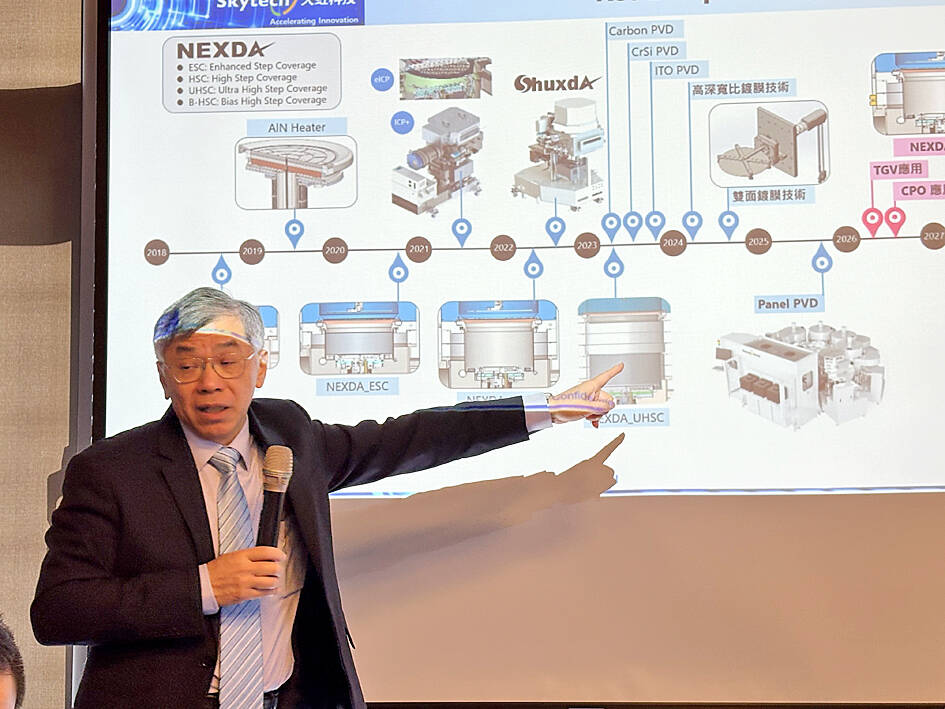
Photo: Lisa Wang, Taipei Times
The company did not disclose the name of the customer, but it is widely believed to be ASE Technology Holding Co (日月光投控), the world’s biggest outsourced semiconductor assembly and test service provider, which has shown interest in fan-out PLP technology.
“We have landed a substantial number of new orders during the first quarter to support equipment delivery in the first half of this year,” Yi said. “We have clear order visibility for this year.”
Overall, this year would be another growth year for the semiconductor equipment sector, as an artificial intelligence (AI) boom would not only benefit chipmakers, but also advanced chip packaging suppliers, he said.
Skytech aims grow its revenue to an all-time high this year, surpassing 2024’s NT$2.59 billion (US$82.02 million), company chairman Paul Huang (黃見駱) said.
Revenue last year contracted 13.26 percent year-on-year to NT$2.24 billion.
Fan-out PLP is considered a successor to chip-on-wafer-on-substrate (CoWoS) technology, which is used in packaging for Nvidia Corp’s AI chips produced by Taiwan Semiconductor Manufacturing Co (TSMC, 台積電).
TSMC is also developing its version of panel-level packaging technology dubbed chip-on-panel-on-substrate (CoPoS) technology, which is likely to enter volume production in 2028, supply chain sources said.
“The CoPoS technology offers a new business opportunity for Skytech,” Yi said, adding that the company currently only supplies spare parts used in CoWoS equipment. “The customer base should be broader as multiple companies aim to tap into the market.”
Aside from robust demand for new advanced packaging equipment, nascent signs showed that compound semiconductor equipment, such as those for silicon carbide semiconductor equipment, is recovering from a slump last year, given improving demand for electric vehicles and autonomous cars, as well as low Earth orbit satellites, Huang said.
To cope with growing demand, Skytech has acquired new sites in Hsinchu City and Tainan to expand capacity, the company said.
Shares of contract chipmaker Taiwan Semiconductor Manufacturing Co (TSMC, 台積電) came under pressure yesterday after a report that Apple Inc is looking to shift some orders from the Taiwanese company to Intel Corp. TSMC shares fell NT$55, or 2.4 percent, to close at NT$2,235 on the local main board, Taiwan Stock Exchange data showed. Despite the losses, TSMC is expected to continue to benefit from sound fundamentals, as it maintains a lead over its peers in high-end process development, analysts said. “The selling was a knee-jerk reaction to an Intel-Apple report over the weekend,” Mega International Investment Services Corp (兆豐國際投顧) analyst Alex Huang
Taiwan Semiconductor Manufacturing Co (TSMC, 台積電) is expected to remain Apple Inc’s primary chip manufacturing partner despite reports that Apple could shift some orders to Intel Corp, industry experts said yesterday. The comments came after The Wall Street Journal reported on Friday that Apple and Intel had reached a preliminary agreement following more than a year of negotiations for Intel to manufacture some chips for Apple devices. Taiwan Institute of Economic Research (台灣經濟研究院) economist Arisa Liu (劉佩真) said TSMC’s advanced packaging technologies, including integrated fan-out and chip-on-wafer-on-substrate, remain critical to the performance of Apple’s A-series and M-series chips. She said Intel and Samsung
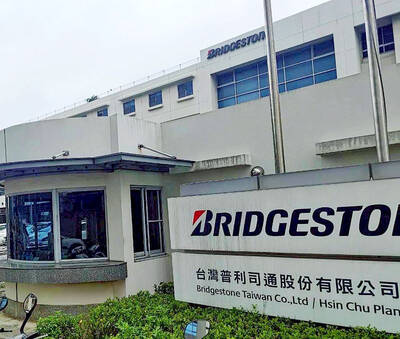
TRANSITION: With the closure, the company would reorganize its Taiwanese unit to a sales and service-focused model, Bridgestone said Bridgestone Corp yesterday announced it would cease manufacturing operations at its tire plant in Hsinchu County’s Hukou Township (湖口), affecting more than 500 workers. Bridgestone Taiwan Co (台灣普利司通) said in a statement that the decision was based on the Tokyo-based tire maker’s adjustments to its global operational strategy and long-term market development considerations. The Taiwanese unit would be reorganized as part of the closure, effective yesterday, and all related production activities would be concluded, the statement said. Under the plan, Bridgestone would continue to deepen its presence in the Taiwanese market, while transitioning to a sales and service-focused business model, it added. The Hsinchu
Taiwan Semiconductor Manufacturing Co (TSMC, 台積電) has approved a capital budget of US$31.28 billion for production expansion to meet long-term development needs during the artificial intelligence (AI) boom. The company’s board meeting yesterday approved the capital appropriation plan for purposes such as the installation of advanced technology capacity and fab construction, the world’s largest contract chipmaker said in a statement. At an earnings conference last month, TSMC forecast that its capital expenditure for this year would be at the higher end of the US$52 billion to US$56 billion range it forecast in January in response to robust demand for 5G, AI and


 RSS
RSS