


Microsoft Corp’s spending surged to a record high and cloud sales growth slowed, sending the shares down sharply amid investor concerns that it could take longer than expected for the company’s artificial intelligence (AI) investments to pay off.
Capital expenditures for the fiscal second quarter ended on Dec. 31 hit US$37.5 billion, up 66 percent from a year earlier and exceeding analyst estimates for US$36.2 billion.
The Azure cloud-computing unit posted a 38 percent revenue gain during the quarter when adjusting for currency fluctuations, just meeting analysts’ projections. That growth rate slowed — by a percentage point — from the prior quarter. The company expects Azure sales to rise 37 percent to 38 percent in the current quarter.
Photo: AP
Microsoft shares fell about 7 percent in extended trading after closing at US$481.63 in New York on Wednesday.
“One of the core issues that is weighing on investors is that capex is growing faster than we expected, and maybe Azure is growing a little bit slower than we expected,” Morgan Stanley analyst Keith Weiss said during an analysts’ call. Investors, he said, were concerned about the return on that spending.
Microsoft chief financial officer Amy Hood responded by saying that a chunk of cloud capacity is going toward internal teams, which boosts products such as Copilot. Had all of the new capacity gone toward Azure, the growth rates would have been notably higher, she said.
The world’s largest software maker has experienced rapid growth in its cloud computing business, thanks in part to a landmark partnership with leading AI start-up OpenAI. But despite spending heavily on data centers, Microsoft has struggled to get capacity online quickly enough to meet demand.
Microsoft has been rushing to bake AI tools, including those powered by OpenAI, into its products, betting that chatbots and automation technology will boost sales of the company’s productivity software and cloud services.
During the analyst call, Microsoft chief executive officer Satya Nadella said companies are now paying for 15 million subscriptions to the M365 Copilot, Microsoft’s main AI tool for office workers. Adoption is growing among the company’s enormous base of corporate users, Nadella said.
Total sales increased 17 percent year-on-year to US$81.3 billion during the quarter, while profit was US$5.16 a share, the company said in a statement on Wednesday. The net income figure was boosted by gains from Microsoft’s investment in OpenAI, which lifted per-share earnings by US$1.02.
Analysts had expected sales of US$80.3 billion and per-share earnings of US$3.92.
The value of commitments from customers that Microsoft expects to materialize as sales in future years more than doubled from a year earlier, primarily the result of a new, US$250 billion deal with OpenAI. The start-up accounted for 45 percent of Microsoft’s backlog, which stood at US$625 billion at the end of December.
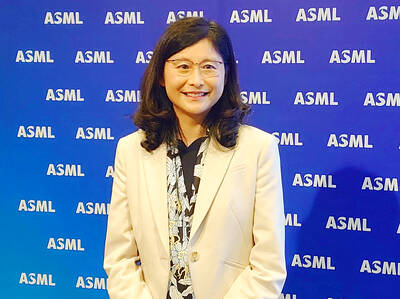
Netherlands-based semiconductor equipment supplier ASML Holding NV yesterday said that it is planning to hire an additional 1,000 people in Taiwan this year in response to growing demand from clients. ASML had previously planned to recruit 600 people this year, but that the plan has been adjusted upward, ASML vice president and ASML Taiwan general manager Grace Wang (汪佳慧) told reporters. ASML has a workforce of more than 4,500 in Taiwan, accounting for about 10 percent of its global total, Wang said. This year’s recruitment campaign would focus on adding people in the customer support, manufacturing and supply chain domains to assist ASML
UNDER MICROSCOPE: Taiwan detained three people who allegedly conspired to buy servers in Taiwan and export them using fraudulent documentation, prosecutors said Nvidia Corp chief executive officer Jensen Huang (黃仁勳) on Saturday urged Super Micro Computer Inc to tighten up on compliance after Taiwan detained three people this week for allegedly making fraudulent declarations about artificial intelligence (AI) servers made by its US partner. The development marked the nation’s first crackdown on semiconductor smuggling, which grew after the US slapped restrictions on exports of high-end chips such as Nvidia AI accelerators to China. Nvidia is “rigorous” in explaining regulations to all of its partners, Huang told reporters after arriving in Taipei. “Ultimately Super Micro has to run their own company,” he said in response to

Nvidia Corp yesterday announced that CEO Jensen Huang (黃仁勳) would attend an employee meeting in Taipei tomorrow to celebrate the launch of the company’s Taiwan headquarters project. Huang would attend a gathering at the site of Nvidia’s planned headquarters in Beitou Shilin Technology Park (北投士林科技園區), the company said in a statement. After arriving in Taiwan on Saturday last week, Huang told reporters that he plans to meet with Quanta Computer Inc (廣達) chairman Barry Lam (林百里) and Taiwan Semiconductor Manufacturing Co (TSMC, 台積電) chairman C.C. Wei (魏哲家), and would attend the groundbreaking ceremony for Nvidia’s Taiwan headquarters tomorrow. Nvidia has not yet applied

Huawei Technologies Co (華為) said it has come up with a new pathway to shorten its gap with industry leader Taiwan Semiconductor Manufacturing Co (TSMC, 台積電), potentially achieving a breakthrough in making advanced semiconductors without cutting-edge equipment. Right now there is about a five-year gap between what TSMC is capable of and what Huawei, together with its manufacturing partner Semiconductor Manufacturing International Corp (中芯), can produce. Huawei is to start making 1.4-nanometer chips by 2031 with its own “LogicFolding” technology, Huawei semiconductor chief He Tingbo (何庭波) said in a rare public appearance during a chip conference yesterday, while TSMC has


 RSS
RSS