


Taiwan’s consumer confidence improved this month to a nine-month high as uncertainties were eased after Taipei and Washington agreed verbally to a deal on tariffs on Jan. 15, a survey released yesterday by National Central University (NCU) showed.
The local consumer confidence index (CCI) rose 2.86 points from a month earlier to 67.16, the highest since April last year, when the index stood at 68.21, the survey conducted from Jan. 18 to Wednesday last week showed.
The CCI measures sentiment over the following six months across six factors: consumer prices, the domestic economic climate, the stock market, durable goods purchases, employment prospects and family finances.
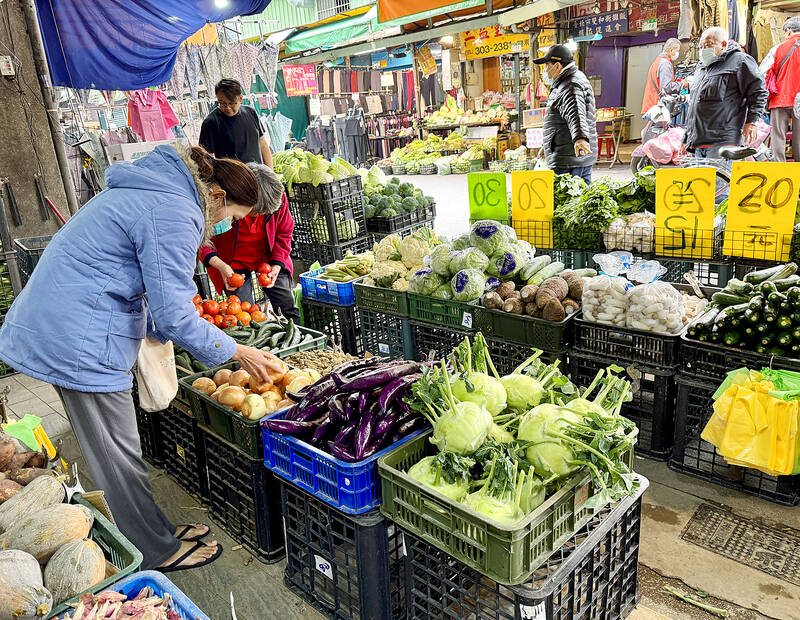
Photo: CNA
The subindices for all six factors improved this month from a month earlier.
The subindex for consumer prices rose to 37.34, up 4.52 from last month, the highest rise among the six factors, while the subindices on the stock market and family finances rose 3.15 and 2.71 to 29.52 and 80.39 respectively, the survey showed.
In addition, the subindices on the local economic climate, purchases of durable goods, and employment also moved higher by 2.3, 2.26 and 2.2, respectively, to 83.69, 98.2 and 73.8, the survey showed.
Under the deal with the US, which has yet to be signed, as some tariff arrangements have yet to be agreed upon, the US would cut tariffs on Taiwanese goods to 15 percent from 20 percent.
NCU Research Center for Taiwan Economic Development director Dachrahn Wu (吳大任) said the lower tariff gave a big boost to sentiment in non-tech industries, because it placed Taiwan on an equal footing with the nation’s major competitors.
However, Wu said that, as part of the deal, Taiwan pledged to move some of its semiconductor supply chain to the US through large investments, and the impact of that would have to be watched.
At the same time, Taiwan’s booming stock market, which has recently closed at all-time highs, has benefited many retail investors, and helped family finances and the local economic climate, he said.
Meanwhile, Taiwan’s ruling and opposition parties should overcome their partisan wrangling to deal with the trade agreement, “or Taiwan’s economy will get hurt,” he added.
Wu cited US President Donald Trump’s threat on Monday to raise tariffs on South Korea-made goods to 25 percent from 15 percent, as South Korean lawmakers have yet to approve a Washington-Seoul trade deal signed last year.
Also this month, the home-buying index jointly compiled by NCU and Taiwan Realty rose 2.32 points from a month earlier to 94.95, the university added.
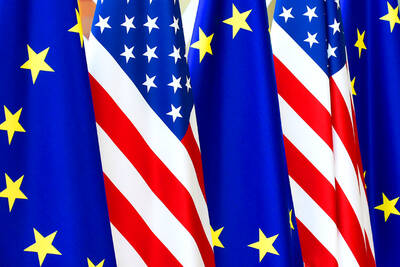
The EU and US are nearing an agreement to coordinate on producing and securing critical minerals, part of a push to break reliance on Chinese supplies. The potential deal would create incentives, such as minimum prices, that could advantage non-Chinese suppliers, according to a draft of an “action plan” seen by Bloomberg. The EU and US would also cooperate on standards, investments and joint projects, as well as coordinate on any supply disruptions by countries like China. The two sides are additionally seeking other “like-minded partners” to join a multicountry accord to help create these new critical mineral supply chains, which feed into

For weeks now, the global tech industry has been waiting for a major artificial intelligence (AI) launch from DeepSeek (深度求索), seen as a benchmark for China’s progress in the fast-moving field. More than a year has passed since the start-up put Chinese AI on the map in early last year with a low-cost chatbot that performed at a similar level to US rivals. However, despite reports and rumors about its imminent release, DeepSeek’s next-generation “V4” model is nowhere in sight. Speculation is also swirling over the geopolitical implications of which computer chips were chosen to train and power the new

Elon Musk’s lieutenants have reached out to chip industry suppliers, including Applied Materials Inc, Tokyo Electron Ltd and Lam Research Corp, for his envisioned Terafab, early steps in an audacious and likely arduous attempt to break into the production of cutting-edge chips. Staff working for the joint venture between Tesla Inc and Space Exploration Technologies Corp (SpaceX) have sought price quotes and delivery times for an array of chipmaking gear, people familiar with the matter said. In past weeks, they’ve contacted makers of photomasks, substrates, etchers, depositors, cleaning devices, testers and other tools, according to the people, who asked not to

Japan approved ¥631.5 billion (US$3.97 billion) in additional subsidies to hasten Rapidus Corp’s entry into the high-stakes artificial intelligence (AI) chipmaking arena, ramping up support for a project widely regarded as a long shot. The capital is intended to bankroll Rapidus’ work for information technology firm Fujitsu Ltd, one of the initial customers that Tokyo hopes would get the signature endeavor off the ground. The new money raises the fees and investments that the government is injecting into the start-up to ¥2.6 trillion by the end of the current fiscal year to March next year, the Japanese Ministry of Economy, Trade and


 RSS
RSS