


Gold yesterday surged to a record high of more than US$5,100 an ounce, extending a historic rally as investors piled into the safe-haven asset amid rising geopolitical uncertainties.
Spot gold were up 2.2 percent at US$5,089.78 per ounce by 6:56am GMT, after earlier touching an all-time high of US$5,110.50. US gold futures for February delivery also gained the same amount to US$5,086.30 per ounce.
The metal soared 64 percent last year, its biggest annual gain since 1979, driven by safe-haven demand, US monetary policy easing, robust central bank purchases including China’s 14th consecutive month of buying last month, and record inflows into exchange-traded funds.
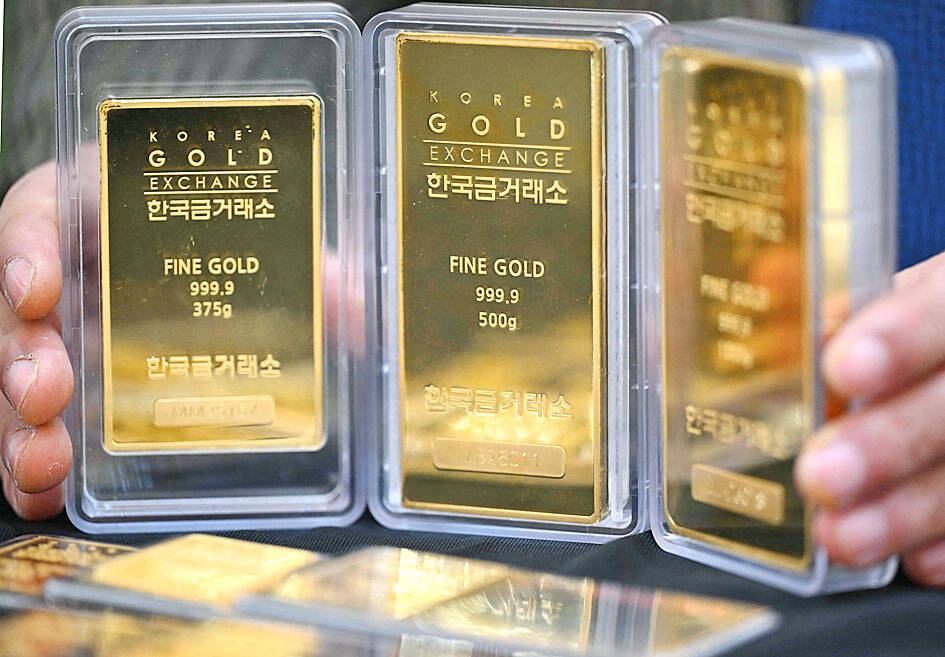
Photo: AFP
Prices have set consecutive record peaks over the past week and have already risen more than 18 percent this year.
The latest catalyst “is effectively this crisis of confidence in the US administration and US assets, that was set off by some of the erratic decisionmaking from the Trump administration last week,” Capital.com senior market analyst Kyle Rodda said.
US President Donald Trump on Wednesday last week abruptly stepped back from threats to impose tariffs on European allies as leverage to seize Greenland.
Over the weekend, he said he would impose a 100 percent tariff on Canada if it followed through on a trade deal with China.
Trump has also threatened to hit French wines and champagnes with 200 percent tariffs in an apparent effort to pressure French President Emmanuel Macron into joining his Board of Peace initiative. Some observers fear the board could undermine the UN’s role as the main global platform for conflict resolution, although Trump has said it would work with the UN.
“This Trump administration has caused a permanent rupture in the way things are done, and so now everyone’s kind of running to gold as the only alternative,” Rodda added.
Meanwhile, a rising yen yesterday dragged the US dollar broadly lower, with markets on alert for possible intervention in the yen and investors cutting US dollar positions ahead of this week’s US Federal Reserve meeting.
A weaker dollar makes greenback-priced gold more affordable for holders of other currencies.
Analysts expect gold prices to climb further toward US$6,000 this year on mounting global tensions as well as strong central-bank and retail demand.
“We expect further upside [for gold]. Our current forecast suggests that prices will peak at around US$5,500 later this year,” Metals Focus director Philip Newman said.
“Periodic pullbacks are likely as investors take profits, but we expect each correction to be short-lived and met with strong buying interest,” Newman added.
Spot silver advanced 4.8 percent to US$107.903, after hitting a record of US$109.44. Spot platinum climbed 3.4 percent to US$2,861.91 per ounce, after hitting a record high of US$2,891.6 earlier in the session, while spot palladium was 2.5 percent higher at US$2,060.70, having touched a more than three-year high.
Silver climbed above the US$100 mark for the first time on Friday, building on its 147 percent rise last year as retail-investor flows and momentum-driven buying compounded a prolonged spell of tightness in physical markets for the metal.

Singapore-based ride-hailing and delivery giant Grab Holdings Ltd has applied for regulatory approval to acquire the Taiwan operations of Germany-based Delivery Hero SE's Foodpanda in a deal valued at about US$600 million. Grab submitted the filing to the Fair Trade Commission on Friday last week, with the transaction subject to regulatory review and approval, the company said in a statement yesterday. Its independent governance structure would help foster a healthy and competitive market in Taiwan if the deal is approved, Grab said. Grab, which is listed on the NASDAQ, said in the filing that US-based Uber Technologies Inc holds about 13 percent of

The domestic unit of the Chinese-owned, Dutch-headquartered chipmaker Nexperia BV will soon be able to produce semiconductors locally within China, according to two company sources. Nexperia is at the center of a global tug-of-war over critical semiconductor technology, with a Dutch court in February ordering a probe into alleged mismanagement at the company. The geopolitical tussle has disrupted supply chains, with some carmakers reportedly forced to cut production due to chip shortages. Local production would allow Nexperia’s domestic arm, Nexperia Semiconductors (China) Ltd (安世半導體中國), to bypass restrictions in place since October on the supply of silicon wafers — etched with tiny components to

Taiwan Semiconductor Manufacturing Co (TSMC, 台積電) yesterday received government approval to deploy its advanced 3-nanometer (3nm) process at its second fab currently under construction in Japan, the Ministry of Economic Affairs said in a news release. The ministry green-lit the plan for the facility in Kumamoto, which is scheduled to start installing equipment and come online in 2028 with a monthly production capacity of 15,000 12-inch wafers, the ministry said. The Department of Investment Review in June 2024 authorized a US$5.26 billion investment for the facility, slated to manufacture 6- to 12nm chips, significantly less advanced than 3nm process. At a meeting with

Taiwan’s food delivery market could undergo a major shift if Singapore-based Grab Holdings Ltd completes its planned acquisition of Delivery Hero SE’s Foodpanda business in Taiwan, industry experts said. Grab on Monday last week announced it would acquire Foodpanda’s Taiwan operations for US$600 million. The deal is expected to be finalized in the second half of this year, with Grab aiming to complete user migration to its platform by the first half of next year. A duopoly between Uber Eats and Foodpanda dominates Taiwan’s delivery market, a structure that has remained intact since the Fair Trade Commission (FTC) blocked Uber Technologies Inc’s


 RSS
RSS