


E.Sun Financial Holding Co (玉山金控) yesterday won shareholder approval to acquire Mercuries Life Insurance Co (三商美邦人壽), clearing a major hurdle in the largest transaction in the bank-led group’s history and advancing its long-standing ambition to become a fully diversified financial conglomerate.
The proposal passed with 85.91 percent of voting rights in favor at an extraordinary shareholders’ meeting, comfortably exceeding the two-thirds threshold required under company law.
E.Sun Financial chairman Joseph Huang (黃男州) said the deal is aimed at boosting the group’s long-term earnings profile rather than delivering an immediate boost to profitability.
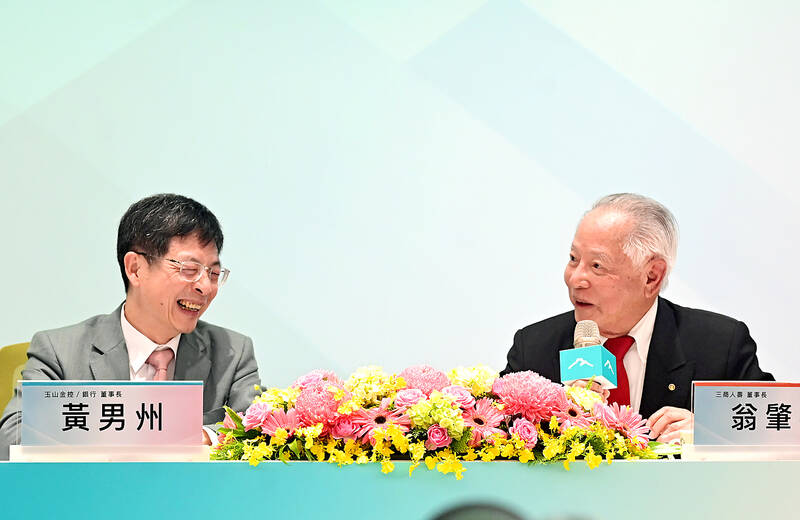
Photo: Wang Yi-sung, Taipei Times
“This acquisition is a strategic investment focused on building a more balanced earnings structure over time,” Huang told reporters after the vote. “We will do our best to integrate Mercuries Life and achieve that goal.”
The boards of both companies agreed to the transaction in November through a share-swap arrangement, according to which each Mercuries Life common share would be exchanged for 0.2486 shares of E.Sun Financial. The deal values Mercuries Life at about NT$48 billion (US$1.52 billion), or NT$8.2 per share.
The share swap is expected to be completed in the second half of this year, subject to regulatory approvals, the companies said.
Upon completion, Mercuries Life would be rebranded as E.Sun Life Insurance, marking a significant expansion of E.Sun Financial’s presence in Taiwan’s increasingly competitive financial services market, which is undergoing consolidation amid tighter capital and regulatory requirements.
Huang said that operational improvement and stricter risk discipline would be the top priorities for the rebranded insurer, as E.Sun Financial seeks to address concerns over Mercuries Life’s balance sheet strength and profitability outlook.
Mercuries Life also secured shareholder approval for the merger at its own extraordinary meeting on the same day that was led by company chairman George Wong (翁肇喜).
The Mercuries Life meeting lasted 20 minutes and concluded without objections, as more than 90 percent of votes cast were in favor of the deal.
Once completed, Mercuries Life would become a wholly owned subsidiary of E.Sun Financial, giving the group a long-sought life insurance arm to complement its core banking and securities businesses.
Wong said that Mercuries Life would focus on maintaining business momentum during the transition period as regulatory and closing procedures begin.
New business contractual service margin — a key profitability metric under Taiwan’s new insurance accounting standards — exceeded NT$10 billion last year, achieving about 95 percent of the company’s internal target, he said.
For this year, management expects contractual service margin to grow by 10 percent, Wong said.
As insurers adapt to tighter capital rules and accounting standards, Mercuries Life has been adjusting its product mix by reducing reliance on investment-linked policies while increasing sales of protection-oriented and traditional insurance products, company officials said.
Investment-linked policies would remain part of the portfolio, but with greater emphasis on long-term value creation, they said.

Netherlands-based semiconductor equipment supplier ASML Holding NV yesterday said that it is planning to hire an additional 1,000 people in Taiwan this year in response to growing demand from clients. ASML had previously planned to recruit 600 people this year, but that the plan has been adjusted upward, ASML vice president and ASML Taiwan general manager Grace Wang (汪佳慧) told reporters. ASML has a workforce of more than 4,500 in Taiwan, accounting for about 10 percent of its global total, Wang said. This year’s recruitment campaign would focus on adding people in the customer support, manufacturing and supply chain domains to assist ASML

UNDER MICROSCOPE: Taiwan detained three people who allegedly conspired to buy servers in Taiwan and export them using fraudulent documentation, prosecutors said Nvidia Corp chief executive officer Jensen Huang (黃仁勳) on Saturday urged Super Micro Computer Inc to tighten up on compliance after Taiwan detained three people this week for allegedly making fraudulent declarations about artificial intelligence (AI) servers made by its US partner. The development marked the nation’s first crackdown on semiconductor smuggling, which grew after the US slapped restrictions on exports of high-end chips such as Nvidia AI accelerators to China. Nvidia is “rigorous” in explaining regulations to all of its partners, Huang told reporters after arriving in Taipei. “Ultimately Super Micro has to run their own company,” he said in response to
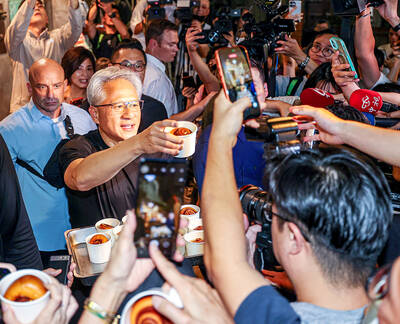
Nvidia Corp yesterday announced that CEO Jensen Huang (黃仁勳) would attend an employee meeting in Taipei tomorrow to celebrate the launch of the company’s Taiwan headquarters project. Huang would attend a gathering at the site of Nvidia’s planned headquarters in Beitou Shilin Technology Park (北投士林科技園區), the company said in a statement. After arriving in Taiwan on Saturday last week, Huang told reporters that he plans to meet with Quanta Computer Inc (廣達) chairman Barry Lam (林百里) and Taiwan Semiconductor Manufacturing Co (TSMC, 台積電) chairman C.C. Wei (魏哲家), and would attend the groundbreaking ceremony for Nvidia’s Taiwan headquarters tomorrow. Nvidia has not yet applied
Huawei Technologies Co (華為) said it has come up with a new pathway to shorten its gap with industry leader Taiwan Semiconductor Manufacturing Co (TSMC, 台積電), potentially achieving a breakthrough in making advanced semiconductors without cutting-edge equipment. Right now there is about a five-year gap between what TSMC is capable of and what Huawei, together with its manufacturing partner Semiconductor Manufacturing International Corp (中芯), can produce. Huawei is to start making 1.4-nanometer chips by 2031 with its own “LogicFolding” technology, Huawei semiconductor chief He Tingbo (何庭波) said in a rare public appearance during a chip conference yesterday, while TSMC has


 RSS
RSS