


Taiwan’s labor market ended last year on a firm footing, with unemployment falling to its lowest level in more than two decades, underscoring steady employment conditions supported by a resilient domestic economy.
The unemployment rate stood at 3.3 percent last month, while the full-year average came in at 3.35 percent — both the lowest readings in 25 years, the Directorate-General of Budget, Accounting and Statistics (DGBAS) said yesterday.
On a seasonally adjusted basis, last month’s jobless rate was 3.35 percent, marking a 26-year low.
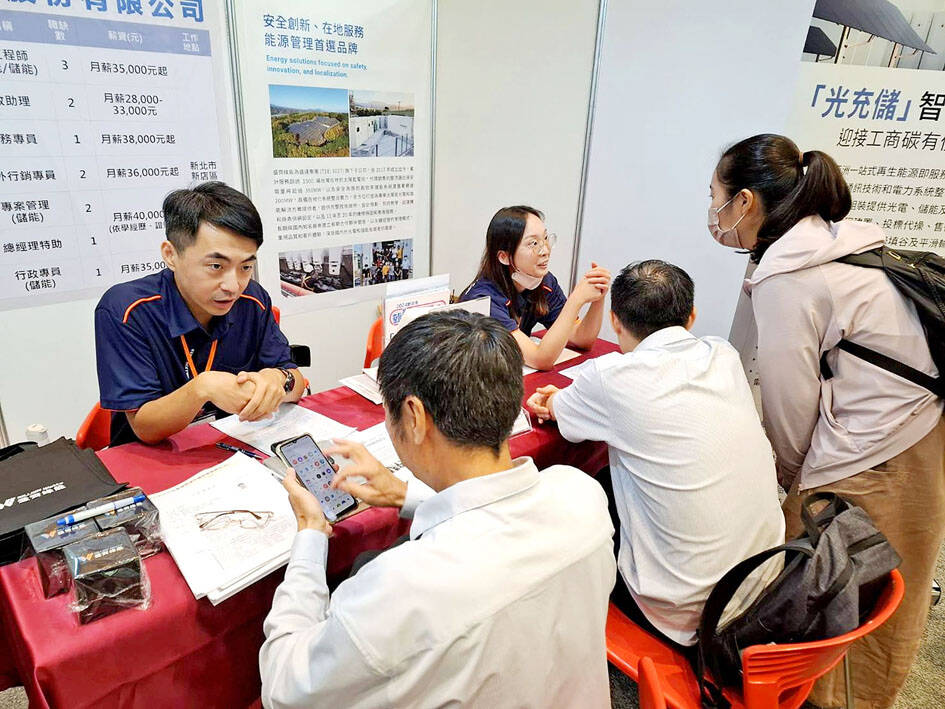
Photo courtesy of New Taipei City Labor Affairs Bureau via CNA
DGBAS Deputy Census Director Tan Wen-ling (譚文玲) said that labor market conditions remained stable last month, supported by steady economic activity and a seasonal pickup in consumption ahead of the Lunar New Year holiday.
Employment typically strengthens during this period, as short-term hiring increases in retail, logistics and other holiday-related industries, she said.
“Based on historical trends, unemployment in January is usually lower than in December,” Tan said, adding that if no unexpected disruptions occur, the jobless rate could edge down further, driven mainly by temporary and short-term hiring tied to year-end festivities.
This year’s Lunar New Year holiday falls in the middle of next month.
Tan also attributed the decline in unemployment to government efforts to boost labor participation, particularly among older workers and women.
Regulatory restrictions on senior employment have been eased, allowing workers aged 65 and older to remain in the workforce by mutual agreement with employers, she said.
Female labor participation has continued to rise, especially among women in their 30s and 40s, making women and middle-aged workers increasingly important pillars of the labor market, Tan said.
By educational attainment, university graduates recorded the highest unemployment rate last year at 4.53 percent, followed by high-school and vocational-school graduates at 3.06 percent.
Postgraduate-degree holders posted the lowest rate, at 2.96 percent.
Unemployment remained significantly higher among younger age groups. The jobless rate stood at 9.21 percent for those aged 15 to 19 and rose to 11.6 percent for the 20-to-24 group, reflecting first-time jobseekers still transitioning into the workforce.
The rate eased to 5.77 percent among people aged 25 to 29 and declined further to 3.37 percent for those aged 30 to 34.
Attention has also turned to whether new Taiwan-US tariff arrangements could support employment.
Tan said it was too early to assess any direct impact, as details were only recently finalized.
Still, she said that the adoption of a flat 15 percent tariff could benefit Taiwan’s traditional industries.
With Europe, Japan and South Korea facing similar tariff levels, the new structure might improve the competitiveness of Taiwanese manufacturers compared with their previous tax burden, she said.

KEEPING UP: The acquisition of a cleanroom in Taiwan would enable Micron to increase production in a market where demand continues to outpace supply, a Micron official said Micron Technology Inc has signed a letter of intent to buy a fabrication site in Taiwan from Powerchip Semiconductor Manufacturing Corp (力積電) for US$1.8 billion to expand its production of memory chips. Micron would take control of the P5 site in Miaoli County’s Tongluo Township (銅鑼) and plans to ramp up DRAM production in phases after the transaction closes in the second quarter, the company said in a statement on Saturday. The acquisition includes an existing 12 inch fab cleanroom of 27,871m2 and would further position Micron to address growing global demand for memory solutions, the company said. Micron expects the transaction to

Vincent Wei led fellow Singaporean farmers around an empty Malaysian plot, laying out plans for a greenhouse and rows of leafy vegetables. What he pitched was not just space for crops, but a lifeline for growers struggling to make ends meet in a city-state with high prices and little vacant land. The future agriculture hub is part of a joint special economic zone launched last year by the two neighbors, expected to cost US$123 million and produce 10,000 tonnes of fresh produce annually. It is attracting Singaporean farmers with promises of cheaper land, labor and energy just over the border.

US actor Matthew McConaughey has filed recordings of his image and voice with US patent authorities to protect them from unauthorized usage by artificial intelligence (AI) platforms, a representative said earlier this week. Several video clips and audio recordings were registered by the commercial arm of the Just Keep Livin’ Foundation, a non-profit created by the Oscar-winning actor and his wife, Camila, according to the US Patent and Trademark Office database. Many artists are increasingly concerned about the uncontrolled use of their image via generative AI since the rollout of ChatGPT and other AI-powered tools. Several US states have adopted

A proposed billionaires’ tax in California has ignited a political uproar in Silicon Valley, with tech titans threatening to leave the state while California Governor Gavin Newsom of the Democratic Party maneuvers to defeat a levy that he fears would lead to an exodus of wealth. A technology mecca, California has more billionaires than any other US state — a few hundred, by some estimates. About half its personal income tax revenue, a financial backbone in the nearly US$350 billion budget, comes from the top 1 percent of earners. A large healthcare union is attempting to place a proposal before


 RSS
RSS