


ASML Holding NV became only the third European company to surpass US$500 billion in market value after key customer Taiwan Semiconductor Manufacturing Co (TSMC, 台積電) gave a stronger-than-anticipated outlook for this year.
Shares of the Dutch semiconductor equipment maker rose as much as 7.6 percent in Amsterdam yesterday, hitting a record high and extending their year-to-date gain to 24 percent. That took ASML’s market capitalization to about 453 billion euros (US$527 billion). Only luxury conglomerate LVMH Moet Hennessy Louis Vuitton SE and Danish drugmaker Novo Nordisk A/S have previously reached the milestone.
ASML surged above the symbolic level after TSMC yesterday forecast capital spending rising to as much as US$56 billion this year, more than expected, showing how the chipmaker is benefiting from the artificial intelligence (AI) boom.
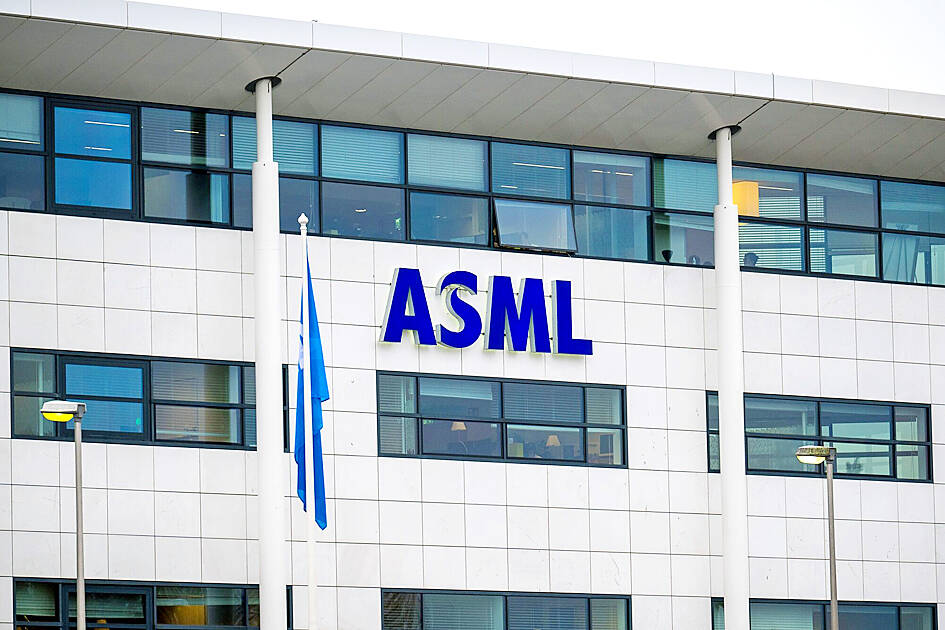
Photo: Bloomberg
“The milestone means a lot for the market sentimentally,” Barclays PLC strategist Emmanuel Cau said. “Europe is a small market, so if ASML as a major stock goes up, the broader market will automatically benefit. The rally in ASML also gives European investors a gateway to play the mainstream AI trade.”
TSMC’s outlook provides fresh optimism for sustained global AI spending this year after signs of volatility in the so-called AI trade. Hundreds of billions of dollars have been committed to build the data centers needed to train and run AI, fueling growth among companies ranging from water chiller manufacturers to chipmakers.
ASML has grown to be Europe’s most valuable company as the only producer of cutting-edge lithography machines that TSMC needs to manufacture chips used in everything from Apple Inc’s smartphones to Nvidia Corp’s AI accelerators.
“This is ultimately a very positive start to the earnings season for the tech giants,” Quilter Cheviot technology research head Ben Barringer said. “These results give us a good indication of what we are likely to see from both the chips companies and the semicap equipment providers.”
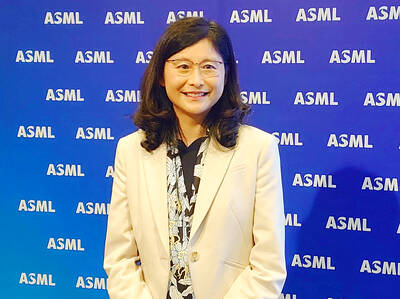
Netherlands-based semiconductor equipment supplier ASML Holding NV yesterday said that it is planning to hire an additional 1,000 people in Taiwan this year in response to growing demand from clients. ASML had previously planned to recruit 600 people this year, but that the plan has been adjusted upward, ASML vice president and ASML Taiwan general manager Grace Wang (汪佳慧) told reporters. ASML has a workforce of more than 4,500 in Taiwan, accounting for about 10 percent of its global total, Wang said. This year’s recruitment campaign would focus on adding people in the customer support, manufacturing and supply chain domains to assist ASML

UNDER MICROSCOPE: Taiwan detained three people who allegedly conspired to buy servers in Taiwan and export them using fraudulent documentation, prosecutors said Nvidia Corp chief executive officer Jensen Huang (黃仁勳) on Saturday urged Super Micro Computer Inc to tighten up on compliance after Taiwan detained three people this week for allegedly making fraudulent declarations about artificial intelligence (AI) servers made by its US partner. The development marked the nation’s first crackdown on semiconductor smuggling, which grew after the US slapped restrictions on exports of high-end chips such as Nvidia AI accelerators to China. Nvidia is “rigorous” in explaining regulations to all of its partners, Huang told reporters after arriving in Taipei. “Ultimately Super Micro has to run their own company,” he said in response to

Nvidia Corp yesterday announced that CEO Jensen Huang (黃仁勳) would attend an employee meeting in Taipei tomorrow to celebrate the launch of the company’s Taiwan headquarters project. Huang would attend a gathering at the site of Nvidia’s planned headquarters in Beitou Shilin Technology Park (北投士林科技園區), the company said in a statement. After arriving in Taiwan on Saturday last week, Huang told reporters that he plans to meet with Quanta Computer Inc (廣達) chairman Barry Lam (林百里) and Taiwan Semiconductor Manufacturing Co (TSMC, 台積電) chairman C.C. Wei (魏哲家), and would attend the groundbreaking ceremony for Nvidia’s Taiwan headquarters tomorrow. Nvidia has not yet applied

Starlux Airlines Co (星宇航空) today unveiled a long-haul network expansion plan at a shareholders’ meeting in Taipei, including direct flights to Barcelona, Spain, and Zurich, Switzerland, as well as a service connecting Taipei, Sydney and New Zealand. Starlux is to become the first Taiwanese carrier to offer non-stop services to the two European cities, while the inaugural oceanic route is expected to expand transit opportunities within the Australia-New Zealand market, Starlux said. Flight services to Chicago, Dallas, Washington and New York are under evaluation, the airline added. Prior to the shareholders’ meeting, the airline earlier this year announced that it would be


 RSS
RSS