


Taiwan today signaled that a tariff deal with the US could come soon, after its negotiators left for the latest round of talks with Washington, saying both sides are expected to announce where they have reached a "consensus."
Taiwan, a global semiconductor powerhouse, has been in talks with the US to get the tariff on its exports cut from 20 to 15 percent.
Vice Premier Cheng Li-chiun (鄭麗君) and Minister Without Portfolio Yang Jen-ni (楊珍妮), who leads the Cabinet’s Office of Trade Negotiations, late yesterday departed for the US for a sixth round of face-to-face consultations, the Executive Yuan’s working group on Taiwan-US trade said in statement.
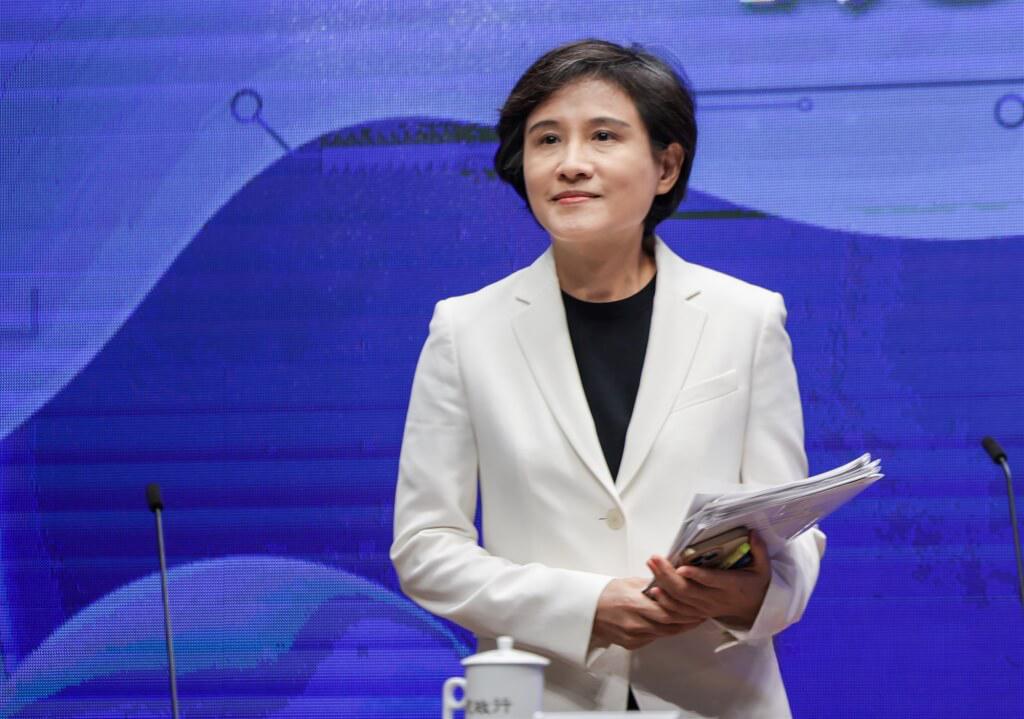
Photo: CNA
The aim is a further reduction in reciprocal tariffs, securing most-favored treatment for tariffs on chips and other products, promoting a better trade balance and forming a strategic partnership on the global artificial intelligence (AI) supply chain, the statement said.
"After this round of consultations, both sides are expected to publicly announce the content on where they have reached consensus," it added, without giving details.
Taiwan would then schedule a date to sign documents with the Office of the US Trade Representative and submit the deal for review in the Legislative Yuan, the statement said.
Two people familiar with the matter said an announcement on the tariffs deal could come by the end of the month.
However, Office of Trade Negotiations spokesman Benjamin Hsu (徐崇欽) said that as the delegation had only just left, it was hard to say when "results can be achieved."
"As for announcing the outcomes, that still requires agreement by both sides," he added.
The White House did not respond to a request for comment on the meetings in Washington. It was not immediately clear which US officials would take part.
A major semiconductor producer, Taiwan has said its offer to the US included help in replicating the nation’s success in building tech clusters around dedicated science parks.
Under the deal, it is expected that chipmaker Taiwan Semiconductor Manufacturing Co (TSMC, 台積電) would commit to building more facilities in Arizona, one of the people said.
TSMC has declined to comment on whether it would invest more in the US on top of the US$165 billion that it has already pledged.
Taiwan's chips are not subject to the US tariffs.
However, US President Donald Trump yesterday imposed a 25 percent tariff on certain AI chips, such as the Nvidia H200 AI processor, under a new national security order released by the White House.
Regarding that new order, Taiwan has previously held multiple discussions with the US and reached a consensus on preferential tariff treatment for semiconductors and related products, the statement said.
"After confirming this with the US side during the current consultations, our side will provide a public explanation," it said, without elaborating.
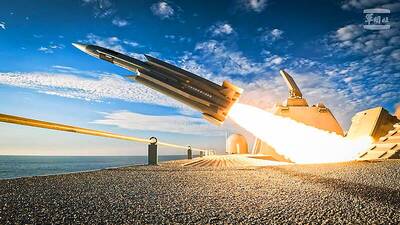
DETERRENCE: With 1,000 indigenous Hsiung Feng II and III missiles and 400 Harpoon missiles, the nation would boast the highest anti-ship missile density in the world With Taiwan wrapping up mass production of Hsiung Feng II and III missiles by December and an influx of Harpoon missiles from the US, Taiwan would have the highest density of anti-ship missiles in the world, a source said yesterday. Taiwan is to wrap up mass production of the indigenous anti-ship missiles by the end of year, as the Chungshan Institute of Science and Technology has been meeting production targets ahead of schedule, a defense official with knowledge of the matter said. Combined with the 400 Harpoon anti-ship missiles Taiwan expects to receive from the US by 2028, the nation would have
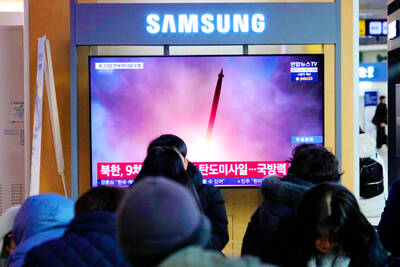
North Korea yesterday fired about 10 ballistic missiles to the sea toward Japan, the South Korean Joint Chiefs of Staff (JCS) said, days after Pyongyang warned of “terrible consequences” over ongoing South Korea-US military drills. Pyongyang recently dashed hopes of a diplomatic thaw with Seoul, Washington’s security ally, describing its latest peace efforts as a “clumsy, deceptive farce.” Seoul’s military detected “around 10 ballistic missiles launched from the Sunan area in North Korea toward the East Sea [Sea of Japan] at around 1:20pm,” JCS said in a statement, referring to South Korea’s name for the body of water. The missiles

‘UNWAVERING FRIENDSHIP’: A representative of a Japanese group that co-organized a memorial, said he hopes Japanese never forget Taiwan’s kindness President William Lai (賴清德) yesterday marked the 15th anniversary of the Tohoku earthquake and tsunami, urging continued cooperation between Taiwan and Japan on disaster prevention and humanitarian assistance. Lai wrote on social media that Taiwan and Japan have always helped each other in the aftermath of major disasters. The magnitude 9 earthquake struck northeastern Japan on March 11, 2011, triggering a massive tsunami that claimed more than 19,000 lives, according to data from Japanese authorities. Following the disaster, Taiwan donated more than US$240 million in aid, making it one of the largest contributors of financial assistance to Japan. In addition to cash donations and
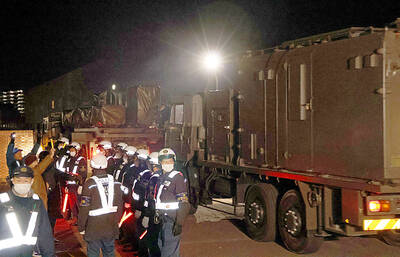
CLOSER TO CHINA: The upgraded Type-12 missile has a range of about 1,000km, compared with the original model’s range of 200km, and can reach mainland China Japan is preparing to deploy its first batch of domestically developed long-range missiles, with their launchers arriving at an army camp yesterday, as the country accelerates its offensive capability in response to rising challenges in the region. The upgraded Type-12 land-to-ship missiles are to be deployed at Camp Kengun in Japan’s southwestern prefecture of Kumamoto by the end of this month, completing the process of deployment, Japanese Chief Cabinet Secretary Minoru Kihara said without giving details. Army vehicles carrying the launchers and other equipment arrived past midnight in a highly secretive mission criticized by residents. Dozens of people stood outside of the


 RSS
RSS