


China’s trade surplus surged to a record of almost US$1.2 trillion last year, the government said yesterday, as exports to other countries made up for slowing shipments to the US under US President Donald Trump’s onslaught of higher tariffs.
China’s exports rose 5.5 percent for the whole of last year to US$3.77 trillion, customs data showed, as Chinese automakers and other manufacturers expanded into markets across the globe. Imports flatlined at US$2.58 trillion.
The results came as China’s exports last month climbed 6.6 percent from the year before in US dollar terms, better than economists’ estimates and higher than November’s 5.9 percent year-on-year increase. Imports last month were up 5.7 percent, compared to November’s 1.9 percent rise.
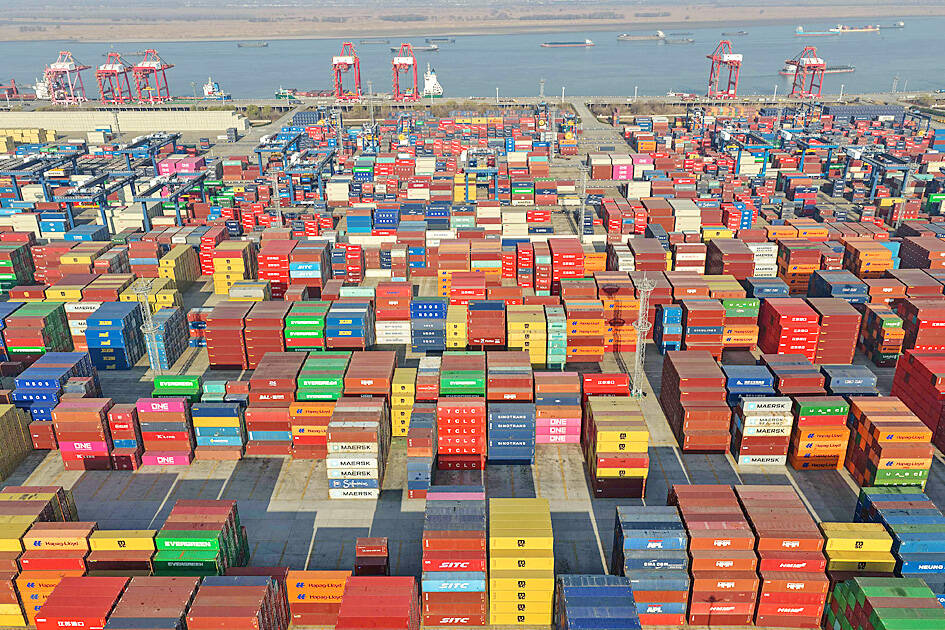
Photo: AFP
Economists expect exports will continue to support China’s economy this year, despite trade friction and geopolitical tensions.
“We continue to expect exports to act as a big growth driver in 2026,” BNP Paribas SA chief China economist Jacqueline Rong (榮靜) said.
While China’s exports to the US fell sharply after Trump returned to office and escalated his trade war with the world’s second-largest economy, that decline has been largely offset by shipments to other markets in South America, Southeast Asia, Africa and Europe.
For the whole of last year, China’s exports to the US fell 20 percent. In contrast, exports to Africa surged 26 percent and those to Southeast Asian countries jumped 13 percent; to the European Union 8 percent, and to Latin America, 7 percent.
Strong global demand for computer chips and other devices and the materials needed to make them were among categories that supported China’s exports, analysts said.
Exports of electronics and electrical equipment were by far the largest export category, rising 8.4 percent from a year earlier.
Car exports also grew last year. Auto exports surged 21 percent last year to more than 7 million units, driven by electric vehicles and plug-in hybrids, the China Association of Automobile Manufacturers said yesterday.
China also exported more grain and fertilizer, while its sales of furniture, shoes and other labor intensive products fell.
Strong exports have helped keep China’s economy growing at an annual rate close to its official target of about 5 percent. That has triggered alarm in countries that fear a flood of cheap imports is damaging local industries.
IMF managing director Kristalina Georgieva last month called for China to fix its economic imbalances and speed up its shift from reliance on exports by boosting domestic demand and investment.
A prolonged property downturn in China after the authorities cracked down on excessive borrowing, triggering defaults by many developers, is still weighing on consumer confidence and domestic demand.
China’s leaders have made increasing spending by consumers and businesses a focus of economic policy, but actions taken so far have had a limited impact. That included government trade-in subsidies over the past months that encouraged consumers to buy newer, more energy efficient items, such as home appliances and vehicles.
“We expect domestic demand growth to stay tepid,” Rong said. “In fact, the policy boost to domestic demand looks weaker than last year — in particular the fiscal subsidy program for consumer goods.”
In the case of autos, domestic sales rose 6 percent last year, but they fell back toward the end of the year as those subsidies were scaled back or phased out in some areas.
Natixis SA senior economist Gary Ng (吳卓殷) said that China’s exports would grow about 3 percent this year, less than the 5.5 percent growth last year. With slow import growth, he expects China’s trade surplus to remain above US$1 trillion this year.

NEW IDENTITY: Known for its software, India has expanded into hardware, with its semiconductor industry growing from US$38bn in 2023 to US$45bn to US$50bn India on Saturday inaugurated its first semiconductor assembly and test facility, a milestone in the government’s push to reduce dependence on foreign chipmakers and stake a claim in a sector dominated by China. Indian Prime Minister Narendra Modi opened US firm Micron Technology Inc’s semiconductor assembly, test and packaging unit in his home state of Gujarat, hailing the “dawn of a new era” for India’s technology ambitions. “When young Indians look back in the future, they will see this decade as the turning point in our tech future,” Modi told the event, which was broadcast on his YouTube channel. The plant would convert

Nanya Technology Corp (南亞科技) yesterday said the DRAM supply crunch could extend through 2028, as the artificial intelligence (AI) boom has led the world’s major memory makers to dramatically reduce production of standard DRAM and allocate a significant portion of their capacity for high-bandwidth memory (HBM) chips. The most severe supply constraints would stretch to the first half of next year due to “very limited” increases in new DRAM capacity worldwide, Nanya Technology president Lee Pei-ing (李培瑛) told a news briefing. The company plans to increase monthly 12-inch wafer capacity to 20,000 in the first half of 2028 after a

Property transactions in the nation’s six special municipalities plunged last month, as a lengthy Lunar New Year holiday combined with ongoing credit tightening dampened housing market activity, data compiled by local land administration offices released on Monday showed. The six cities recorded a total of 10,480 property transfers last month, down 42.5 percent from January and marking the second-lowest monthly level on record, the data showed. “The sharp drop largely reflected seasonal factors and tighter credit conditions,” Evertrust Rehouse Co (永慶房屋) deputy research manager Chen Chin-ping (陳金萍) said. The nine-day Lunar New Year holiday fell in February this year, reducing

Zimbabwe’s ban on raw lithium exports is forcing Chinese miners to rethink their strategy, speeding up plans to process the metal locally instead of shipping it to China’s vast rechargeable battery industry. The country is Africa’s largest lithium producer and has one of the world’s largest reserves, according to the US Geological Survey (USGS). Zimbabwe already banned the export of lithium ore in 2022 and last year announced it would halt exports of lithium concentrates from January next year. However, on Wednesday it imposed the ban with immediate effect, leaving unclear what the lithium mining sector would do in the


 RSS
RSS