


The nation’s machinery industry showed a strong recovery last year, with full-year exports rising 9.1 percent year-on-year to US$31.859 billion, the Taiwan Association of Machinery Industry said in a report on Monday.
It came as machinery exports continued to grow significantly last month, increasing 14.3 percent year-on-year and marking the 11th consecutive month of growth since February last year, the association said.
Taiwan’s machinery exports comprise mainly inspection and testing equipment, electronic equipment and machine tools.
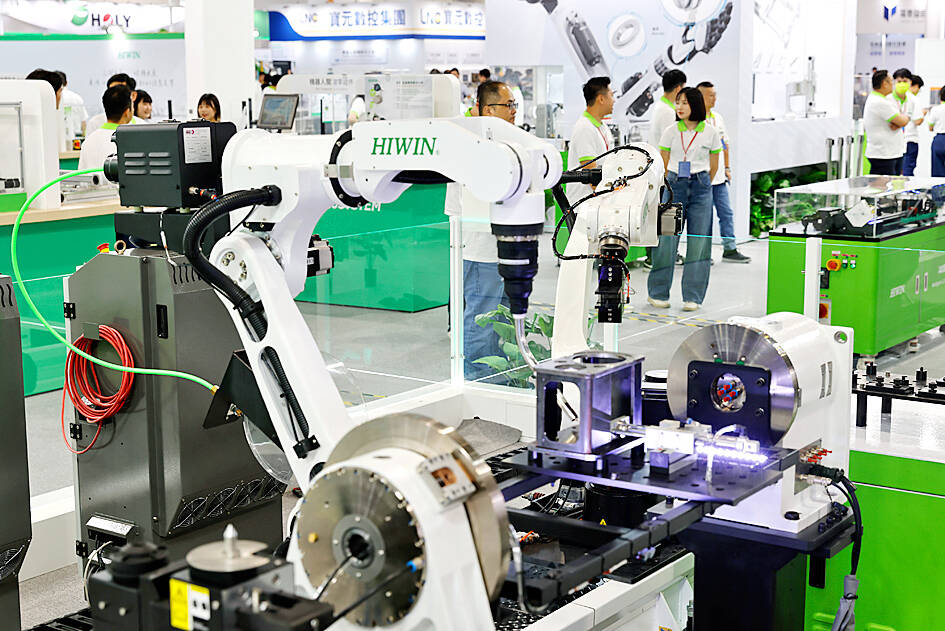
Exports of inspection and testing equipment increased 15 percent to US$5.484 billion, and those of electronic equipment rose 10.2 percent to US$5.456 billion, while exports of machine tools fell 9.6 percent to US$2.004 billion last year, association data showed.
“Benefiting from robust demand for artificial intelligence, high-performance computing and cloud data services, along with the spectacular performance of the semiconductor industry, exports of electronic equipment and testing equipment showed strong performance last year,” the association said in the report.
“However, affected by weakening market demand and unfavorable exchange rates, machine tool exports last year reached only US$2 billion, marking a new low since the 2009 global financial crisis,” it said.
The machine tool industry continues to face external challenges.
Last month alone, exports reached only US$177 million, an annual decline of 17.7 percent, with shipments to China, including Hong Kong — the sector’s largest export destination — plummeting 21.4 percent and those to the US, the second-largest market, falling 19.8 percent, the association said.
In addition, a relatively strong New Taiwan dollar compared with regional rivals’ currencies made it hard for local machine toolmakers to secure orders, it said.
From 2021 to Friday last week, the NT dollar had depreciated 11.2 percent against the US dollar, much less than the yen’s 53.2 percent plunge and won’s 34.1 percent fall, it said.
“With the loss of price advantage due to the comparatively larger depreciation of the Japanese and South Korean currencies, coupled with competition from low-priced Chinese goods, exports of machine tools have decreased substantially” over the past few years, the association said.
However, it emphasized that the overall machinery industry recovered last year despite US tariffs and geopolitical conflicts, as annual growth in total machinery exports returned to positive territory following contractions of 0.6 percent in 2024 and 15.4 percent in 2023.
The report added that global economic uncertainty had gradually eased, with local machinery manufacturers posting growth in shipments to the US and China last year.
For the whole of last year, exports to the US increased 16 percent to US$8.34 billion and those to China rose 5 percent to US$7.18 billion, association data showed.
The US and China remained the two largest buyers of Taiwanese machinery products last year, accounting for 26.2 percent and 22.5 percent share of the nation’s total exports respectively, followed by Japan, with purchases totaling US$2.15 billion, or 7.7 percent, the data showed.

South Korea’s equity benchmark yesterday crossed a new milestone just a month after surpassing the once-unthinkable 5,000 mark as surging global memory demand powers the country’s biggest chipmakers. The KOSPI advanced as much as 2.6 percent to a record 6,123, with Samsung Electronics Co and SK Hynix Inc each gaining more than 2 percent. With the benchmark now up 45 percent this year, South Korea’s stock market capitalization has also moved past France’s, following last month’s overtaking of Germany’s. Long overlooked by foreign funds, despite being undervalued, South Korean stocks have now emerged as clear winners in the global market. The so-called “artificial intelligence

NEW IDENTITY: Known for its software, India has expanded into hardware, with its semiconductor industry growing from US$38bn in 2023 to US$45bn to US$50bn India on Saturday inaugurated its first semiconductor assembly and test facility, a milestone in the government’s push to reduce dependence on foreign chipmakers and stake a claim in a sector dominated by China. Indian Prime Minister Narendra Modi opened US firm Micron Technology Inc’s semiconductor assembly, test and packaging unit in his home state of Gujarat, hailing the “dawn of a new era” for India’s technology ambitions. “When young Indians look back in the future, they will see this decade as the turning point in our tech future,” Modi told the event, which was broadcast on his YouTube channel. The plant would convert

‘SEISMIC SHIFT’: The researcher forecast there would be about 1.1 billion mobile shipments this year, down from 1.26 billion the prior year and erasing years of gains The global smartphone market is expected to contract 12.9 percent this year due to the unprecedented memorychip shortage, marking “a crisis like no other,” researcher International Data Corp (IDC) said. The new forecast, a dramatic revision down from earlier estimates, gives the latest accounting of the ongoing memory crunch that is affecting every corner of the electronics industry. The demand for advanced memory to power artificial intelligence (AI) tasks has drained global supply until well into next year and jeopardizes the business model of many smartphone makers. IDC forecast about 1.1 billion mobile shipments this year, down from 1.26 billion the prior
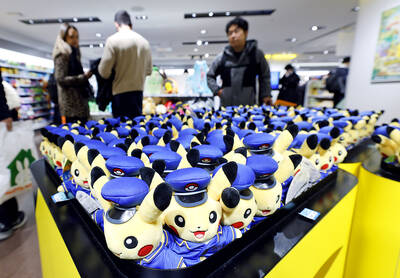
People stand in a Pokemon store in Tokyo on Thursday. One of the world highest-grossing franchises is celebrated its 30th anniversary yesterday.


 RSS
RSS