


At the CES trade show in Las Vegas for the past week, robots poured coffee, played table tennis, dealt poker hands and folded laundry — all within a few meters of one another.
Human-inspired robots, aptly called humanoids, have emerged as the tech industry’s big bet on what comes next. They stand erect, like people, although they cannot always walk. And they can move through the world as people do, use the same tools and perform similar tasks — but ultimately more efficiently. Or at least that is the goal.
Companies are pitching the latest bots as home helpers and companions, but there is a long way to go on that front. Unleashing these machines in the controlled environment of a factory is hard enough; navigating the idiosyncrasies of the family home is another matter entirely. Humanoids will have to get a lot better and cheaper first.
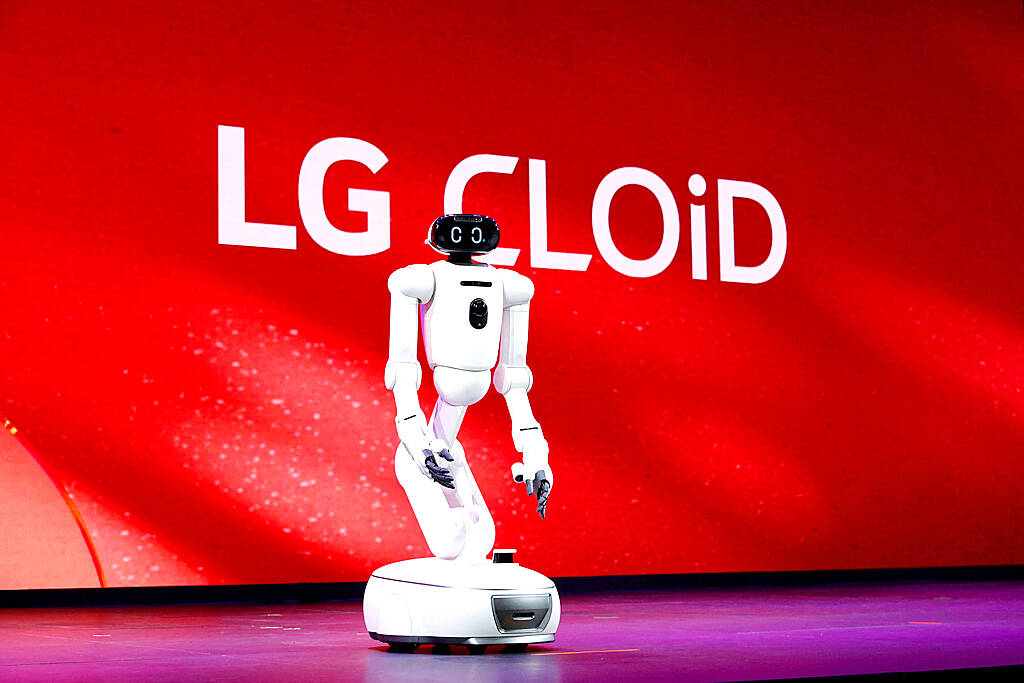
Photo: Reuters
When LG Electronics Inc’s new robot, CLOiD, rolled onto the CES stage earlier this week, the real surprise was not its human form — it was that the company attempted a live demo at all. Humanoids are often kept tucked away in warehouses, with companies offering little proof that they work outside of closely managed experiments. Those that do attempt public presentations often find the risk outweighs the reward.
However, CLOiD — which stands at about 1.5m tall and has a digital display for eyes — trundled across the stage on wheels and waved to conference attendees with its two hands. It then slowly loaded a single piece of clothing into a washing machine — almost painfully slowly.
“LG’s AI home envisions a seamlessly connected flow between devices, spaces and human behavior, ultimately achieving our goal of a zero-labor home that saves both time and comfort,” LG executive Brandt Varner said during a press event on Monday, pitching a vision of domestic automation so seamless that CLOiD might one day toast a croissant for you before you head out to work.
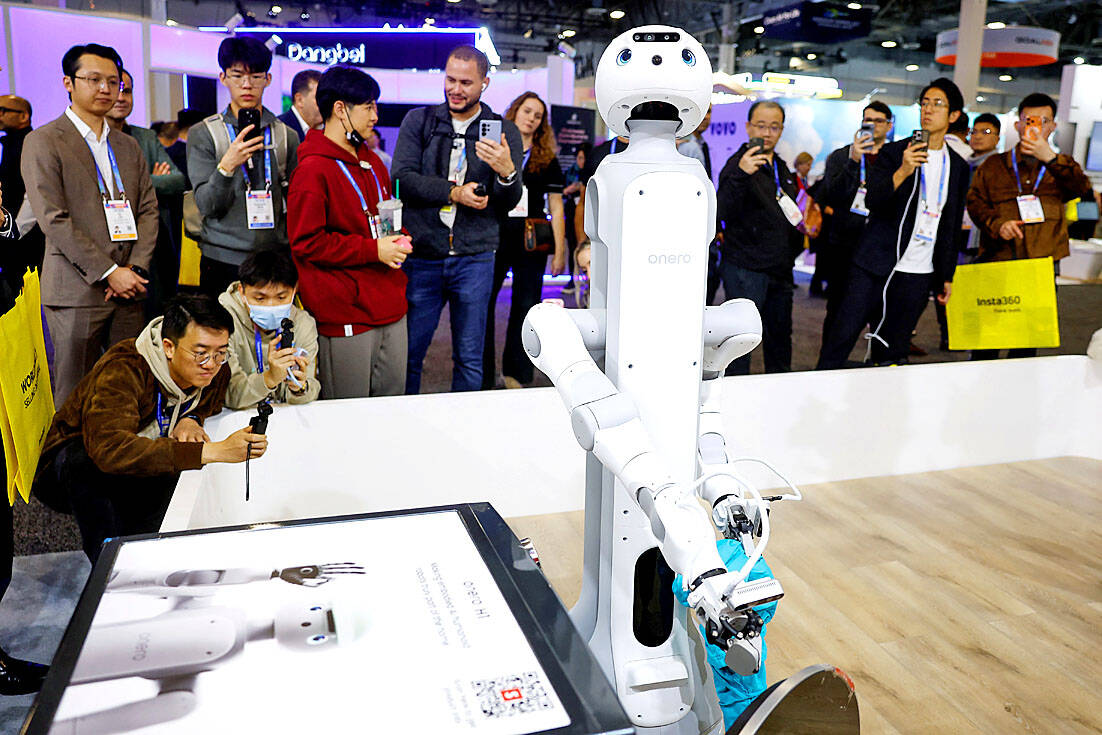
Photo: AFP
The concept robot, which uses artificial intelligence (AI) and vision-based technology to perform household tasks like laundry, is part of LG’s broader push into what it calls “ambient care” — the promise of machines quietly helping daily life flow more smoothly.
It is a bold attempt to reshape how robotics fit into the home, not necessarily through spectacle, but through mundane, repetitive chores.
LG was not the only player promising a future with less laundry: It was joined by others, including SwitchBot’s Onero H1, another task-focused robot on wheels.
For years, fine motor control, particularly involving thumbs, has been a major obstacle.
However, recent advances are making humanoids more nimble, allowing them to perform multiple tasks simultaneously.
Humanoid robots were among the biggest draws this year at CES, which ended on Friday. The Consumer Technology Association, which organizes the annual show, dedicated an exhibition hall to robotics, reflecting how “physical AI” has become the tech industry’s next big phase. Beyond humanoids, many robotics on display were designed for business settings, including manufacturing, logistics and food service. Companies such as Artly Coffee and VenHub Global showcased AI-powered robotic cafes and convenience stores.
However, it was impossible to ignore the life-size humanoids. Nylo, a machine built by IntBot, greeted attendees and answered questions without human assistance. The company lured reporters and attendees to its booth with the promise of “real-world proof, not just a demo” in a press release.
Bigger companies also demonstrated their prowess in robotics. Chipmaker Qualcomm Inc used its CES booth to make the case that its processors and software form the backbone of physical AI, and are capable of powering household robots and full-size humanoids.
Boston Dynamics and majority-owner Hyundai Motor Co announced that testing is under way for a next-generation version of the humanoid Atlas robot used at the automaker’s factory in Ellabell, Georgia.
Boston Dynamics is already considered a leader in advanced robotics, thanks to the success of its robotic dog Spot and a mobile robotic arm known as Stretch for restocking warehouses.
Money has been flooding into robotics, but significant challenges remain before humanoids are deemed sufficiently safe, mobile and cheap to be commercially viable.
Some companies have moved away from legged robots, which can be unstable, in favor of bots on wheels and other designs.
Home environments can be difficult for robots to navigate because they are unpredictable and often cluttered. And although bots loading washing machines might stun on stage, it is hard to justify paying tens of thousands of dollars to save a few minutes on laundry day.
More compelling uses might present themselves in settings such as hospitals, where robots could handle repetitive laundry work at scale.
Robots must also move beyond step-by-step instructions — “the boxes need to be in the van” — and figure out what to do themselves, said Bill Ray, chief of research at market firm Gartner.
For now, the near future will likely be dominated by robots built for specific jobs, like mowing the lawn and yes, doing laundry, rather than humanoids trying to do everything at once.
For all these reasons, deployment will accelerate more quickly in factories, where robots are often separated from their human colleagues, but it will likely be years before they are commonplace in ordinary homes.
“We’ve been saying for the last few years that the most practical application for a humanoid robot was to artificially inflate your share price,” Ray said. “They look great walking on stage, but are entirely impractical in use.”

Cairo’s new monorail slices across the city skyline, running above the familiar chaos of blaring horns and aging buses’ exhaust fumes that mark rush hour below. The US$4.5 billion monorail, opened this month, is among Egypt’s most prominent new transport projects, part of a debt-funded infrastructure drive criticized for sapping state finances while bringing limited benefits to most of the country’s 109 million people. “It feels like you’re in a different country,” said Ramy Sayed, a restaurant manager, aboard a driverless Innovia 300 train. “No noise, no traffic, we’re not used to this.” The eastern line runs 56km from the bustling middle-class
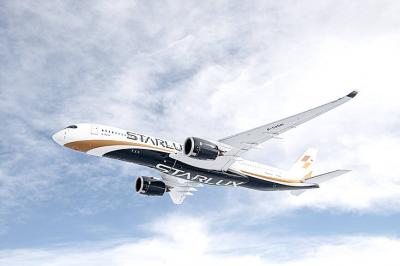
Starlux Airlines Co (星宇航空) today unveiled a long-haul network expansion plan at a shareholders’ meeting in Taipei, including direct flights to Barcelona, Spain, and Zurich, Switzerland, as well as a service connecting Taipei, Sydney and New Zealand. Starlux is to become the first Taiwanese carrier to offer non-stop services to the two European cities, while the inaugural oceanic route is expected to expand transit opportunities within the Australia-New Zealand market, Starlux said. Flight services to Chicago, Dallas, Washington and New York are under evaluation, the airline added. Prior to the shareholders’ meeting, the airline earlier this year announced that it would be
Taiwanese prosecutors suspect that three people successfully smuggled at least one shipment of Nvidia Corp artificial intelligence (AI) chips to China after first exporting them to Japan, people familiar with the matter said. The trio was detained last week by the Keelung District Prosecutors’ Office for allegedly falsifying documents related to exports of Super Micro Computer Inc servers containing advanced Nvidia chips, which the US has barred from sale to China without a license from Washington. The move marked Taiwan’s first public crackdown on AI chip diversion after years of pressure from the US to take a more active role in curtailing
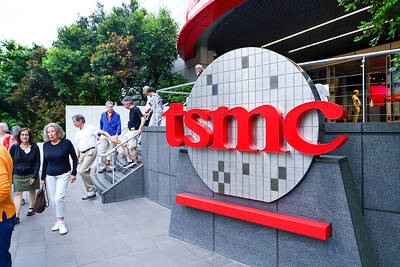
Taiwan Semiconductor Manufacturing Co (TSMC, 台積電) employee bonuses are likely to grow more than 30 percent this year, in line with the past few years as the company’s profits continue to set new records, an anonymous source cited TSMC chairman C.C. Wei (魏哲家) as saying yesterday. TSMC, the world’s largest contract chipmaker, is committed to taking care of its workers, the source said, citing Wei’s meeting with employees yesterday morning. Wei also expressed gratitude to employees for their contribution to the company’s improving bottom line, the source added. Since 2023, TSMC’s employee bonuses have grown at an annual rate of


 RSS
RSS