


Chinese Nationalist Party (KMT) Legislator Lin Te-fu (林德福) yesterday raised concerns that the heavy weighting of contract chipmaker Taiwan Semiconductor Manufacturing Co (TSMC, 台積電) is distorting the performance of the TAIEX.
Speaking at a meeting of the Legislative Yuan’s Finance Committee, Lin said the TAIEX has topped the 30,000-point mark for the first time in history, and TSMC, which accounts for more than 40 percent of total market value, served as a driver to the gains, but many other stocks remained weak.
"The market structure has lost its balance," Lin said. "Many investors who do not hold TSMC cannot share in the benefits created by the TAIEX’s rise."
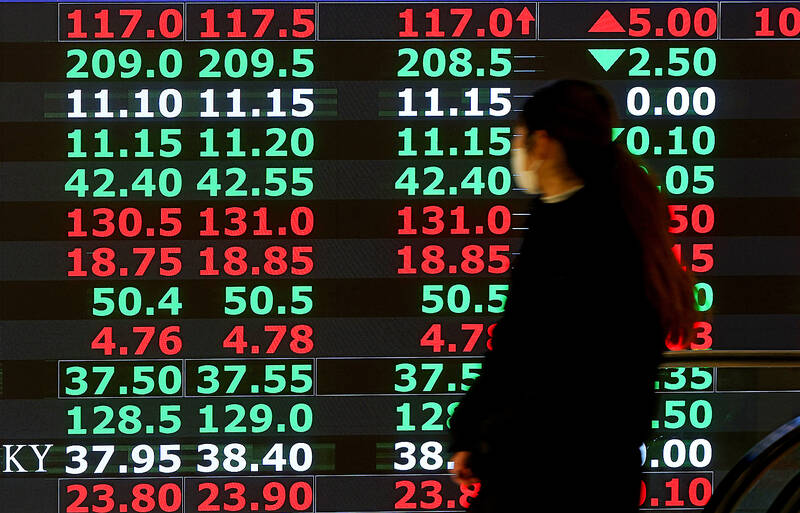
Photo: CNA
On Monday, the TAIEX soared 755.23 points, or 2.57 percent, to close at 30,105.04 as TSMC surged 5.36 percent to close at a record high of NT$1,670 amid optimism over the artificial intelligence (AI) boom. The stock’s gains contributed about 680 points to the TAIEX’s rise.
Despite the significant gains, 749 stocks fell on the main board on Monday with only 156 stocks moving higher. On the over-the-counter (OTC) market, 649 stocks lost steam, while 158 moved higher.
On Tuesday, TSMC rose 2.1 percent to close at a new high of NT$1,705. The rise contributed about 280 points to the TAIEX’s rise and helped push the benchmark index to end at another high of 30,576.3.
Yesterday, TSMC closed at NT$1,675, down 1.76 percent on profit taking, pushing the TAIEX lower by 0.46 percent. Without TSMC, the index would have posted gains.
Lin said with TSMC, which has remained above its 240-day moving average of around NT$1,173, attracting most of the spotlight, 1,263 out of the 1,947 companies (64.87 percent) listed on the local main board and the OTC market still moved below their 240-day moving average, indicating they are in weakness.
The lawmaker said that as a result of US tariff policies, many companies in the old economy sector have come under pressure and are even struggling to survive.
If fears that an AI bubble will burst become a reality, the local stock market will be severely impacted with many investors hurt, he added.
When asked whether the Financial Supervisory Commission (FSC) is prepared for the worst in the market, FSC Chairman Peng Jin-lung (彭金隆) said the capital market is full of uncertainties and the commission is prepared to take on such uncertainties as "that is our regular task."
The FSC has instructed the Taiwan Stock Exchange (TWSE) and the Taipei Exchange to serve as a market maker by promoting listed companies with sound fundamentals to attract the attention of investors thereby making these stocks more liquid for trading, Peng said.
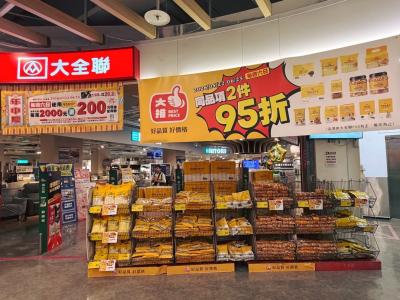
The Mega PX Mart Zhonglun (中崙) store in Taipei’s Zhongshan District (中山) would close on Sept. 13 after 22 years of business, Ruentex Development Co (潤泰創新) said today. More than 160 employees at the store would be assisted in finding new positions, with job openings to be made available in the coming days, Reuntex spokesman Chen Po-yu (陳柏宇) said. The Zhonglun store, previously an RT-Mart, opened in December 2004 as Taiwan’s first urban hypermarket in central Taipei. Due to high rents in the city center, the store never turned a profit in its 22 years of operation, Chen said. Even

Google DeepMind vice president John Jumper, who won the 2024 Nobel Prize in chemistry for his work on artificial intelligence (AI), is leaving the company to join Anthropic PBC. Jumper has been a key member of Google’s AI coding development team and his departure strains the tech giant’s efforts to beat Anthropic, OpenAI and SpaceX in the race to build the most powerful AI models. Google has struggled to sell AI coding tools to businesses, according to former employees. Employees and executives at DeepMind have raised concerns in the past few months that the company does not have a clear solution for

RESTRICTION BREACH: ASML said that it denies ‘unfounded rumors regarding non-compliance with export controls concerning China,’ and enforces controls strictly US Secretary of Commerce Howard Lutnick in a series of recent meetings outlined concerns to Dutch chip-equipment giant ASML Holding NV’s senior leaders that one of its top-of-the-line machines might have made its way into China, in violation of US-led export restrictions. In the meetings, Lutnick expressed concern to ASML executives over the company’s extreme ultraviolet lithography (EUV) machines, people familiar with the talks said. EUV systems are used by firms such as Taiwan Semiconductor Manufacturing Co (台積電) to manufacture processors for the likes of Nvidia Corp and Apple Inc. ASML has never been allowed to ship them to China because of curbs
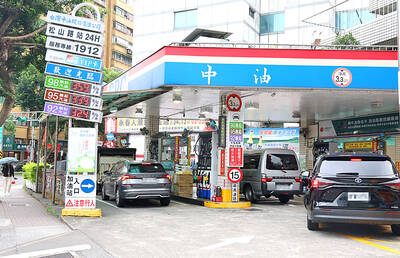
PROMISING SIGNS: The indications of a peace deal, or at least a ceasefire, between the US and Iran have global prices easing down slightly after months of shooting State-owned oil supplier CPC Corp, Taiwan (CPC, 台灣中油) announced on Saturday that it would cut domestic gasoline and diesel prices by NT$1.0 (US$0.03) and NT$0.7 per liter respectively this week, reflecting reduced upward pressure on international energy prices. The announcement marked an end to the company’s 11-week streak of leaving its retail fuel prices unchanged amid military conflicts in the Middle East. CPC said in a statement that international crude prices fell last week after the US and Iran announced plans to sign a memorandum of understanding to extend their ceasefire for 60 days and open the Strait of Hormuz, the choke


 RSS
RSS