

In March, following angst-ridden months as Europe came to terms with US President Donald Trump’s return to the White House, financial markets in Paris, Milan and Berlin were gripped by a surge of optimism. The cause was a historic deal brokered by then-German chancellor-elect Friedrich Merz, which loosened constitutional spending constraints in the EU’s powerhouse nation. Here at last, it was hoped, was the fiscal kick-start required to end a prolonged period of economic stagnation, and mitigate geopolitical headwinds blowing from the US and China.
Six months into Merz’s chancellorship, the angst is back and there are the first murmurings of rebellion. The chancellor’s plan included “whatever it takes” levels of defense spending, designed to prepare Germany for a changed era in which the US was no longer a dependable ally, and a huge 500 billion euros (US$581 billion) investment in infrastructure and the green transition, but last week, the chancellor’s team of economic advisers downgraded growth forecasts for next year to below 1 percent. Ahead of what would constitute a fourth year of near-flatlining, business confidence has slumped.
Lifting Germany’s “debt brake” was never going to be an instant panacea for longstanding problems. Patience is required, for example, before the full impact of spending on the country’s ailing transport systems is felt, but across Europe, patience is a virtue that is in short supply among voters, who feel that their living standards have been stagnating — or worse — since the crash of 2008. According to one survey, fewer than one in five Germans wish to see Merz standing again at the next federal election.
As the far-right Alternative for Germany party tops the polls, such disillusionment is a problem not just for the chancellor and his center-right-led coalition government, but for mainstream politics as a whole. Germany has found itself at the sharp end of a wider geopolitical storm: Russia’s war in Ukraine, aggressive Chinese competition and Trump’s trade wars have all combined to undermine an export-led model that underpinned European prosperity.
Merz was right to recognize that the exceptional times required a bold and imaginative fiscal response, but as discontent grows, he is already under pressure from critics to rein in social spending in the hope of increasing the nation’s competitiveness.
For a chancellor who once served on the supervisory board of Black Rock and forged a political reputation as a fiscal hawk, that would be a kind of reversion to type. Merz’s Social Democratic coalition partners would attempt to see off a threatened revolt by Christian Democrat lawmakers over a proposed pensions package, but the siren calls from familiar quarters on the right should be resisted more generally.
For Germany — and for Europe as a whole — the imperatives of the age are to revive a battered and bruised social model, and to turbocharge investment as the global economy is shaped to suit a multipolar world. Falling back on the failed economic orthodoxies of a previous era would only further empower the far-right, which began its gradual ascent during the austerity years that followed the crash.
Merz has had a difficult first six months in office, but as the scale of the challenges facing Europe’s most important economy becomes ever clearer, Germany cannot afford to go back to the future.
Taiwan’s democracy and high-tech economy play a crucial role in global affairs and are central to the world’s embrace of a raft of next-generation technologies, including AI. It is underpinned by a security relationship with the United States that’s existed in several iterations since 1949 and the Chinese Nationalist Party’s (KMT) retreat from China. A central pillar of that security relationship is the American willingness to sell arms to Taiwan. Indeed, since 1979 it has been embedded in US law, with the Taiwan Relations Act (TRA) charging the US with helping to improve the island’s ability to deter an attack from
Academia Historica director Chen Tsui-lien (陳翠蓮), speaking at the handover ceremony for her new role on Monday, said that when she accepted the position, she knew that her peaceful life as a history professor was a thing of the past, and that from now on she would have to “wear a helmet.” A specialist in Taiwan’s post-World War II history and the 228 Incident, she has been accused of being politically divisive. A phrase she used in her acceptance speech set headlines alight this week, putting her in the sights of editorials in blue-leaning media. She said opposition figures calling for
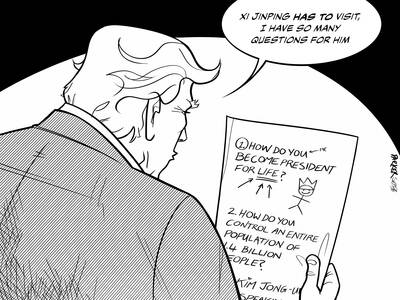
EDITORIAL CARTOON
Taiwanese-Americans, lawmakers and civic groups marched through Manhattan on Saturday last week in support of Taiwan’s participation in the UN. Marshall Islands Permanent Representative to the UN John Silk joined the demonstration, saying he hoped Taiwan would one day be able to participate in UN meetings as a member, and Democratic Progressive Party Legislator Wang Yi-chuan (王義川) took part while visiting New York City with a delegation. Taiwanese communities in Vancouver held a “UN for Taiwan” event. The campaign comes as the 81st UN General Assembly gets under way. In Taipei, President William Lai (賴清德) said China was deliberately misinterpreting UN


 RSS
RSS