


Stocks and bonds slipped along with gold and silver on the last day of last year, ending an otherwise buoyant year on a lackluster note.
The S&P 500 extended a stretch of post-Christmas losses, paring the benchmark’s advance to roughly 16 percent last year. The NASDAQ 100 was down 0.8 percent on Wednesday, its fourth day of losses. Even so, both indices have posted double-digit gains for three consecutive years, their longest winning streak since 2021.
Gold and silver fell at the end of their best year since the 1970s. Gold fell 1 percent, but closed out the year with a 63.7 percent gain, while silver swung back to a loss, returning 9.4 percent after Tuesday’s gain of more than 10 percent. Silver gained more than 140 percent for the year.
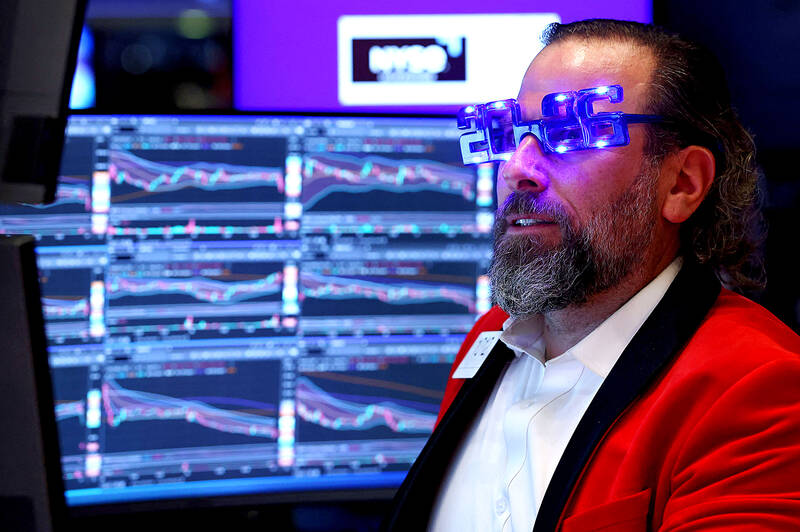
Photo: AFP
Investors last year enjoyed blockbuster returns in a market that had been powered by optimism about the vast economic potential of artificial intelligence (AI) and primed by US Federal Reserve interest rate cuts. It was not a smooth ride, with traders weathering swings triggered by a range of forces including US trade policies, geopolitical tensions, concerns over lofty valuations and uncertainty about the path of monetary policy.
For the new year, market research firm Bespoke Investment Group LLC cautions against expecting solid market performance during the first trading day. Since 1953, the S&P 500’s median change to begin a new year has been a 0.3 percent drop, with gains less than half the time, Bespoke said in a statement.
The stock market has traded lower on the first trading day in each of the past three years, the statement said.
Among other asset classes, US Treasuries posted their strongest year of returns since 2020. On Wednesday, Treasuries ticked lower, with the 10-year yield climbing to 4.17 percent.
The US dollar was little changed on Wednesday after three days of wins. Still, the greenback recorded its worst year since 2017, with investors predicting more declines if the next Fed chief opts for deeper interest rate cuts.
In the crypto arena, bitcoin suffered a loss for the year after erasing an earlier rally that had sent it to a record in October.
The digital currency has settled into a range of roughly US$85,000 to US$95,000 following a crash in October that has put it on pace for a first annual loss in three years. After starting last year with a rally spurred by optimism about the crypto-friendly policies of US President Donald Trump’s administration, bitcoin was hit by the uncertainty surrounding US tariffs.
Copper had its best year since 2009, fueled by near-term supply tightness and bets that demand for the metal key in electrification would outpace production.
Copper set several records in an end-of-year surge, rallying 42 percent on the London Metal Exchange last year. Prices dipped 1.1 percent on Wednesday.
Oil closed out the year with its steepest annual loss since 2020 as the market confronts wide-
ranging geopolitical risks and rising supplies across the globe. The price of West Texas Intermediate crude, the US benchmark, slipped 0.9 percent to US$57.42 per barrel, while Brent crude, the international standard, fell 0.8 percent to US$60.85 per barrel.

KEEPING UP: The acquisition of a cleanroom in Taiwan would enable Micron to increase production in a market where demand continues to outpace supply, a Micron official said Micron Technology Inc has signed a letter of intent to buy a fabrication site in Taiwan from Powerchip Semiconductor Manufacturing Corp (力積電) for US$1.8 billion to expand its production of memory chips. Micron would take control of the P5 site in Miaoli County’s Tongluo Township (銅鑼) and plans to ramp up DRAM production in phases after the transaction closes in the second quarter, the company said in a statement on Saturday. The acquisition includes an existing 12 inch fab cleanroom of 27,871m2 and would further position Micron to address growing global demand for memory solutions, the company said. Micron expects the transaction to

Vincent Wei led fellow Singaporean farmers around an empty Malaysian plot, laying out plans for a greenhouse and rows of leafy vegetables. What he pitched was not just space for crops, but a lifeline for growers struggling to make ends meet in a city-state with high prices and little vacant land. The future agriculture hub is part of a joint special economic zone launched last year by the two neighbors, expected to cost US$123 million and produce 10,000 tonnes of fresh produce annually. It is attracting Singaporean farmers with promises of cheaper land, labor and energy just over the border.

US actor Matthew McConaughey has filed recordings of his image and voice with US patent authorities to protect them from unauthorized usage by artificial intelligence (AI) platforms, a representative said earlier this week. Several video clips and audio recordings were registered by the commercial arm of the Just Keep Livin’ Foundation, a non-profit created by the Oscar-winning actor and his wife, Camila, according to the US Patent and Trademark Office database. Many artists are increasingly concerned about the uncontrolled use of their image via generative AI since the rollout of ChatGPT and other AI-powered tools. Several US states have adopted

A proposed billionaires’ tax in California has ignited a political uproar in Silicon Valley, with tech titans threatening to leave the state while California Governor Gavin Newsom of the Democratic Party maneuvers to defeat a levy that he fears would lead to an exodus of wealth. A technology mecca, California has more billionaires than any other US state — a few hundred, by some estimates. About half its personal income tax revenue, a financial backbone in the nearly US$350 billion budget, comes from the top 1 percent of earners. A large healthcare union is attempting to place a proposal before


 RSS
RSS