


Consumers’ economic mood and consumption attitude appeared slightly downbeat this month, and they were also cautious about next year’s inflation outlook, a survey released yesterday by Cathay Financial Holding Co (國泰金控) showed.
At the same time, people’s confidence in stock investment fell, and they were conservative about both pay raises and year-end bonuses, the survey of 13,154 respondents from Dec. 1 to 7 found.
While most domestic and foreign institutions have predicted Taiwan’s GDP to expand by more than 3 percent next year, Cathay Financial’s survey showed that respondents forecast an average growth of 2.56 percent for next year, with only 28 percent expecting the economy to grow by more than 3 percent.

Photo: CNA
“The public’s view on economic growth is relatively conservative,” Cathay Financial said in a statement.
The Directorate-General of Budget, Accounting and Statistics (DGBAS) last month forecast a 3.54 percent GDP growth for next year, while the central bank last week projected a 3.67 percent expansion in the economy.
As for inflation, respondents on average predicted a 2.17 percent increase in consumer prices next year, with 53 percent expecting price increases to surpass 2 percent, the monthly survey found.
That’s higher than the DGBAS’ 1.61 percent growth forecast and the central bank’s 1.63 percent estimate for the inflation rate. “People’s expectation for inflation is relatively higher,” Cathay Financial said in the statement.
In recent months, investors’ sentiment for local equities has rebounded notably from lows seen in early April following US President Donald Trump’s announcement of exorbitant tariffs on most of Washington’s major trading partners.
The TAIEX closed 1.64 percent higher at 28,149.54 yesterday, up 23.29 percent so far this year and up 61.86 percent from the April 9 low of 17,391.76 on easing tariff concerns, artificial intelligence (AI) hype and expectations of more US Federal Reserve interest rate cuts.
However, investors’ optimism in local equities and their risk appetite slid this month after the stock market consolidated and showed a range-bound trading recently, weighed down by growing concerns over the health of the AI industry, Cathay Financial said.
Even though Taiwan’s economic growth is projected to reach a 15-year high this year, people’s salary and year-end bonus expectations also showed a conservative mentality, according to the survey.
About 48 percent of respondents expected their regular wages to remain unchanged next year, while 46 percent believed wages would increase. But, only 8 percent expected an increase of more than 3 percent, the survey showed.
Meanwhile, 57 percent of respondents expected their year-end bonuses to be equivalent to one to three months’ salary and 29 percent predicted less than one month. Yet, 14 percent of respondents expected more than three months and 7 percent projected more than five months, it found.
Taiwan’s long-term economic competitiveness will hinge not only on national champions like Taiwan Semiconductor Manufacturing Co. (TSMC, 台積電) but also on the widespread adoption of artificial intelligence (AI) and other emerging technologies, a US-based scholar has said. At a lecture in Taipei on Tuesday, Jeffrey Ding, assistant professor of political science at the George Washington University and author of "Technology and the Rise of Great Powers," argued that historical experience shows that general-purpose technologies (GPTs) — such as electricity, computers and now AI — shape long-term economic advantages through their diffusion across the broader economy. "What really matters is not who pioneers

In a high-security Shenzhen laboratory, Chinese scientists have built what Washington has spent years trying to prevent: a prototype of a machine capable of producing the cutting-edge semiconductor chips that power artificial intelligence (AI), smartphones and weapons central to Western military dominance, Reuters has learned. Completed early this year and undergoing testing, the prototype fills nearly an entire factory floor. It was built by a team of former engineers from Dutch semiconductor giant ASML who reverse-engineered the company’s extreme ultraviolet lithography (EUV) machines, according to two people with knowledge of the project. EUV machines sit at the heart of a technological Cold

TAIWAN VALUE CHAIN: Foxtron is to fully own Luxgen following the transaction and it plans to launch a new electric model, the Foxtron Bria, in Taiwan next year Yulon Motor Co (裕隆汽車) yesterday said that its board of directors approved the disposal of its electric vehicle (EV) unit, Luxgen Motor Co (納智捷汽車), to Foxtron Vehicle Technologies Co (鴻華先進) for NT$787.6 million (US$24.98 million). Foxtron, a half-half joint venture between Yulon affiliate Hua-Chuang Automobile Information Technical Center Co (華創車電) and Hon Hai Precision Industry Co (鴻海精密), expects to wrap up the deal in the first quarter of next year. Foxtron would fully own Luxgen following the transaction, including five car distributing companies, outlets and all employees. The deal is subject to the approval of the Fair Trade Commission, Foxtron said. “Foxtron will be
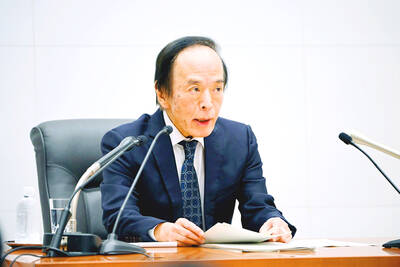
INFLATION CONSIDERATION: The BOJ governor said that it would ‘keep making appropriate decisions’ and would adjust depending on the economy and prices The Bank of Japan (BOJ) yesterday raised its benchmark interest rate to the highest in 30 years and said more increases are in the pipeline if conditions allow, in a sign of growing conviction that it can attain the stable inflation target it has pursued for more than a decade. Bank of Japan Governor Kazuo Ueda’s policy board increased the rate by 0.2 percentage points to 0.75 percent, in a unanimous decision, the bank said in a statement. The central bank cited the rising likelihood of its economic outlook being realized. The rate change was expected by all 50 economists surveyed by Bloomberg. The


 RSS
RSS