


US President Donald Trump’s administration has launched a review that could result in the first shipments to China of Nvidia’s second-most powerful artificial intelligence (AI) chips, five sources said, making good on his pledge to allow the sales.
Trump this month said he would allow sales of Nvidia’s H200 chips to China, with the US government collecting a 25 percent fee.
The sales would help keep US firms ahead of Chinese chipmakers by cutting demand for Chinese chips.
Photo: Reuters
The move drew fire from China hawks across the political spectrum in the US over concerns the chips would supercharge Beijing’s military and erode the US’ advantage in AI.
However, questions have remained about how quickly Washington might approve such sales and whether Beijing would allow Chinese firms to purchase the Nvidia chips.
The US Department of Commerce, which oversees export policy, has sent license applications for the chip sales to the US departments of state, energy and defense for review, the sources said on condition of anonymity because the process is not public.
The agencies have 30 days to weigh in, according to export regulations.
One of the sources, an administration official, said that the review would be thorough and “not some perfunctory box we are checking.”
The final decision rests with Trump, the rules say.
The start of the inter-agency licensing review has not been reported previously.
The commerce department and Nvidia did not immediately respond to requests for comment.
A White House spokesperson did not comment on the review, but said “the Trump administration is committed to ensuring the dominance of the American tech stack — without compromising on national security.”
The administration of former US president Joe Biden had imposed a raft of restrictions on advanced AI chip sales to China and countries it feared could become conduits for smuggling into the nation, citing national security fears.
Trump’s move represents a departure from that policy and a dramatic reversal from his first term, when he drew international attention by cracking down on Chinese access to US technology.
At the time, he cited reports that Beijing steals US intellectual property and harnesses commercially obtained technology to bolster its military, allegations that Beijing denies.
Exporting large numbers of the chips to China would be “a significant strategic mistake,” said Chris McGuire, a former White House National Security Council official under Biden and senior fellow at the New York City-based Council on Foreign Relations.
McGuire described the chips as “the one thing holding China back in AI.”
“I cannot possibly fathom how the departments of commerce, state, energy and defense could certify that exporting these chips to China is in the US’ national security interest,” he said.
Led by David Sacks, the White House AI adviser, several members of the Trump administration said that shipping advanced AI chips to China discourages Chinese competitors such as Huawei Technology Co (華為) from redoubling efforts to catch up with Nvidia’s and AMD’s most-advanced chip designs.
While the H200 chips are slower than Nvidia’s Blackwell chips at many AI tasks, they remain in wide use in the industry and have never been allowed for sale in China.
Trump had previously opened the door to sales of a less-advanced version of Nvidia’s Blackwell chips, its cutting-edge offering, but backed away from the move and approved sales of the H200 instead.

Cairo’s new monorail slices across the city skyline, running above the familiar chaos of blaring horns and aging buses’ exhaust fumes that mark rush hour below. The US$4.5 billion monorail, opened this month, is among Egypt’s most prominent new transport projects, part of a debt-funded infrastructure drive criticized for sapping state finances while bringing limited benefits to most of the country’s 109 million people. “It feels like you’re in a different country,” said Ramy Sayed, a restaurant manager, aboard a driverless Innovia 300 train. “No noise, no traffic, we’re not used to this.” The eastern line runs 56km from the bustling middle-class
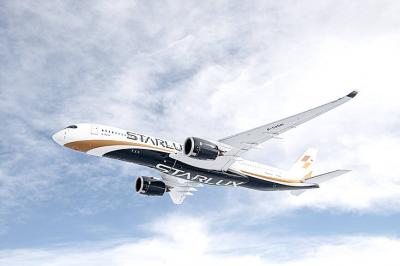
Starlux Airlines Co (星宇航空) today unveiled a long-haul network expansion plan at a shareholders’ meeting in Taipei, including direct flights to Barcelona, Spain, and Zurich, Switzerland, as well as a service connecting Taipei, Sydney and New Zealand. Starlux is to become the first Taiwanese carrier to offer non-stop services to the two European cities, while the inaugural oceanic route is expected to expand transit opportunities within the Australia-New Zealand market, Starlux said. Flight services to Chicago, Dallas, Washington and New York are under evaluation, the airline added. Prior to the shareholders’ meeting, the airline earlier this year announced that it would be

Taiwanese firms have increased investment in the Philippines in recent years as Manila’s ties with Washington deepen and global supply chains continue to shift away from China, an expert at the Chung-Hua Institution for Economic Research (CIER, 中華經濟研究院) said yesterday. The Philippines had not been among Taiwanese investors’ top choices in Southeast Asia, CIER Taiwan ASEAN Studies Center director Kristy Hsu (徐遵慈) said at a seminar in Taipei. However, Taiwan’s investment in the country has grown significantly since the COVID-19 pandemic, reaching US $257 million last year, a high in recent years, she said. Although Taiwan’s total investment in the Philippines still lags

Intel Corp regards Taiwan Semiconductor Manufacturing Co (TSMC, 台積電) as a longstanding partner, as the US chipmaker would continue outsourcing production of advanced chips to TSMC, Intel chief executive officer Lip-Bu Tan (陳立武) said yesterday. “I don’t look at people as competitors. I look at the collaboration... Nvidia is also, you know, a good friend,” Tan told a news conference following his keynote speech at the Computex trade show in Taipei. “It’s a very trusted partnership for us... We are a big, top customer for them, and we’re going to continue doing that,” he said, referring to TSMC, the world’s largest foundry


 RSS
RSS