


Inclusive institutions that cultivate talent across society have propelled Taiwan to “one of the most extraordinary economic experiences in world history,” Nobel laureate James Robinson said yesterday.
“The Taiwanese experience is dramatic,” Robinson said, referring to Taiwan’s significant rise in GDP per capita during a lecture in Taipei.
According to the IMF, Taiwan’s GDP per capita rose from US$2,370 in 1980 to US$37,830 this year, an increase of nearly 1,500 percent.
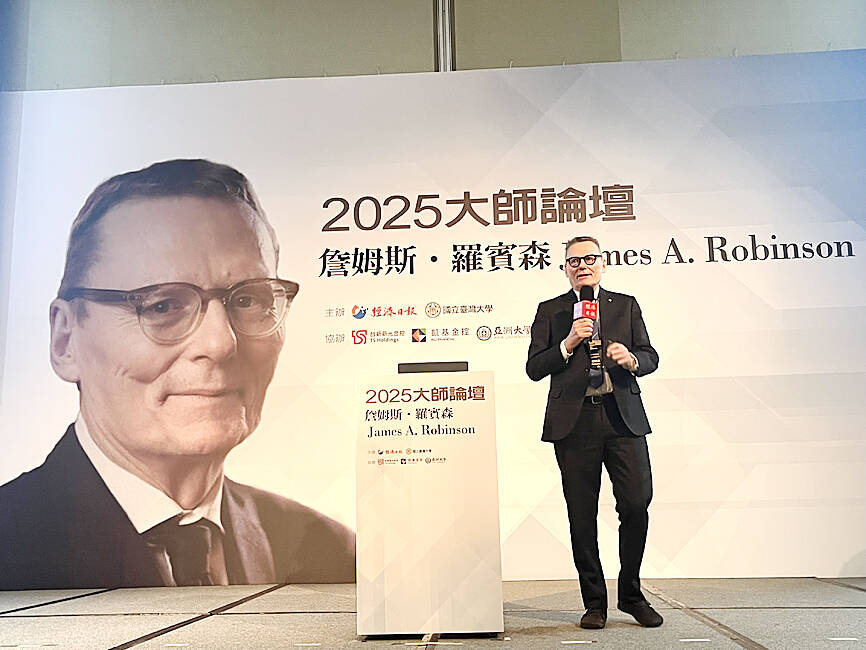
Photo: CNA
Robinson said that long-term growth in Taiwan was contingent on a political and economic system that created broad-based incentives and opportunities for innovation, allowing a meritocratic environment in which all “latent talent in society can get to the top.”
Hallmarks of inclusive institutions include robust rule of law and intellectual property protections, said Robinson, who was awarded the 2024 Nobel Prize in Economic Sciences for his work with Daron Acemoglu and Simon Johnson.
This stands in contrast with “extractive institutions,” which Robinson said concentrate political power and economic opportunities in the hands of a narrow elite.
While such systems can achieve some initial growth, it is only “transitory,” as the elite eventually prioritizes political control and wealth extraction over the broad-based incentives needed for sustained innovation, he said.
Addressing China’s sustained growth despite its extractive political institutions, the University of Chicago professor suggested that this relies on a temporary and unstable combination of inclusive economic institutions and extractive political institutions.
He warned that this structure is fundamentally incompatible with an advanced, innovative economy, as political control will eventually undermine innovation, citing the disappearance of high-profile entrepreneurs like Jack Ma (馬雲), founder of Alibaba Group Holding Ltd (阿里巴巴).
“I just think you can’t have a modern, inclusive, innovative economy when Jack Ma criticizes the government and then disappears. It can’t happen.”

ENERGY ISSUES: The TSIA urged the government to increase natural gas and helium reserves to reduce the impact of the Middle East war on semiconductor supply stability Chip testing and packaging service provider ASE Technology Holding Co (日月光投控) yesterday said it planned to invest more than NT$100 billion (US$3.15 billion) in building a new advanced chip testing facility in Kaohsiung to keep up with customer demand driven by the artificial intelligence (AI) boom. That would be included in the company’s capital expenditure budget next year, ASE said. There is also room to raise this year’s capital spending budget from a record-high US$7 billion estimated three months ago, it added. ASE would have six factories under construction this year, another record-breaking number, ASE chief operating officer Tien Wu

The EU and US are nearing an agreement to coordinate on producing and securing critical minerals, part of a push to break reliance on Chinese supplies. The potential deal would create incentives, such as minimum prices, that could advantage non-Chinese suppliers, according to a draft of an “action plan” seen by Bloomberg. The EU and US would also cooperate on standards, investments and joint projects, as well as coordinate on any supply disruptions by countries like China. The two sides are additionally seeking other “like-minded partners” to join a multicountry accord to help create these new critical mineral supply chains, which feed into

For weeks now, the global tech industry has been waiting for a major artificial intelligence (AI) launch from DeepSeek (深度求索), seen as a benchmark for China’s progress in the fast-moving field. More than a year has passed since the start-up put Chinese AI on the map in early last year with a low-cost chatbot that performed at a similar level to US rivals. However, despite reports and rumors about its imminent release, DeepSeek’s next-generation “V4” model is nowhere in sight. Speculation is also swirling over the geopolitical implications of which computer chips were chosen to train and power the new
TECH WINNERS: Taiwan and South Korea reported robust trade, which suggests that they have critical advantages in the rapidly expanding AI supply chain, an official said Exports last month surged to a new high, as booming demand tied to artificial intelligence (AI) infrastructure fueled shipments of advanced technology components, underscoring the nation’s pivotal role in the global semiconductor supply chain. Outbound shipments climbed to US$80.18 billion, the highest ever for a single month, rising 61.8 percent from a year earlier and marking the 29th consecutive month of growth, the Ministry of Finance said yesterday. “The surge was driven primarily by global investment in AI infrastructure,” Department of Statistics Director-General Beatrice Tsai (蔡美娜) said. The mass production of next-generation AI computing systems has accelerated procurement across the semiconductor supply


 RSS
RSS