


E.Sun Financial Holding Co (玉山金控) has achieved “Leadership” status across all three categories in this year’s Carbon Disclosure Project (CDP).
The company was awarded the highest “A” rating in the Climate Change and Forests category, securing a place on CDP’s respected annual “A” list and achieving a Leadership level “A-” rating in Water Security.
The result reflects E.Sun Financial’s sustained commitment to transparency and efforts on climate, forest and water management.
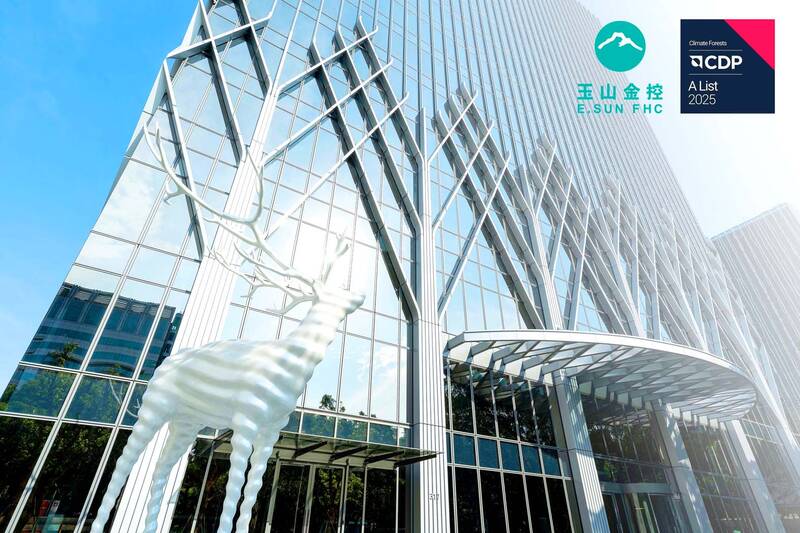
Photo courtesy of E.Sun Financial Holding Co
The CDP is a globally recognized environmental disclosure platform that supported more than 24,800 companies and nearly 1,000 cities, states and regions last year. It aligns with IFRS S2 climate standards and the Task Force on Climate-related Financial Disclosures (TCFD) and has incorporated the Taskforce on Nature-related Financial Disclosures (TNFD) into its scope.
The assessment covers critical nature issues, including forests, water resources and biodiversity, evaluating companies’ depth of reporting, understanding of environmental risks and evidence of following best practices — including ambitious target-setting and verified action. Companies must continuously improve to meet the CDP’s rigorous and independent methodology.
E.Sun Financial remains committed to environmental action, targeting net zero emissions by 2050 and nature positive outcomes. Since 2022, the company has published an integrated TCFD/TNFD “Climate and Nature Report” following both frameworks, and obtained BSI Taiwan TNFD conformity verification last year.
Under E.Sun Financial’s “Biodiversity Conservation and No Deforestation Commitment,” the company pledged to advance biodiversity and forest restoration to realize the UN Convention on Biological Diversity’s 2050 vision of “Living in Harmony with Nature.”
Subsidiary E.Sun Commercial Bank (玉山銀行) supports Taiwan’s sustainable food and agriculture transition through the “Farm to Table Sustainable Food Value Chain” program.
E.Sun Financial’s partnership with CPC Corp, Taiwan (台灣中油) also facilitated the first other effective area-based conservation measures-linked loan, in response to the government’s “Human-Biodiversity Coexistence Areas Certification Program” and contributing to the UN’s “30×30” biodiversity target.
Beyond Taiwan, E.Sun Financial pursues strategic international engagement. At this year’s UN Climate Change Conference, also known as COP30, the company established strategic collaboration with the World Climate Foundation, joined the Nature Investment Coalition and was invited to serve as Asia chair. In that capacity, the company intends to connect financial institutions, industry leaders, governments and academia across Asia to drive investments in biodiversity conservation, natural capital investment and the development of biodiversity credit mechanisms.
E.Sun Financial firmly believes a good environmental, social and governance strategy is a good business development strategy. As the global focus on climate and nature evolves, the company will continue aligning with global trends and integrating its financial expertise, working diligently with like-minded partners to promote environmental protection and social inclusion, thereby bringing positive impacts to Taiwan and beyond.

HORMUZ ISSUE: The US president said he expected crude prices to drop at the end of the war, which he called a ‘minor excursion’ that could continue ‘for a little while’ The United Arab Emirates (UAE) and Kuwait started reducing oil production, as the near-closure of the crucial Strait of Hormuz ripples through energy markets and affects global supply. Abu Dhabi National Oil Co (ADNOC) is “managing offshore production levels to address storage requirements,” the company said in a statement, without giving details. Kuwait Petroleum Corp said it was lowering production at its oil fields and refineries after “Iranian threats against safe passage of ships through the Strait of Hormuz.” The war in the Middle East has all but closed Hormuz, the narrow waterway linking the Persian Gulf to the open seas,

Nanya Technology Corp (南亞科技) yesterday said the DRAM supply crunch could extend through 2028, as the artificial intelligence (AI) boom has led the world’s major memory makers to dramatically reduce production of standard DRAM and allocate a significant portion of their capacity for high-bandwidth memory (HBM) chips. The most severe supply constraints would stretch to the first half of next year due to “very limited” increases in new DRAM capacity worldwide, Nanya Technology president Lee Pei-ing (李培瑛) told a news briefing. The company plans to increase monthly 12-inch wafer capacity to 20,000 in the first half of 2028 after a

Taiwan has enough crude oil reserves for more than 100 days and sufficient natural gas reserves for more than 11 days, both above the regulatory safety requirement, Minister of Economic Affairs Kung Ming-hsin (龔明鑫) said yesterday, adding that the government would prioritize domestic price stability as conflicts in the Middle East continue. Overall, energy supply for this month is secure, and the government is continuing efforts to ensure sufficient supply for next month, Kung told reporters after meeting with representatives from business groups at the ministry in Taipei. The ministry has been holding daily cross-ministry meetings at the Executive Yuan to ensure
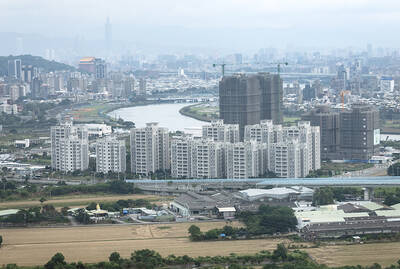
Property transactions in the nation’s six special municipalities plunged last month, as a lengthy Lunar New Year holiday combined with ongoing credit tightening dampened housing market activity, data compiled by local land administration offices released on Monday showed. The six cities recorded a total of 10,480 property transfers last month, down 42.5 percent from January and marking the second-lowest monthly level on record, the data showed. “The sharp drop largely reflected seasonal factors and tighter credit conditions,” Evertrust Rehouse Co (永慶房屋) deputy research manager Chen Chin-ping (陳金萍) said. The nine-day Lunar New Year holiday fell in February this year, reducing


 RSS
RSS