


Taiwan’s ongoing selective credit controls enjoy broad public support as tighter mortgage rules help cool transactions and ease upward pressure on housing prices, according to a survey released yesterday by Evertrust Rehouse Co (永慶房屋).
The findings could encourage the central bank to extend restrictive lending terms at its quarterly board meeting next week.
Fifty-three percent said the latest round of credit tightening introduced in September last year has helped restrain price increases, while nearly 60 percent believe it has curbed speculative activity, Evertrust research manager Daniel Chen (陳賜傑) said, citing the quarterly online survey.
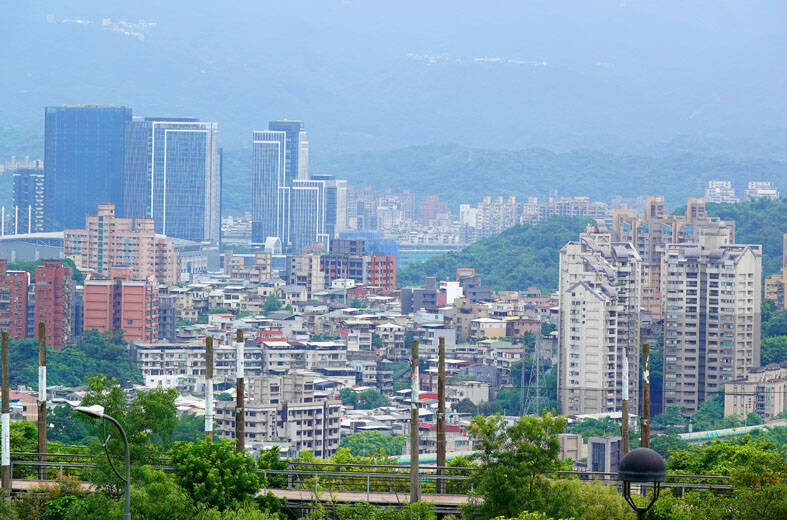
Photo: CNA
Sixty-eight percent supported extending the measures through next year, underscoring persistent public concerns that home prices could rebound if the central bank loosens restrictions, Chen said.
The central bank is scheduled to review real-estate lending rules on Thursday next week to assess their effectiveness in cooling property lending, which approached a record high in summer last year and risked turning into a housing bubble, central bank Governor Yang Chin-long (楊金龍) said at the prior policy meeting.
The property market has since slowed, as lenders tightened mortgage terms, reduced loan-to-value ratios and lengthened the application process to as long as six months from about one month previously. Borrowers must also demonstrate stronger income qualifications to obtain mortgages.
Housing transactions and prices have softened, a trend expected to persist into next year if the central bank maintains its restrictive stance, Chen said.
Tougher financing requirements have prompted investors to retreat from the market, allowing genuine homebuyers to dominate demand and bringing conditions closer to real supply-demand fundamentals, he said.
“Property fever has evidently cooled for the past 15 months,” Chen said, adding that the public strongly favors preserving an environment friendly to buyers with self-occupancy needs.
People worry that if the measures are withdrawn too soon, prices could surge again, squeezing affordability for first-time buyers and owner-occupiers, Chen said.
Separately, Taiwan’s presale housing market flashed a “yellow-blue” light last month — indicating contraction — according to a monthly survey by My Housing Monthly (住展雜誌).
A wave of year-end presale launches boosted supply, but buying momentum failed to keep pace, said Chen Ping-chen (陳炳辰), the magazine’s research chief and spokesman.
Presale project launches increased, while the number of newly completed homes declined. Other market indicators — visitor traffic, transaction volumes, bargaining rates and the number of projects available for sale — were largely unchanged, pointing to a weak, directionless market with no clear recovery in buying sentiment, Chen Ping-chen said.

Netherlands-based semiconductor equipment supplier ASML Holding NV yesterday said that it is planning to hire an additional 1,000 people in Taiwan this year in response to growing demand from clients. ASML had previously planned to recruit 600 people this year, but that the plan has been adjusted upward, ASML vice president and ASML Taiwan general manager Grace Wang (汪佳慧) told reporters. ASML has a workforce of more than 4,500 in Taiwan, accounting for about 10 percent of its global total, Wang said. This year’s recruitment campaign would focus on adding people in the customer support, manufacturing and supply chain domains to assist ASML

UNDER MICROSCOPE: Taiwan detained three people who allegedly conspired to buy servers in Taiwan and export them using fraudulent documentation, prosecutors said Nvidia Corp chief executive officer Jensen Huang (黃仁勳) on Saturday urged Super Micro Computer Inc to tighten up on compliance after Taiwan detained three people this week for allegedly making fraudulent declarations about artificial intelligence (AI) servers made by its US partner. The development marked the nation’s first crackdown on semiconductor smuggling, which grew after the US slapped restrictions on exports of high-end chips such as Nvidia AI accelerators to China. Nvidia is “rigorous” in explaining regulations to all of its partners, Huang told reporters after arriving in Taipei. “Ultimately Super Micro has to run their own company,” he said in response to

Nvidia Corp yesterday announced that CEO Jensen Huang (黃仁勳) would attend an employee meeting in Taipei tomorrow to celebrate the launch of the company’s Taiwan headquarters project. Huang would attend a gathering at the site of Nvidia’s planned headquarters in Beitou Shilin Technology Park (北投士林科技園區), the company said in a statement. After arriving in Taiwan on Saturday last week, Huang told reporters that he plans to meet with Quanta Computer Inc (廣達) chairman Barry Lam (林百里) and Taiwan Semiconductor Manufacturing Co (TSMC, 台積電) chairman C.C. Wei (魏哲家), and would attend the groundbreaking ceremony for Nvidia’s Taiwan headquarters tomorrow. Nvidia has not yet applied

Huawei Technologies Co (華為) said it has come up with a new pathway to shorten its gap with industry leader Taiwan Semiconductor Manufacturing Co (TSMC, 台積電), potentially achieving a breakthrough in making advanced semiconductors without cutting-edge equipment. Right now there is about a five-year gap between what TSMC is capable of and what Huawei, together with its manufacturing partner Semiconductor Manufacturing International Corp (中芯), can produce. Huawei is to start making 1.4-nanometer chips by 2031 with its own “LogicFolding” technology, Huawei semiconductor chief He Tingbo (何庭波) said in a rare public appearance during a chip conference yesterday, while TSMC has


 RSS
RSS