


Hon Hai Precision Industry Co (鴻海精密) yesterday said higher tariffs on imports into Mexico would not have a major impact on its operations, as the measure does not target the company’s core information and communications technology (ICT) business.
Hon Hai expects the potential impact to be limited, as the affected items are mainly non-ICT products, Hon Hai rotating chief executive officer Kathy Yang (楊秋瑾) told reporters on the sidelines of a contract-signing ceremony in Kaohsiung.
Although the company’s automotive electronics business might be affected, Hon Hai is not overly concerned about the situation, Yang said.
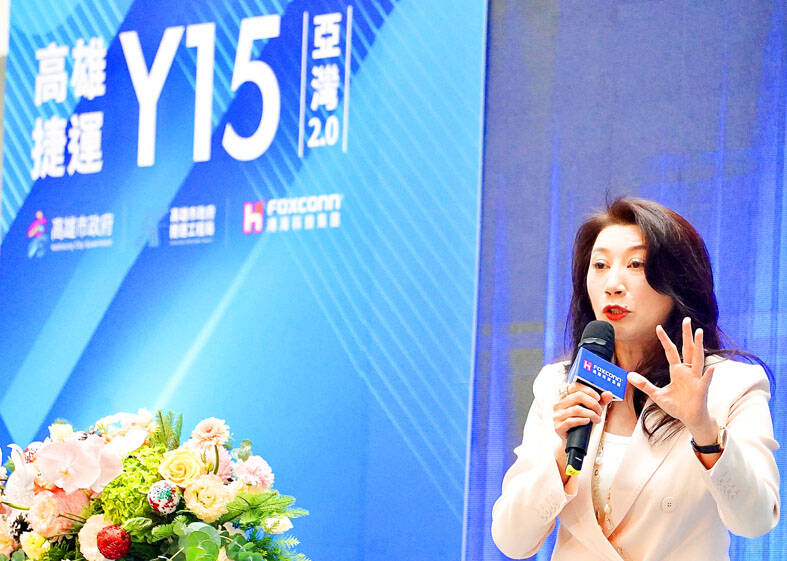
Photo: CNA
Mexican lawmakers on Wednesday backed a measure to raise tariffs to as high as 50 percent from between 15 percent and 20 percent on imports of light vehicles from China and countries that have no trade agreement with Mexico.
Hon Hai said it also implemented multiple duty-deferral mechanisms in Mexico to mitigate potential impacts, as it had anticipated the situation early on.
“Every country has its own policies and considerations, and as a large company that faces political and societal changes on a daily basis, we have a certain degree of resilience and ability to respond, so we are not overly concerned,” Yang said.
Hon Hai yesterday held a contract-signing ceremony for a land development project to build a new headquarters at the under-construction MRT Y15 station in Kaohsiung’s Asia New Bay Area (亞洲新灣區).
With a total investment of NT$15.9 billion (US$509.58 million), Hon Hai’s overall investment in Kaohsiung would exceed NT$25 billion, Yang said.
The project is expected to begin construction in 2027 and be completed in 2033, Hon Hai said.
It would comprise two buildings — one residential and the other a mixed-use complex housing technology research-and-development (R&D) offices, retail space and a shopping mall, Hon Hai said.
The two buildings are to serve as a key base for product verification, featuring 45 floors above ground, a height of 234m and a total floor area of 11,350m2, and are expected to create about 2,000 jobs upon completion, Hon Hai said.
After completion, the buildings would house Hon Hai’s smart city, software R&D, battery cell and energy storage R&D, EV technology development, and artificial intelligence (AI) application teams, the company said.
Aside from Kaohsiung, Hon Hai in February also signed a memorandum of understanding (MOU) with the government of Mexico’s Sonora State to collaborate on smart city development.
The collaboration has already been launched, and the company also plans to promote the smart city model developed in Kaohsiung to Sonora, as well as other cities in Taiwan, Yang said.
However, as such projects involve high complexity and cannot be replicated simply by securing a site in Taiwan — given the extensive technological integration and long-term planning required — the company would only further assess similar plans after the model matures, she said.
In May, Hon Hai announced a partnership with Nvidia Corp to build a supercomputing center in the Asia New Bay Area, with an investment of NT$42 billion, a project the company in October said is expected to be completed next year.
As the scale of the Nvidia project is immense — which Yang described as “the highest level in Asia” — and several technologies and plans are still being finalized, a detailed construction schedule would be released once development becomes clearer, she said.
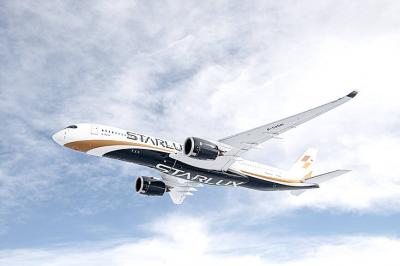
Starlux Airlines Co (星宇航空) today unveiled a long-haul network expansion plan at a shareholders’ meeting in Taipei, including direct flights to Barcelona, Spain, and Zurich, Switzerland, as well as a service connecting Taipei, Sydney and New Zealand. Starlux is to become the first Taiwanese carrier to offer non-stop services to the two European cities, while the inaugural oceanic route is expected to expand transit opportunities within the Australia-New Zealand market, Starlux said. Flight services to Chicago, Dallas, Washington and New York are under evaluation, the airline added. Prior to the shareholders’ meeting, the airline earlier this year announced that it would be
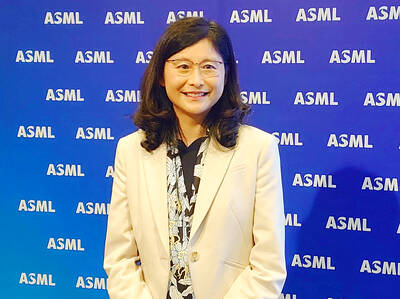
Netherlands-based semiconductor equipment supplier ASML Holding NV yesterday said that it is planning to hire an additional 1,000 people in Taiwan this year in response to growing demand from clients. ASML had previously planned to recruit 600 people this year, but that the plan has been adjusted upward, ASML vice president and ASML Taiwan general manager Grace Wang (汪佳慧) told reporters. ASML has a workforce of more than 4,500 in Taiwan, accounting for about 10 percent of its global total, Wang said. This year’s recruitment campaign would focus on adding people in the customer support, manufacturing and supply chain domains to assist ASML
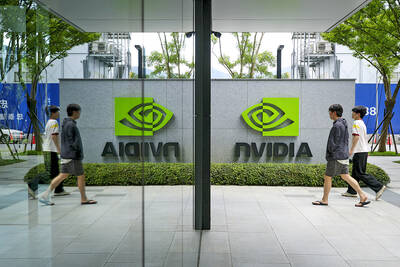
UNDER MICROSCOPE: Taiwan detained three people who allegedly conspired to buy servers in Taiwan and export them using fraudulent documentation, prosecutors said Nvidia Corp chief executive officer Jensen Huang (黃仁勳) on Saturday urged Super Micro Computer Inc to tighten up on compliance after Taiwan detained three people this week for allegedly making fraudulent declarations about artificial intelligence (AI) servers made by its US partner. The development marked the nation’s first crackdown on semiconductor smuggling, which grew after the US slapped restrictions on exports of high-end chips such as Nvidia AI accelerators to China. Nvidia is “rigorous” in explaining regulations to all of its partners, Huang told reporters after arriving in Taipei. “Ultimately Super Micro has to run their own company,” he said in response to

Nvidia Corp yesterday announced that CEO Jensen Huang (黃仁勳) would attend an employee meeting in Taipei tomorrow to celebrate the launch of the company’s Taiwan headquarters project. Huang would attend a gathering at the site of Nvidia’s planned headquarters in Beitou Shilin Technology Park (北投士林科技園區), the company said in a statement. After arriving in Taiwan on Saturday last week, Huang told reporters that he plans to meet with Quanta Computer Inc (廣達) chairman Barry Lam (林百里) and Taiwan Semiconductor Manufacturing Co (TSMC, 台積電) chairman C.C. Wei (魏哲家), and would attend the groundbreaking ceremony for Nvidia’s Taiwan headquarters tomorrow. Nvidia has not yet applied


 RSS
RSS