


The National Stabilization Fund’s (NSF) executive committee is open to expanding the size of the NT$500 billion (US$16.02 billion) scheme to NT$1 trillion, as long as the move helps maintain the stability and resilience of the local stock market amid an increasingly complex and challenging global environment, the fund said in a written report to the Legislative Yuan.
The report came as the legislature’s Finance Committee is slated today to review an amendment to the Act for the Establishment and Administration of the National Stabilization Fund (國家金融安定基金設置及管理條例) proposed by lawmakers, including Democratic Progressive Party Legislator Kuo Kuo-wen (郭國文) and Lee Kuen-cheng (李坤城), to double the fund’s size.
Under the current regulations, the NSF can utilize two sources of funding: up to NT$200 billion in borrowing from financial institutions, collateralized by stocks held by the National Treasury Administration in public and private enterprises, and as much as NT$300 billion in borrowing from the four major government funds — Civil Servants Pension Fund, the Postal Savings Fund, the Labor Insurance Fund and the Labor Pension Fund.
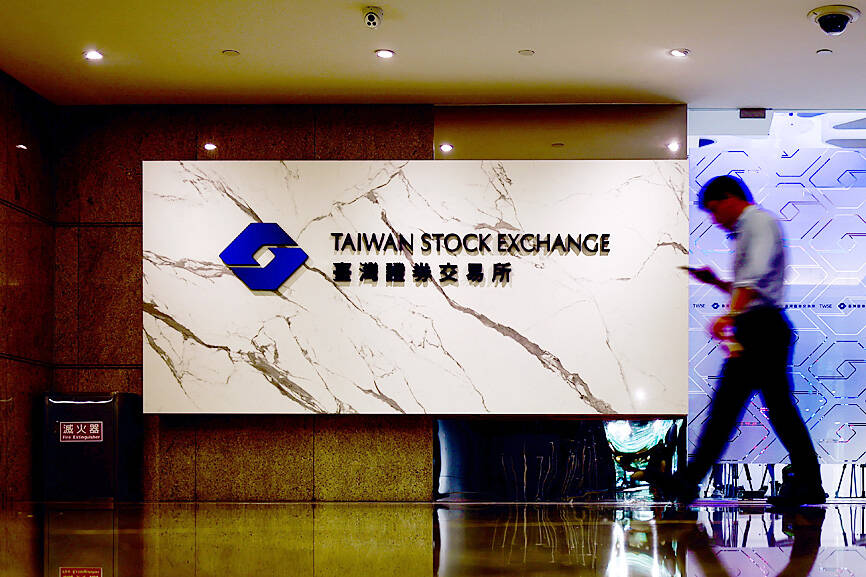
Photo: Ritchie B. Tongo, EPA-EFE
Lawmakers have proposed removing the ceilings on the two borrowing sources to give the NSF greater flexibility to raise funds amid market turbulence. The written report showed the fund aims to maintain the NT$300 billion ceiling for borrowing from the four major government funds, but increase the ceiling to NT$700 billion for lending from financial institutions.
The government established the stabilization fund in 2000 to serve as a buffer when major domestic or international events trigger large movements of global funds, significantly affect public confidence or cause disorder in Taiwan’s capital and financial markets.
The fund on April 9 intervened in the market amid panic sell-offs triggered by US President Donald Trump’s sweeping tariff announcement on April 2, marking the ninth intervention since its establishment.
The stabilization fund acknowledged in the report that the local stock market is susceptible to international political and economic fluctuations, as market capitalization has soared to more than NT$97 trillion as of the end of last month from NT$9.2 trillion in 2000, and the proportion of stocks held by foreign investors has climbed to 46.85 percent from 8.44 percent over the same period.
From April 9 to Nov. 30, foreign investors sold a net NT$394 billion of local shares, it added.
The TAIEX yesterday closed down 121.18 points, or 0.43 percent, at 28,182.60, as investors avoided taking risks ahead of the US Federal Reserve’s policy-setting meeting this week. The benchmark index has risen 23.43 percent since the beginning of this year.
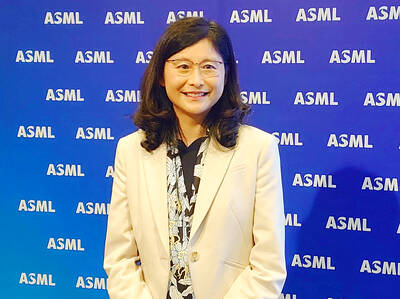
Netherlands-based semiconductor equipment supplier ASML Holding NV yesterday said that it is planning to hire an additional 1,000 people in Taiwan this year in response to growing demand from clients. ASML had previously planned to recruit 600 people this year, but that the plan has been adjusted upward, ASML vice president and ASML Taiwan general manager Grace Wang (汪佳慧) told reporters. ASML has a workforce of more than 4,500 in Taiwan, accounting for about 10 percent of its global total, Wang said. This year’s recruitment campaign would focus on adding people in the customer support, manufacturing and supply chain domains to assist ASML
UNDER MICROSCOPE: Taiwan detained three people who allegedly conspired to buy servers in Taiwan and export them using fraudulent documentation, prosecutors said Nvidia Corp chief executive officer Jensen Huang (黃仁勳) on Saturday urged Super Micro Computer Inc to tighten up on compliance after Taiwan detained three people this week for allegedly making fraudulent declarations about artificial intelligence (AI) servers made by its US partner. The development marked the nation’s first crackdown on semiconductor smuggling, which grew after the US slapped restrictions on exports of high-end chips such as Nvidia AI accelerators to China. Nvidia is “rigorous” in explaining regulations to all of its partners, Huang told reporters after arriving in Taipei. “Ultimately Super Micro has to run their own company,” he said in response to
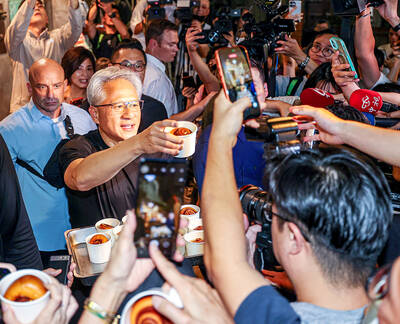
Nvidia Corp yesterday announced that CEO Jensen Huang (黃仁勳) would attend an employee meeting in Taipei tomorrow to celebrate the launch of the company’s Taiwan headquarters project. Huang would attend a gathering at the site of Nvidia’s planned headquarters in Beitou Shilin Technology Park (北投士林科技園區), the company said in a statement. After arriving in Taiwan on Saturday last week, Huang told reporters that he plans to meet with Quanta Computer Inc (廣達) chairman Barry Lam (林百里) and Taiwan Semiconductor Manufacturing Co (TSMC, 台積電) chairman C.C. Wei (魏哲家), and would attend the groundbreaking ceremony for Nvidia’s Taiwan headquarters tomorrow. Nvidia has not yet applied
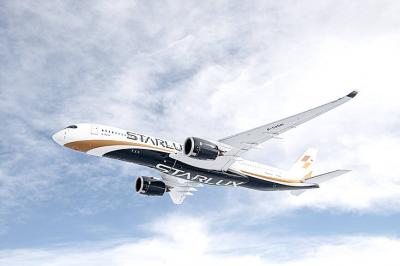
Starlux Airlines Co (星宇航空) today unveiled a long-haul network expansion plan at a shareholders’ meeting in Taipei, including direct flights to Barcelona, Spain, and Zurich, Switzerland, as well as a service connecting Taipei, Sydney and New Zealand. Starlux is to become the first Taiwanese carrier to offer non-stop services to the two European cities, while the inaugural oceanic route is expected to expand transit opportunities within the Australia-New Zealand market, Starlux said. Flight services to Chicago, Dallas, Washington and New York are under evaluation, the airline added. Prior to the shareholders’ meeting, the airline earlier this year announced that it would be


 RSS
RSS