


Taiwan’s foreign exchange reserves at the end of last month fell below US$600 billion as the central bank stepped in to sell the US dollar to prevent it from appreciating further against the New Taiwan dollar.
Data released on Friday by the central bank showed that the country’s forex reserves fell US$406 million from October to US$599.79 billion — the second consecutive month that forex reserves moved lower.
November was a traditional peak cash dividend payment month, as many foreign institutional investors rushed to move their funds out of Taiwan, placing the NT dollar under pressure, Department of Foreign Exchange Director-General Eugene Tsai (蔡烱民) told reporters.
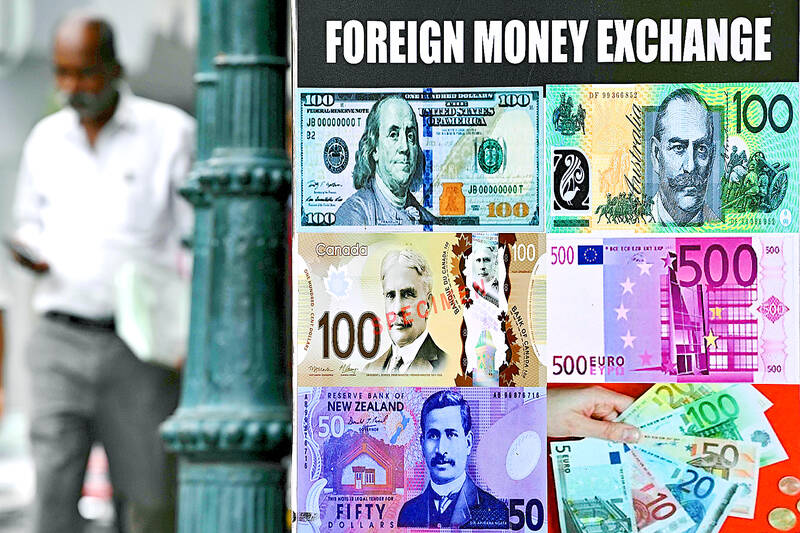
Photo: AFP
Foreign institutional investors remitted about US$11 billion funds out of Taiwan, including cash dividends and earnings they received, the highest amount in eight months, Tsai said.
Taiwan’s forex reserves hit a new high of NT$602.94 billion at the end of September, the first time it stood above the US$600 billion level, as the central bank bought the greenback to prevent the NT dollar from rising too fast.
However, in October and last month, market conditions changed as a weakening NT dollar forced the central bank to intervene by selling the US dollar, sending the country’s forex reserves lower.
Foreign investors held US$1.09 trillion in Taiwan-listed stocks, bonds and NT dollar deposits at the end of last month, down from a record high of US$1.15 trillion in October, central bank data showed.
The holdings were 182 percent of Taiwan’s total forex reserves last month, down from 192 percent in October, due to weakness in the local stock market, where the TAIEX fell 2.15 percent.
Meanwhile, the central bank announced it would release its first set of quarterly market intervention data next month for its third-quarter intervention.
In the past, the central bank released such data every six months, but it last month said that after consulting with the US Department of the Treasury, it decided to release the data on a quarterly basis — in January, April, July and November — to enhance market transparency.

Apple Inc increased iPhone production in India by about 53 percent last year and now makes a quarter of its marquee devices there, reflecting the US company’s efforts to avoid tariffs on China. The company assembled about 55 million iPhones in India last year, up from 36 million a year earlier, people familiar with the matter said, asking not to be named because the numbers aren’t public. Apple makes about 220 million to 230 million iPhones a year globally, with India’s share of the total increasing rapidly. Apple has accelerated its expansion in the world’s most populous country in recent years, bolstered

Taiwan Semiconductor Manufacturing Co’s (TSMC, 台積電) share of the global foundry market rose to almost 70 percent last year amid booming demand for artificial intelligence (AI), market information advisory firm TrendForce Corp (集邦科技) said on Thursday. The contract chipmaker posted US$122.54 billion in revenue, up 36.1 percent from a year earlier, accounting for 69.9 percent of the global market, TrendForce said. Its share was up from 64.4 percent in 2024, it said. TSMC’s closest rival, Samsung Electronics, was a distant second, posting US$12.63 billion in sales, down 3.9 percent from a year earlier, for a 7.2 percent share of the global market. In the

HEADWINDS: The company said it expects its computer business, as well as consumer electronics and communications segments to see revenue declines due to seasonality Pegatron Corp (和碩) yesterday said it aims to grow its artificial intelligence (AI) server revenue more than 10-fold this year from last year, driven by orders from neocloud solutions clients and large cloud service providers. The electronics manufacturing service provider said AI server revenue growth would be driven primarily by the Nvidia Corp GB300 server platform. Server shipments are expected to increase each quarter this year, with the second half likely to outperform the first half, it said. The AI server market is expected to broaden this year as more inference applications emerge, which would drive demand for system-on-chip, application-specific integrated circuits

DAMAGE REPORT: Global central banks are assessing war-driven inflation risks as the law of unintended consequences careens around the world, spiking oil prices Central banks from Washington to London and from Jakarta to Taipei are about to make their first assessments of economic damage after more than two weeks of conflict between the US and Iran. Decisions this week encompassing every member of the G7 and eight of the world’s 10 most-traded currency jurisdictions are likely to confirm to investors that the specter of a new inflation shock is already worrying enough to prompt heightened caution. The US Federal Reserve is widely expected to do exactly what everyone anticipated weeks ahead of its March 17-18 policy gathering: hold rates steady. The narrative surrounding that


 RSS
RSS