


The EU yesterday released its plan to try to end the 27-nation bloc’s dependence on China for rare earths, as Beijing’s stranglehold threatens key industries.
China, the world’s top producer of rare earths, in October announced new controls on the export of the elements, which are used to make magnets crucial to the auto, electronics and defense industries.
The move rattled markets and snarled supply chains until China later said it would suspend the curbs for one year.
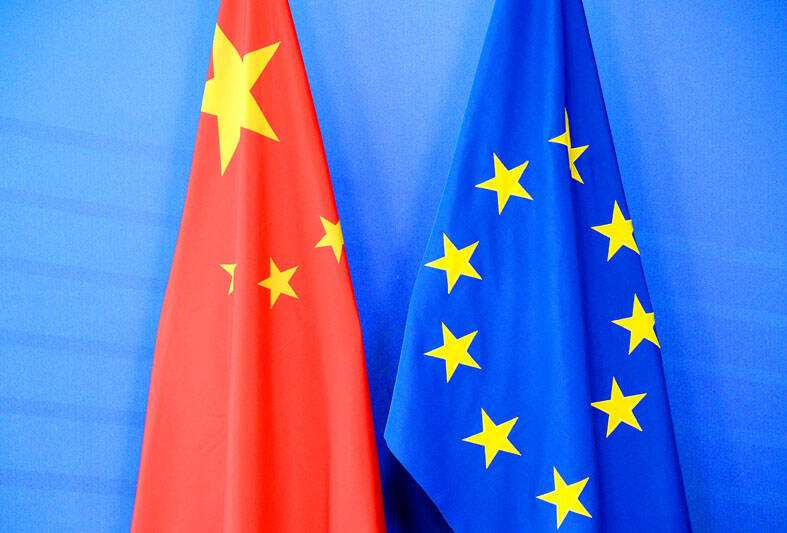
Photo: AFP
Already since April, Beijing has required licenses for certain exports of the materials, hitting global manufacturing sectors.
European Commission Executive Vice-President for Prosperity and Industrial Strategy Stephane Sejourne has called on the bloc to “step up” against what he said was essentially a “racket” being run by Beijing.
The new plan would look to push for the EU to speed up the joint purchasing of critical raw materials including rare earths, accelerate production and recycling in Europe, work with reliable partners and conclude new partnerships.
The EU’s executive body would also propose next week the creation of a European Center for Critical Raw Materials that would be the bloc’s supply hub, modeled on Japan’s state-run Japan Oil, Gas and Metals National Corp.
The EU finds itself squeezed between China’s restrictions and the US under President Donald Trump, which is negotiating bilateral agreements on all fronts to secure its own supplies.
A study published on Monday by the EU Chamber of Commerce in China said that 60 percent of its members expected disruptions to their supply chains because of government-imposed restrictions, and 13 percent fear they might have to interrupt or slow down production.
“The situation is really urgent from our perspective,” said Florian Anderhuber, the deputy director general of Euromines lobby group. “Speed is now of the essence.”
Euromines is calling to accelerate permits for new mines in Europe and to slash the red tape required. It also wants financing guarantees and initiatives to reduce price differences between China and Europe, which has acted as a break on producers on the continent.
In addition, the European Commission would update its strategy for ensuring the EU’s “economic security.”
The first strategy was produced in 2023 as the bloc grappled with the harsh lessons from the COVID-19 pandemic and Ukraine war that showed up the fragility of its supply lines.
In the face of new diplomatic and geopolitical tensions, most strikingly a US administration willing to act aggressively on trade against its close allies, Brussels needs a refresh. The new strategy would look to revise how Europe could use its most potent trade tools, such as controls on foreign investment and export restrictions, to flex its own muscles.

South Korea’s equity benchmark yesterday crossed a new milestone just a month after surpassing the once-unthinkable 5,000 mark as surging global memory demand powers the country’s biggest chipmakers. The KOSPI advanced as much as 2.6 percent to a record 6,123, with Samsung Electronics Co and SK Hynix Inc each gaining more than 2 percent. With the benchmark now up 45 percent this year, South Korea’s stock market capitalization has also moved past France’s, following last month’s overtaking of Germany’s. Long overlooked by foreign funds, despite being undervalued, South Korean stocks have now emerged as clear winners in the global market. The so-called “artificial intelligence

NEW IDENTITY: Known for its software, India has expanded into hardware, with its semiconductor industry growing from US$38bn in 2023 to US$45bn to US$50bn India on Saturday inaugurated its first semiconductor assembly and test facility, a milestone in the government’s push to reduce dependence on foreign chipmakers and stake a claim in a sector dominated by China. Indian Prime Minister Narendra Modi opened US firm Micron Technology Inc’s semiconductor assembly, test and packaging unit in his home state of Gujarat, hailing the “dawn of a new era” for India’s technology ambitions. “When young Indians look back in the future, they will see this decade as the turning point in our tech future,” Modi told the event, which was broadcast on his YouTube channel. The plant would convert

‘SEISMIC SHIFT’: The researcher forecast there would be about 1.1 billion mobile shipments this year, down from 1.26 billion the prior year and erasing years of gains The global smartphone market is expected to contract 12.9 percent this year due to the unprecedented memorychip shortage, marking “a crisis like no other,” researcher International Data Corp (IDC) said. The new forecast, a dramatic revision down from earlier estimates, gives the latest accounting of the ongoing memory crunch that is affecting every corner of the electronics industry. The demand for advanced memory to power artificial intelligence (AI) tasks has drained global supply until well into next year and jeopardizes the business model of many smartphone makers. IDC forecast about 1.1 billion mobile shipments this year, down from 1.26 billion the prior
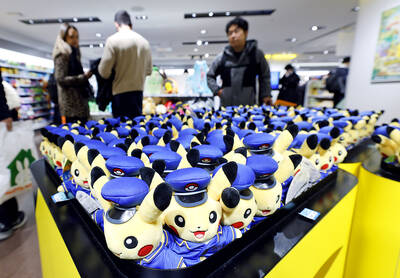
People stand in a Pokemon store in Tokyo on Thursday. One of the world highest-grossing franchises is celebrated its 30th anniversary yesterday.


 RSS
RSS