


China’s factory activity shrank for an eighth consecutive month last month, official data showed yesterday, suggesting the world’s second-largest economy remains subdued despite a trade truce with the US.
The manufacturing purchasing managers’ index (PMI) — a key measure of industrial health — was 49.2 last month, according to the Chinese National Bureau of Statistics (NBS).
That marked an improvement from 49 recorded in October, but remained below the 50 mark that separates expansion from contraction.
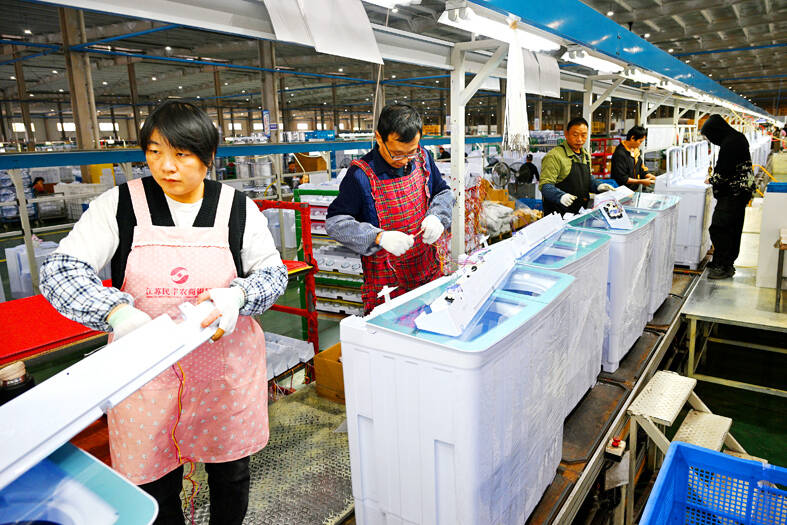
Photo: AP
The reading missed a median forecast of 49.4 from a Bloomberg survey of economists.
The figure comes after Chinese President Xi Jinping (習近平) and US President Donald Trump met in South Korea in October and agreed on a temporary truce in their bruising trade war.
Meanwhile, the nonmanufacturing PMI, which measures activity in sectors including services and construction, was 49.5 last month, marking the first contraction in nearly three years.
That was partly attributable to the “fading holiday effect” after the end of China’s “Golden Week” National Day holiday in October, NBS statistician Huo Lihui (霍麗慧) said in a statement.
Weakness in the real-estate and residential services sectors also helped drag the figure down 0.6 percentage points from October.
While Chinese authorities previously rolled out measures such as trade-in subsidies for home appliances and electric vehicles, some of them are set to be phased out, and sales and demand are likely to drop, analysts said.
The fading boost from the consumer goods trade-in policies might be weighing on domestic demand for manufactured goods and “signals on domestic demand have been mixed,” Capital Economics economist Huang Zichun (黃子春) said last week.
Chinese officials have set a target of about 5 percent economic growth for this year. The economy expanded 4.8 percent in the July-to-September quarter.
“This year’s growth target is likely to require minimal additional support to be reached,” ING Bank NV chief Greater China economist Lynn Song (宋林) wrote in a note earlier this month.
Additional reporting by AP

Apple Inc increased iPhone production in India by about 53 percent last year and now makes a quarter of its marquee devices there, reflecting the US company’s efforts to avoid tariffs on China. The company assembled about 55 million iPhones in India last year, up from 36 million a year earlier, people familiar with the matter said, asking not to be named because the numbers aren’t public. Apple makes about 220 million to 230 million iPhones a year globally, with India’s share of the total increasing rapidly. Apple has accelerated its expansion in the world’s most populous country in recent years, bolstered

Taiwan Semiconductor Manufacturing Co’s (TSMC, 台積電) share of the global foundry market rose to almost 70 percent last year amid booming demand for artificial intelligence (AI), market information advisory firm TrendForce Corp (集邦科技) said on Thursday. The contract chipmaker posted US$122.54 billion in revenue, up 36.1 percent from a year earlier, accounting for 69.9 percent of the global market, TrendForce said. Its share was up from 64.4 percent in 2024, it said. TSMC’s closest rival, Samsung Electronics, was a distant second, posting US$12.63 billion in sales, down 3.9 percent from a year earlier, for a 7.2 percent share of the global market. In the

HEADWINDS: The company said it expects its computer business, as well as consumer electronics and communications segments to see revenue declines due to seasonality Pegatron Corp (和碩) yesterday said it aims to grow its artificial intelligence (AI) server revenue more than 10-fold this year from last year, driven by orders from neocloud solutions clients and large cloud service providers. The electronics manufacturing service provider said AI server revenue growth would be driven primarily by the Nvidia Corp GB300 server platform. Server shipments are expected to increase each quarter this year, with the second half likely to outperform the first half, it said. The AI server market is expected to broaden this year as more inference applications emerge, which would drive demand for system-on-chip, application-specific integrated circuits

DAMAGE REPORT: Global central banks are assessing war-driven inflation risks as the law of unintended consequences careens around the world, spiking oil prices Central banks from Washington to London and from Jakarta to Taipei are about to make their first assessments of economic damage after more than two weeks of conflict between the US and Iran. Decisions this week encompassing every member of the G7 and eight of the world’s 10 most-traded currency jurisdictions are likely to confirm to investors that the specter of a new inflation shock is already worrying enough to prompt heightened caution. The US Federal Reserve is widely expected to do exactly what everyone anticipated weeks ahead of its March 17-18 policy gathering: hold rates steady. The narrative surrounding that


 RSS
RSS