


Japanese tourism and retail shares dived yesterday after China warned its citizens to avoid the tourist hot spot in a spat over Japanese Prime Minister Sanae Takaichi’s comments on Taiwan.
A senior Japanese official arrived in China, reports said, seeking to defuse the row sparked by Takaichi’s suggestion that Tokyo could intervene militarily in any attack on Taiwan.
Asia’s two top economies are closely entwined, with China being the biggest source of tourists — almost 7.5 million visitors in the first nine months of this year — coming to Japan.
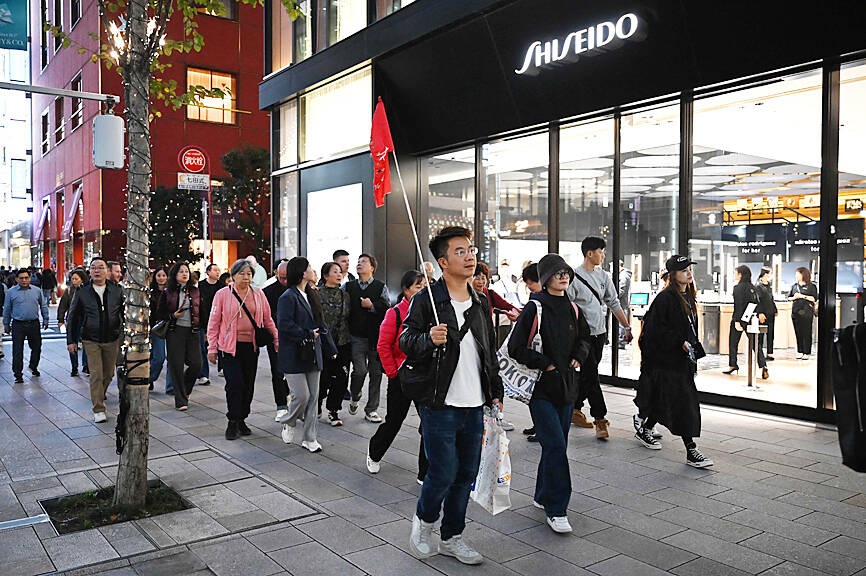
Photo: AFP
Drawn by a weak yen making shopping cheaper, they collectively splurged more than US$1 billion a month in the third quarter, accounting for almost 30 percent of all tourist spending.
Japan was also the fourth-most popular destination for Chinese tourists last year, helping the land of Mount Fuji, sushi and geishas set new records for foreign arrivals.
However, in fears that this might stop, investors yesterday wiped 9 percent off Japanese cosmetics firm Shiseido Co’s market value.
Department store group Isetan Mitsukoshi Holdings Ltd fell 11.3 percent, Pan Pacific International Holdings Corp, behind discount retail chain and tourist magnet Don Quijote, slid 5.3 percent, and Fast Retailing Co — the owner of Uniqlo — shed 4.8 percent.
Japan Airlines Co, whose shares nosedived 3.4 percent, has not seen any major cancelations on flights to and from China, a spokesperson said.
In Tokyo, the Nikkei 225 closed down 0.1 percent at 50,323.91.
The diplomatic spat could spell further bad news for Japan’s economy, which shrank by 0.4 percent quarter-on-quarter in the third quarter, the first contraction in six quarters, official data showed.
Capital Economics Ltd senior Japan economist Marcel Thieliant warned that the tensions risked escalating “into a full-blown trade spat,” similar to a previous episode in the early 2010s.
That could include China restricting exports of rare earths or imposing restrictions on Japanese exports.
“Carmakers look particularly vulnerable as they are already under enormous pressure from the ascent of Chinese electric vehicle manufacturers,” Thieliant added.
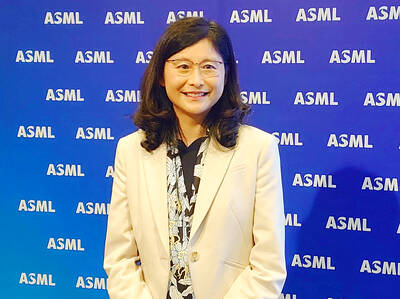
Netherlands-based semiconductor equipment supplier ASML Holding NV yesterday said that it is planning to hire an additional 1,000 people in Taiwan this year in response to growing demand from clients. ASML had previously planned to recruit 600 people this year, but that the plan has been adjusted upward, ASML vice president and ASML Taiwan general manager Grace Wang (汪佳慧) told reporters. ASML has a workforce of more than 4,500 in Taiwan, accounting for about 10 percent of its global total, Wang said. This year’s recruitment campaign would focus on adding people in the customer support, manufacturing and supply chain domains to assist ASML

UNDER MICROSCOPE: Taiwan detained three people who allegedly conspired to buy servers in Taiwan and export them using fraudulent documentation, prosecutors said Nvidia Corp chief executive officer Jensen Huang (黃仁勳) on Saturday urged Super Micro Computer Inc to tighten up on compliance after Taiwan detained three people this week for allegedly making fraudulent declarations about artificial intelligence (AI) servers made by its US partner. The development marked the nation’s first crackdown on semiconductor smuggling, which grew after the US slapped restrictions on exports of high-end chips such as Nvidia AI accelerators to China. Nvidia is “rigorous” in explaining regulations to all of its partners, Huang told reporters after arriving in Taipei. “Ultimately Super Micro has to run their own company,” he said in response to
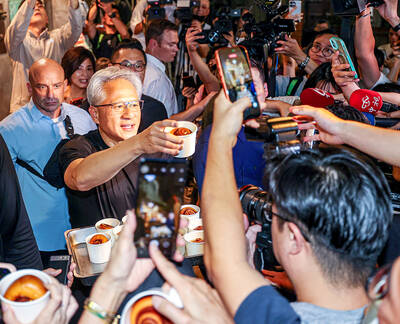
Nvidia Corp yesterday announced that CEO Jensen Huang (黃仁勳) would attend an employee meeting in Taipei tomorrow to celebrate the launch of the company’s Taiwan headquarters project. Huang would attend a gathering at the site of Nvidia’s planned headquarters in Beitou Shilin Technology Park (北投士林科技園區), the company said in a statement. After arriving in Taiwan on Saturday last week, Huang told reporters that he plans to meet with Quanta Computer Inc (廣達) chairman Barry Lam (林百里) and Taiwan Semiconductor Manufacturing Co (TSMC, 台積電) chairman C.C. Wei (魏哲家), and would attend the groundbreaking ceremony for Nvidia’s Taiwan headquarters tomorrow. Nvidia has not yet applied

Huawei Technologies Co (華為) said it has come up with a new pathway to shorten its gap with industry leader Taiwan Semiconductor Manufacturing Co (TSMC, 台積電), potentially achieving a breakthrough in making advanced semiconductors without cutting-edge equipment. Right now there is about a five-year gap between what TSMC is capable of and what Huawei, together with its manufacturing partner Semiconductor Manufacturing International Corp (中芯), can produce. Huawei is to start making 1.4-nanometer chips by 2031 with its own “LogicFolding” technology, Huawei semiconductor chief He Tingbo (何庭波) said in a rare public appearance during a chip conference yesterday, while TSMC has


 RSS
RSS