


Two of Taiwan’s largest financial groups yesterday sought to reassure investors that they can weather currency volatility, following a rare joint statement by Taiwan’s central bank and the US Department of the Treasury that rekindled expectations of the local currency’s appreciation.
CTBC Financial Holding Co (中信金控) president and spokeswoman Rachael Kao (高麗雪) told an investors’ conference that the local currency is expected to maintain a long-term appreciation trend, with the New Taiwan dollar likely to hover at about NT$30 through the end of this year.
The NT dollar yesterday closed NT$0.030 lower at NT$31.180 against the US dollar in Taipei. The dip came despite the central bank saying in the joint statement on Friday that it would provide the US Treasury with intervention data quarterly beginning next month, up from twice a year previously.
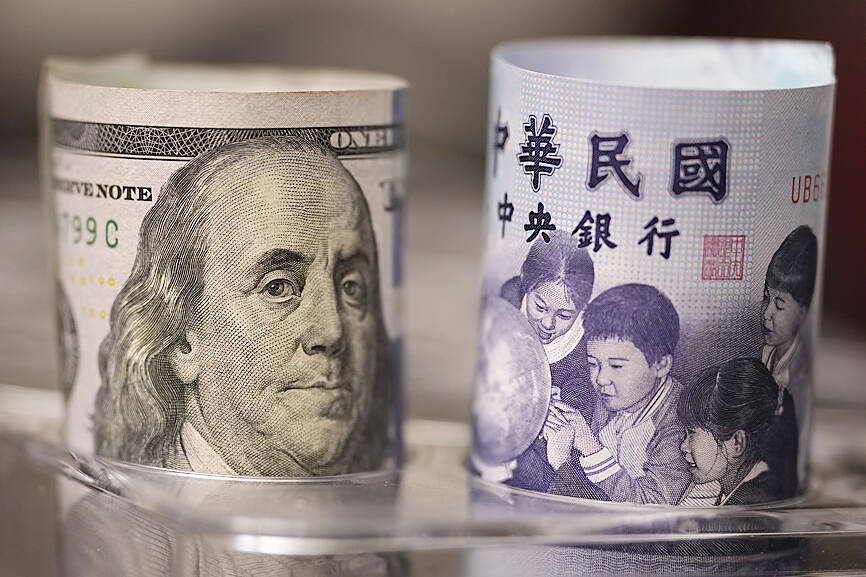
Photo: CNA
Kao said the statement should not be seen as a shift in the central bank’s foreign-exchange policy or a restriction on Taiwan’s exchange-rate flexibility, adding that the US Treasury has previously issued similar statements for Japan, South Korea, Switzerland, Malaysia and Thailand.
Kao highlighted the local currency’s robust outlook, citing strong external balances and resilient capital inflows as supportive factors.
Taiwan Life Insurance Co (台灣人壽), a subsidiary of CTBC Financial, held NT$17.6 billion (US$564.46 million) in foreign-exchange reserves as of Sept. 30, Taiwan Life chief investment officer Yeh Pai-hung (葉?宏) said, adding that currency fluctuations within NT$2 would not materially affect its earnings.
If currency hedging costs — through instruments such as forwards, options or swaps — fall below 3 percent, the company would increase its hedge ratio, Yeh said.
Cathay Life Insurance Co (國泰人壽), Taiwan’s largest insurer by assets, said its foreign-exchange reserve fund provides ample room to absorb currency swings even if the NT dollar strengthens to NT$28 against the greenback.
“We do not expect a material impact from the expected currency appreciation,” Cathay Life spokesman Lin Chao-ting (林昭廷) said.
Lin emphasized that domestic insurers hold substantial offshore portfolios with investment horizons exceeding 20 years, so most foreign-exchange gains or losses remain unrealized and are reflected only on paper.
The life insurance sector has gradually reduced its reliance on traditional hedging tools, which carry elevated costs, in favor of expanding foreign-exchange reserves as a form of “self-insurance,” Lin said.
The sector has enhanced reserve buffers since May, when the NT dollar surged, with plans for an additional 30 percent increase by the end of the year, he said.
The measures leave local insurers well-positioned to withstand further currency volatility, should the NT dollar climb higher, he added.

Cairo’s new monorail slices across the city skyline, running above the familiar chaos of blaring horns and aging buses’ exhaust fumes that mark rush hour below. The US$4.5 billion monorail, opened this month, is among Egypt’s most prominent new transport projects, part of a debt-funded infrastructure drive criticized for sapping state finances while bringing limited benefits to most of the country’s 109 million people. “It feels like you’re in a different country,” said Ramy Sayed, a restaurant manager, aboard a driverless Innovia 300 train. “No noise, no traffic, we’re not used to this.” The eastern line runs 56km from the bustling middle-class

Taiwanese firms have increased investment in the Philippines in recent years as Manila’s ties with Washington deepen and global supply chains continue to shift away from China, an expert at the Chung-Hua Institution for Economic Research (CIER, 中華經濟研究院) said yesterday. The Philippines had not been among Taiwanese investors’ top choices in Southeast Asia, CIER Taiwan ASEAN Studies Center director Kristy Hsu (徐遵慈) said at a seminar in Taipei. However, Taiwan’s investment in the country has grown significantly since the COVID-19 pandemic, reaching US $257 million last year, a high in recent years, she said. Although Taiwan’s total investment in the Philippines still lags
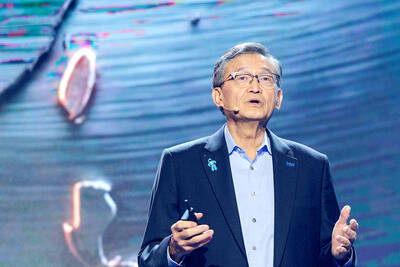
Intel Corp regards Taiwan Semiconductor Manufacturing Co (TSMC, 台積電) as a longstanding partner, as the US chipmaker would continue outsourcing production of advanced chips to TSMC, Intel chief executive officer Lip-Bu Tan (陳立武) said yesterday. “I don’t look at people as competitors. I look at the collaboration... Nvidia is also, you know, a good friend,” Tan told a news conference following his keynote speech at the Computex trade show in Taipei. “It’s a very trusted partnership for us... We are a big, top customer for them, and we’re going to continue doing that,” he said, referring to TSMC, the world’s largest foundry

Artificial intelligence (AI) agents would supplant smartphones as the center of people’s digital lives, fundamentally reshaping personal devices and driving a major computing upgrade cycle, Qualcomm Inc CEO Cristiano Amon said yesterday. In his keynote speech for this year’s Computex trade show in Taipei, Amon said that the rise of "agentic AI" — AI systems capable of reasoning, planning and carrying out tasks autonomously — would transform how people interact with technology across phones, PCs, vehicles and wearable devices. Describing the technology as the next major evolution in computing, Amon said that "2026 is the year of agents.” For decades, smartphones have sat


 RSS
RSS