


Apple Inc is stepping up its succession-planning efforts as it prepares for Tim Cook to step down as chief executive of the tech giant as soon as next year, the Financial Times reported on Friday.
John Ternus, Apple’s senior vice president of hardware engineering, is widely seen as Cook’s most likely successor, the FT reported, citing several people familiar with discussions.
Apple did not immediately respond to a Reuters request for comment.
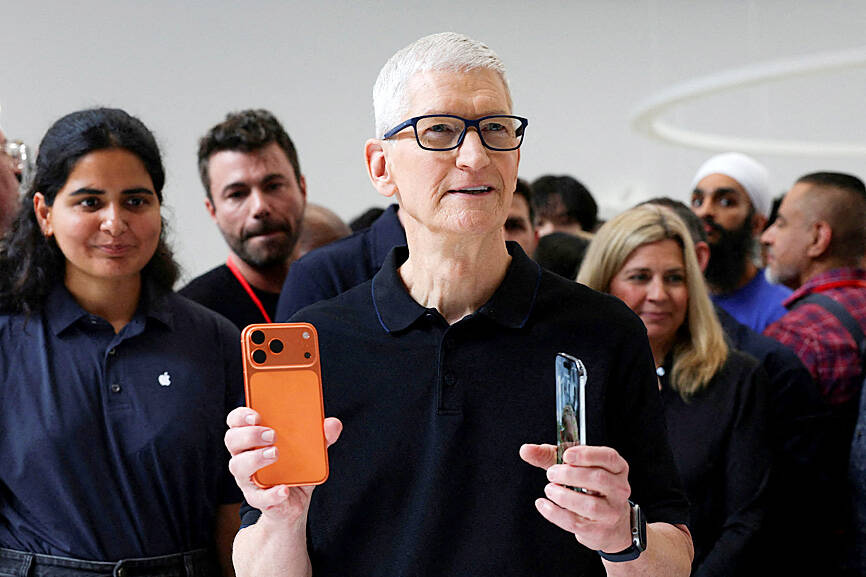
Photo: REUTERS
The newspaper quoted people familiar with discussions inside the iPhone maker as saying its board and senior executives had recently intensified preparations for Cook to hand over the reins after more than 14 years.
Apple is unlikely to name a new CEO before its next earnings report in late January, which covers the critical holiday period, the FT said.
Cook became CEO in 2011 after Silicon Valley legend Steve Jobs resigned, ending his reign at the technology giant he cofounded in a garage.
Separately, sales of iPhones in China rose 22 percent from year-earlier levels in the first month after the iPhone 17 series launched, even as the broader market softened, a private survey showed on Friday.
The new lineup drove most of Apple’s smartphone sales in China in the period from the Sept. 19 launch, with the 17 series accounting for nearly four-fifths of units sold to consumers, according to the data from research firm Counterpoint.
The iPhone 17 launch drew hundreds of people to Apple’s Beijing flagship on release day — a sign of continued enthusiasm for the brand, despite intensifying competition from Huawei Technologies Co (華為) and Xiaomi Corp (小米).
China’s smartphone market remained weak amid subdued consumer demand, with third-quarter sales down 2.7 percent year-on-year, Counterpoint said.

Netherlands-based semiconductor equipment supplier ASML Holding NV yesterday said that it is planning to hire an additional 1,000 people in Taiwan this year in response to growing demand from clients. ASML had previously planned to recruit 600 people this year, but that the plan has been adjusted upward, ASML vice president and ASML Taiwan general manager Grace Wang (汪佳慧) told reporters. ASML has a workforce of more than 4,500 in Taiwan, accounting for about 10 percent of its global total, Wang said. This year’s recruitment campaign would focus on adding people in the customer support, manufacturing and supply chain domains to assist ASML

UNDER MICROSCOPE: Taiwan detained three people who allegedly conspired to buy servers in Taiwan and export them using fraudulent documentation, prosecutors said Nvidia Corp chief executive officer Jensen Huang (黃仁勳) on Saturday urged Super Micro Computer Inc to tighten up on compliance after Taiwan detained three people this week for allegedly making fraudulent declarations about artificial intelligence (AI) servers made by its US partner. The development marked the nation’s first crackdown on semiconductor smuggling, which grew after the US slapped restrictions on exports of high-end chips such as Nvidia AI accelerators to China. Nvidia is “rigorous” in explaining regulations to all of its partners, Huang told reporters after arriving in Taipei. “Ultimately Super Micro has to run their own company,” he said in response to

Nvidia Corp yesterday announced that CEO Jensen Huang (黃仁勳) would attend an employee meeting in Taipei tomorrow to celebrate the launch of the company’s Taiwan headquarters project. Huang would attend a gathering at the site of Nvidia’s planned headquarters in Beitou Shilin Technology Park (北投士林科技園區), the company said in a statement. After arriving in Taiwan on Saturday last week, Huang told reporters that he plans to meet with Quanta Computer Inc (廣達) chairman Barry Lam (林百里) and Taiwan Semiconductor Manufacturing Co (TSMC, 台積電) chairman C.C. Wei (魏哲家), and would attend the groundbreaking ceremony for Nvidia’s Taiwan headquarters tomorrow. Nvidia has not yet applied

Huawei Technologies Co (華為) said it has come up with a new pathway to shorten its gap with industry leader Taiwan Semiconductor Manufacturing Co (TSMC, 台積電), potentially achieving a breakthrough in making advanced semiconductors without cutting-edge equipment. Right now there is about a five-year gap between what TSMC is capable of and what Huawei, together with its manufacturing partner Semiconductor Manufacturing International Corp (中芯), can produce. Huawei is to start making 1.4-nanometer chips by 2031 with its own “LogicFolding” technology, Huawei semiconductor chief He Tingbo (何庭波) said in a rare public appearance during a chip conference yesterday, while TSMC has


 RSS
RSS