


Switzerland on Friday announced plans to invest US$200 billion in the US through 2028 as it finalized a hard-wrought deal to slash US tariffs on Swiss goods.
Swiss Department of Economic Affairs, Education and Research head Guy Parmelin said US President Donald Trump’s administration has agreed to cut US tariffs on most Swiss goods to 15 percent — the same level imposed on the neighboring EU — from 39 percent, the highest rate on any Western country.
Speaking to reporters in Bern, Parmelin hailed the deal as a result of “new momentum generated by the commitment of the American president” and said it would take “several weeks” to take effect.

Photo: Bloomberg
The White House confirmed the deal on Friday, adding that companies from Switzerland and tiny Liechtenstein would invest US$67 billion of the US$200 billion in the US next year.
“These investments will create thousands of well-paying American jobs across all 50 states in a number of sectors, such as pharmaceuticals, machinery, medical devices, aerospace, construction, advanced manufacturing, gold manufacturing and energy infrastructure,” a White House fact sheet stated.
The US consistently runs a deficit — more than US$38 billion last year — in the trade of goods with Switzerland. The White House said “this deal with Switzerland will put us on a path to eliminate that deficit by 2028.”
Earlier, US Trade Representative Jamieson Greer on CNBC said that Switzerland would move manufacturing of some pharmaceuticals, gold smelting and railway equipment to the US.
Switzerland is already a top foreign investor in the US. The US$200 billion in Swiss investment would involve the private sector — what Parmelin called “Team Switzerland” cooperating with government.
Some Swiss goods, notably in the pharmaceuticals, chemicals, gold and semiconductor industries, had already been exempted from the 39 percent rate, which had threatened to put Swiss goods at a massive disadvantage to competitors from the EU and beyond.
The US would also suspend extra tariffs on other goods deemed “important” such as in aviation, but those on other sectors such as industrial machinery, watches, coffee and cheese would continue, Parmelin said, adding that Switzerland would continue to try to lower the tariffs on those.
Meanwhile, Trump on Friday announced that he was scrapping US tariffs on beef, coffee, tropical fruits and a broad swath of other commodities — a dramatic move that comes amid mounting pressure on his administration to better combat high consumer prices.
The US president’s abrupt retreat from his signature tariff policy on so many staples key to the American diet is significant, and it comes after voters in off-year elections this month cited economic concerns as their top issue, resulting in big wins for Democrats in Virginia, New Jersey and other key races around the country.
“We just did a little bit of a rollback on some foods like coffee,” Trump said aboard Air Force One as he flew to Florida hours after the tariff announcement was made.
Pressed on his tariffs helping to increase consumer prices, Trump said: “I say they may, in some cases” have that effect.
“But to a large extent they’ve been borne by other countries,” he added.
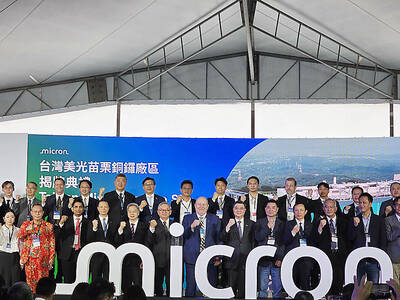
UNPRECEDENTED PACE: Micron Technology has announced plans to expand manufacturing capabilities with the acquisition of a new chip plant in Miaoli Micron Technology Inc unveiled a newly acquired chip plant in Miaoli County yesterday, as the company expands capacity to meet growing demand for advanced DRAM chips, including high-bandwidth memory chips amid the artificial intelligence boom. The plant in Miaoli County’s Tongluo Township (銅鑼), which Micron acquired from Powerchip Semiconductor Manufacturing Corp (力積電) for US$1.8 billion, is expected to make a sizeable capacity contribution to the company from fiscal 2028, the company said in a statement. It would be an extended production site of Micron’s large-scale manufacturing hub in Taichung, the company said. As the global semiconductor industry is racing to reach US$1 trillion

Singapore-based ride-hailing and delivery giant Grab Holdings Ltd has applied for regulatory approval to acquire the Taiwan operations of Germany-based Delivery Hero SE's Foodpanda in a deal valued at about US$600 million. Grab submitted the filing to the Fair Trade Commission on Friday last week, with the transaction subject to regulatory review and approval, the company said in a statement yesterday. Its independent governance structure would help foster a healthy and competitive market in Taiwan if the deal is approved, Grab said. Grab, which is listed on the NASDAQ, said in the filing that US-based Uber Technologies Inc holds about 13 percent of
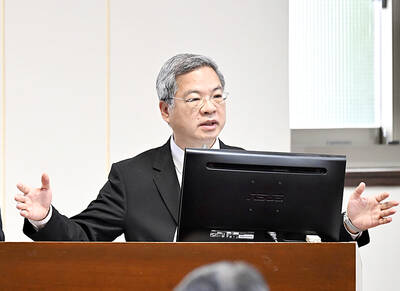
ABOVE LEGAL REQUIREMENT: The Ministry of Economic Affairs is prepared if LNG supply is disrupted, with more than the legal requirement of 11 days of inventory Taiwan has largely secured liquefied natural gas (LNG) supplies through May and arranged about half of June’s supply, Minister of Economic Affairs Kung Ming-hsin (龔明鑫) said yesterday. Since the Middle East conflict began on Feb. 28, Taiwan’s LNG inventories have remained more than 12 days, exceeding the legal requirement of 11 days, indicating no major supply concerns for domestic gas and electricity, Kung said at a meeting of the legislature’s Economics Committee in Taipei. The ministry aims to increase the figure to 14 days by the end of next year, he said. While one or two LNG or crude oil shipments for May

Taiwan’s food delivery market could undergo a major shift if Singapore-based Grab Holdings Ltd completes its planned acquisition of Delivery Hero SE’s Foodpanda business in Taiwan, industry experts said. Grab on Monday last week announced it would acquire Foodpanda’s Taiwan operations for US$600 million. The deal is expected to be finalized in the second half of this year, with Grab aiming to complete user migration to its platform by the first half of next year. A duopoly between Uber Eats and Foodpanda dominates Taiwan’s delivery market, a structure that has remained intact since the Fair Trade Commission (FTC) blocked Uber Technologies Inc’s


 RSS
RSS