


Tax revenue from securities transactions last month increased 41.9 percent from a year earlier to NT$30.3 billion (US$975.8 million), rising on an annual basis for the third consecutive month and marking the highest for the month of October as Taiwanese stocks continued to perform strongly, data released by the Ministry of Finance showed yesterday.
Last month, the TAIEX surged 2,412.81 points, or 9.34 percent, marking its largest-ever monthly rise for October as market sentiment was buoyed by a nearly 15 percent gain in contract chipmaker Taiwan Semiconductor Manufacturing Co (TSMC, 台積電), which accounts for more than 40 percent of the main board’s capitalization. The TAIEX also surpassed the 28,000-point mark for the first time.
Average daily turnover of the local stock market rose to NT$626.7 billion last month, up 45.4 percent from a year earlier, the ministry said in a statement.
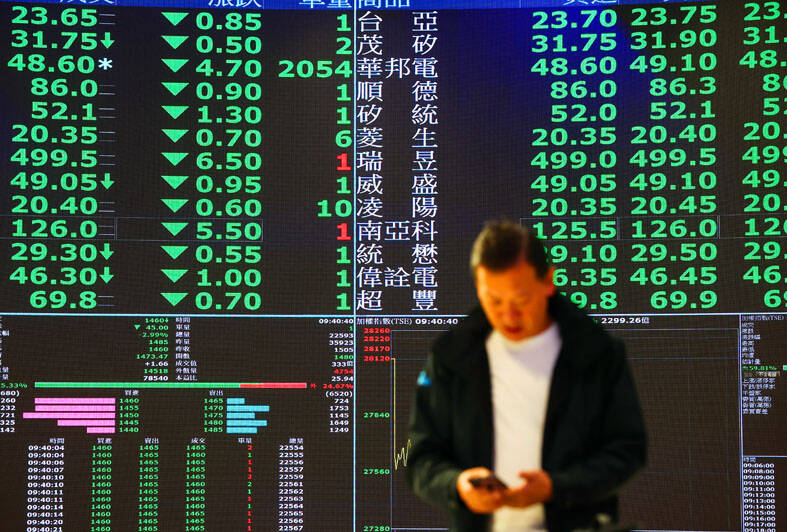
Photo: CNA
However, the US government shutdown, US Federal Reserve Chair Jerome Powell’s hawkish remarks and concerns about an artificial intelligence bubble have dampened the market’s risk appetite. Coupled with mixed corporate earnings results lately, the TAIEX is likely to shift to a consolidation pattern in the near term, casting a shadow over securities transaction tax revenue this month.
The TAIEX yesterday closed down 84.56 points, or 0.30 percent, at 27,784.95, after several large-cap tech stocks, including TSMC, pared early gains on profit-taking.
In the first 10 months of this year, cumulative tax revenue from securities transactions totaled NT$228.6 billion, down 5.5 percent from the same period last year, ministry data showed.
The decline came as the local bourse was affected by US tariff policies during the first half of the year, with average daily turnover dropping 5.1 percent to NT$463.2 billion over the period, the ministry said.
Overall, the nation last month collected NT$417.4 billion in tax revenue, up NT$67.6 billion, or 19.3 percent, from a year earlier, the ministry said.
The ministry attributed the growth mainly to increases in corporate income tax revenue, which rose NT$60 billion year-on-year, and securities transaction tax revenue, which climbed NT$8.9 billion from a year earlier.
Meanwhile, business tax revenue posted the largest decline of NT$3 billion year-on-year, and land value increment tax revenue fell by NT$1.7 billion, it said.
In the first 10 months of the year, cumulative tax revenue decreased by NT$6.7 billion, or 0.2 percent, year-on-year to NT$3.29 trillion, mainly as decreases in revenues from securities transactions, business, land value increment and commodity taxes offset the increases in revenue from personal income and corporate income taxes, the ministry said.
The January-to-October figure was 2.2 percent below the government’s budget target for the 10 months and reached 86.5 percent of its full-year target, it said.
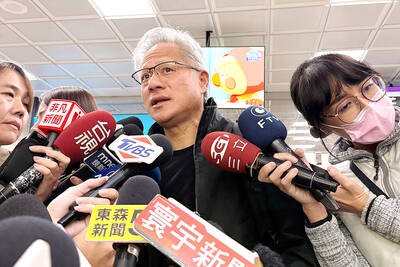
PERSISTENT RUMORS: Nvidia’s CEO said the firm is not in talks to sell AI chips to China, but he would welcome a change in US policy barring the activity Nvidia Corp CEO Jensen Huang (黃仁勳) said his company is not in discussions to sell its Blackwell artificial intelligence (AI) chips to Chinese firms, waving off speculation it is trying to engineer a return to the world’s largest semiconductor market. Huang, who arrived in Taiwan yesterday ahead of meetings with longtime partner Taiwan Semiconductor Manufacturing Co (TSMC, 台積電), took the opportunity to clarify recent comments about the US-China AI race. The Nvidia head caused a stir in an interview this week with the Financial Times, in which he was quoted as saying “China will win” the AI race. Huang yesterday said

Nissan Motor Co has agreed to sell its global headquarters in Yokohama for ¥97 billion (US$630 million) to a group sponsored by Taiwanese autoparts maker Minth Group (敏實集團), as the struggling automaker seeks to shore up its financial position. The acquisition is led by a special purchase company managed by KJR Management Ltd, a Japanese real-estate unit of private equity giant KKR & Co, people familiar with the matter said. KJR said it would act as asset manager together with Mizuho Real Estate Management Co. Nissan is undergoing a broad cost-cutting campaign by eliminating jobs and shuttering plants as it grapples

The Chinese government has issued guidance requiring new data center projects that have received any state funds to only use domestically made artificial intelligence (AI) chips, two sources familiar with the matter told Reuters. In recent weeks, Chinese regulatory authorities have ordered such data centers that are less than 30 percent complete to remove all installed foreign chips, or cancel plans to purchase them, while projects in a more advanced stage would be decided on a case-by-case basis, the sources said. The move could represent one of China’s most aggressive steps yet to eliminate foreign technology from its critical infrastructure amid a

MORE WEIGHT: The national weighting was raised in one index while holding steady in two others, while several companies rose or fell in prominence MSCI Inc, a global index provider, has raised Taiwan’s weighting in one of its major indices and left the country’s weighting unchanged in two other indices after a regular index review. In a statement released on Thursday, MSCI said it has upgraded Taiwan’s weighting in the MSCI All-Country World Index by 0.02 percentage points to 2.25 percent, while maintaining the weighting in the MSCI Emerging Markets Index, the most closely watched by foreign institutional investors, at 20.46 percent. Additionally, the index provider has left Taiwan’s weighting in the MSCI All-Country Asia ex-Japan Index unchanged at 23.15 percent. The latest index adjustments are to


 RSS
RSS