


Nissan Motor Co has agreed to sell its global headquarters in Yokohama for ¥97 billion (US$630 million) to a group sponsored by Taiwanese autoparts maker Minth Group (敏實集團), as the struggling automaker seeks to shore up its financial position.
The acquisition is led by a special purchase company managed by KJR Management Ltd, a Japanese real-estate unit of private equity giant KKR & Co, people familiar with the matter said.
KJR said it would act as asset manager together with Mizuho Real Estate Management Co.
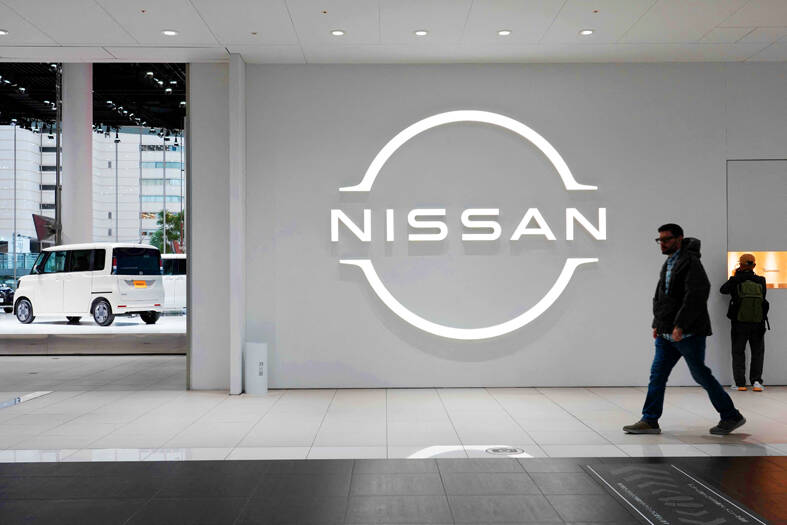
Photo: AFP
Nissan is undergoing a broad cost-cutting campaign by eliminating jobs and shuttering plants as it grapples with its worst financial position in more than two decades.
Operating income in the quarter ended on Sept. 30 was ¥52 billion, the company said yesterday.
However, Nissan withheld a forecast for full-year net income and said it would forgo an interim dividend for the fiscal year ending March next year.
Operating losses widened to ¥177 billion for the first half of the fiscal year, chief financial officer Jeremie Papin told reporters.
Retail sales during the period fell almost 18 percent in China and 17 percent in Japan, outweighing the 2 percent increase in the US, he said.
With investors bracing for a downbeat report following Nissan’s surprise forecast last week of a ¥275 billion annual operating loss — an outlook it reiterated yesterday— Papin struck an upbeat tone for the coming months.
The company expects a strong rebound in sales volumes and “We’re confident the next half will deliver growth,” Papin said.
The carmaker kept its full-year sales outlook at 3.25 million units.
Minth Group is the primary investor in the ¥97 billion transaction, which is part of a 20-year sale and leaseback agreement, Nissan said in a filing.
Nissan stands to make a net gain of about ¥74 billion.
“The proceeds will be used to maintain critical investments, while also enabling modernization of internal systems,” Nissan said.
The transaction would not affect operations or staffing at its headquarters.
“This move reflects a disciplined approach to capital efficiency unlocking value from non-core assets to support transformation during the challenging years,” the carmaker said.
Nissan’s headquarters was originally in Ginza, an upmarket shopping district in Tokyo, but it relocated in 2009 after construction of a new office in Yokohama, where the company was founded.
Chief executive officer Ivan Espinosa pledged earlier this year to cut 20,000 jobs and reduce Nissan’s global manufacturing operations from 17 sites to 10.
MANAGING RISKS: Taiwan has secured LNG sufficient to cover 95 percent of electricity demand for next month, UBS said, describing the government’s approach as proactive UBS Group AG has raised its forecast for Taiwan’s economic growth this year to 8 percent, up from 6.9 percent previously, and said expansion could reach as high as 8.6 percent if external energy shocks are avoided. The upgrade reflects a stronger-than-expected first-quarter performance and sustained momentum in artificial intelligence (AI)-driven exports, which UBS said are providing a firm foundation for growth despite geopolitical and energy risks. Taiwan’s GDP expanded 13.69 percent year-on-year in the first quarter, the fastest growth since the second quarter of 1987, the Directorate-General of Budget, Accounting and Statistics (DGBAS) reported on Thursday. On a seasonally
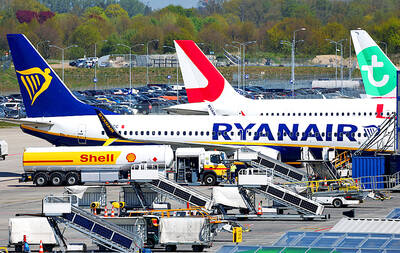
Ryanair, Transavia, Volotea and other low-cost airlines are feeling the financial pain from high jet fuel prices as a result of the Middle East war and are cutting flights. The closure of the Strait of Hormuz has taken a huge chunk of oil supplies off the market, sending the price of jet fuel soaring and triggering fears of shortages that could force airlines to cancel flights. Airlines are not waiting for a lack of supplies to react. “Travel alert: Airlines are cutting thousands of flights right now,” Travel Therapy host Karen Schaler said in an Instagram reel this past weekend.
Shares of Taiwan Semiconductor Manufacturing Co (TSMC, 台積電) have repeatedly hit new highs, but an equity analyst said the stock’s valuation remains within a reasonable range and any pullback would likely be technical. The contract chipmaker’s historical price-to-earnings (P/E) ratio has ranged between 20 and 30, Cathay Futures Consultant Co (國泰證期) analyst Tsai Ming-han (蔡明翰) told Central News Agency. With market consensus projecting that TSMC would post earnings per share of about NT$100 (US$3.17) this year, supported by strong global demand for artificial intelligence (AI) applications, and the stock currently trading at a P/E ratio of below 25, Tsai said the valuation
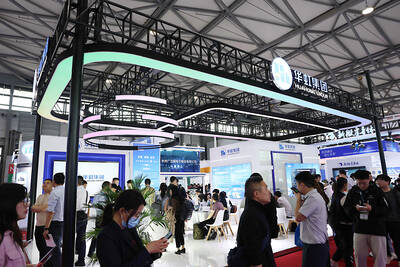
The US Department of Commerce last week ordered multiple chip equipment companies to halt shipments of certain tools to China’s second-largest chipmaker, Hua Hong Semiconductor Ltd (華虹半導體), its latest action to slow the country’s development of advanced chips, two people familiar with the matter said. The department sent letters to at least a handful of companies informing them of restrictions on tools and other materials destined for two Hua Hong facilities US officials believe make China’s most sophisticated chips, the people said. Top US chip equipment companies Lam Research Corp, Applied Materials Inc and KLA Corp, each of which has significant


 RSS
RSS