


Macronix International Co (旺宏) yesterday said chip prices started to pick up, driven by rising demand for NOR flash memory used in high-performance data centers worldwide.
The chipmaker said new data centers are based on Nvidia Corp’s advanced graphics processing units, rather than the x86 central processing units used in the past.
“We found accumulated demand in recent months keeps rising, mostly for data center-related [chips],” Macronix chairman and CEO Miin Wu (吳敏求) told reporters at an annual technology forum arranged by National Cheng Kung University in Tainan.

Photo: CNA
“Demand will be very significant,” Wu said. “We did see increases in price.”
Two weeks ago, Macronix said it had secured “firm orders” from customers to fully utilize its 12-inch fab, marking a dramatic recovery from a utilization ratio of 50 percent a year ago. The company has struggled to swing back to profit amid low factory utilization over the past 3 years.
Wu did not regard the improvement in chip demand and prices as a curtain raiser for a “super cycle” for the memory industry, as some module suppliers imagine. Instead, he offered a more conservative view, saying the psychological factor might have played a part in supply shortages.
“It is very difficult to predict how long it will last,” Wu said. “It looks like industry heavyweights such as Samsung Electronics Co did make some [capacity] adjustments, while some companies are benefiting from such adjustments.”
When asked if the epicycle is due to more fundamental and structural changes in the memory industry, Wu said it was not; there “just so happens to be such a demand.”
Alongside NOR flash memory, Macronix has high hopes for its new low-density embedded multi-media card (eMMC) module business as Samsung is reportedly phasing out of the multi-level cell (MLC) NAND flash memory market and shifting its resources to higher-density memory chips. That indicated that Macronix has a good chance to fill the void left by Samsung.
“Macronix is facing a unique situation concerning eMMC NAND. Everyone is knocking on our door,” Wu said. The company has to be selective, given its limited capacity of MLC NAND flash memory.
The company expects the new eMMC business to generate a revenue stream in about four or five months. MLC NAND flash memory chips are integrated with controllers in eMMC modules for use in a wide range of electronics.
During the technology forum yesterday, Mirle Automation Corp (盟立) chairman Sun Houng (孫弘) said the company is tapping into the new advanced chip packaging area by supplying stocker automation systems.
As semiconductor companies are adopting heavy and large square glass substrates, overtaking 12-inch round substrates, Mirle said it has the advantage in supplying new automated stockers, given its longstanding partnerships with chip packaging companies.
Mirle counts chip packager Powertech Technology Inc (力成科技) as one of its customers.
Powertech is one of the first semiconductor companies in Taiwan heavily investing in advanced chip packaging technology using square glass substrates.

Cairo’s new monorail slices across the city skyline, running above the familiar chaos of blaring horns and aging buses’ exhaust fumes that mark rush hour below. The US$4.5 billion monorail, opened this month, is among Egypt’s most prominent new transport projects, part of a debt-funded infrastructure drive criticized for sapping state finances while bringing limited benefits to most of the country’s 109 million people. “It feels like you’re in a different country,” said Ramy Sayed, a restaurant manager, aboard a driverless Innovia 300 train. “No noise, no traffic, we’re not used to this.” The eastern line runs 56km from the bustling middle-class

Starlux Airlines Co (星宇航空) today unveiled a long-haul network expansion plan at a shareholders’ meeting in Taipei, including direct flights to Barcelona, Spain, and Zurich, Switzerland, as well as a service connecting Taipei, Sydney and New Zealand. Starlux is to become the first Taiwanese carrier to offer non-stop services to the two European cities, while the inaugural oceanic route is expected to expand transit opportunities within the Australia-New Zealand market, Starlux said. Flight services to Chicago, Dallas, Washington and New York are under evaluation, the airline added. Prior to the shareholders’ meeting, the airline earlier this year announced that it would be
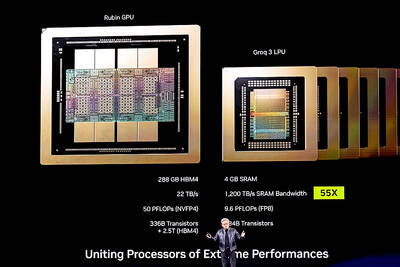
Taiwanese prosecutors suspect that three people successfully smuggled at least one shipment of Nvidia Corp artificial intelligence (AI) chips to China after first exporting them to Japan, people familiar with the matter said. The trio was detained last week by the Keelung District Prosecutors’ Office for allegedly falsifying documents related to exports of Super Micro Computer Inc servers containing advanced Nvidia chips, which the US has barred from sale to China without a license from Washington. The move marked Taiwan’s first public crackdown on AI chip diversion after years of pressure from the US to take a more active role in curtailing
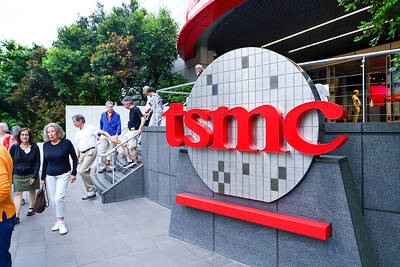
Taiwan Semiconductor Manufacturing Co (TSMC, 台積電) employee bonuses are likely to grow more than 30 percent this year, in line with the past few years as the company’s profits continue to set new records, an anonymous source cited TSMC chairman C.C. Wei (魏哲家) as saying yesterday. TSMC, the world’s largest contract chipmaker, is committed to taking care of its workers, the source said, citing Wei’s meeting with employees yesterday morning. Wei also expressed gratitude to employees for their contribution to the company’s improving bottom line, the source added. Since 2023, TSMC’s employee bonuses have grown at an annual rate of


 RSS
RSS