


China is allowing Dutch chipmaker Nexperia BV to export again, setting the stage for the Netherlands to suspend its powers over the Chinese-owned company.
Signaling a breakthrough in a conflict that threatened to disrupt automotive production around the world, the Dutch government is ready to shelve the measure that gave it the authority to change key corporate decisions, people familiar with the matter said.
That order, which was issued in September by Dutch Minister of Economic Affairs Vincent Karremans, sparked the dispute and could be rescinded as soon as next week if chip flows are confirmed.
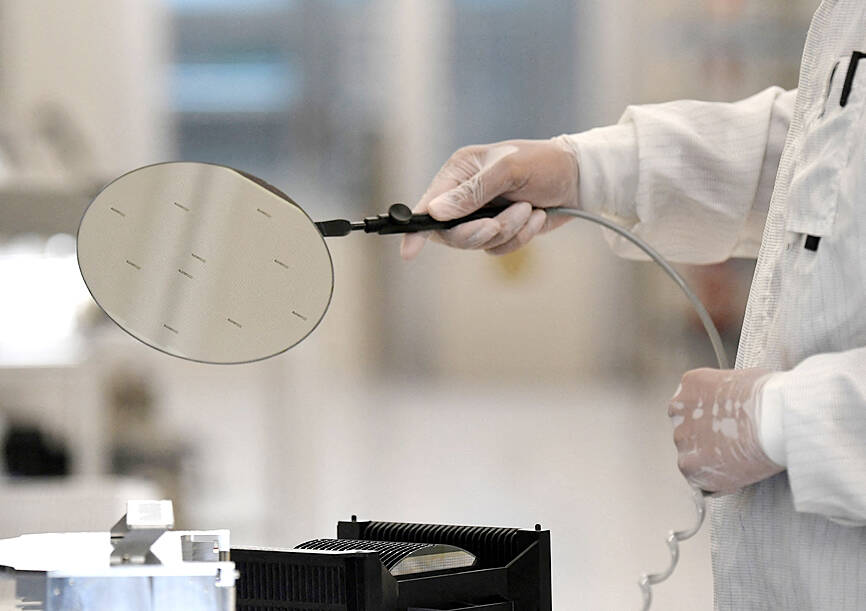
Photo: Reuters
The chips have begun shipping again from Nexperia’s Chinese operations, said officials from several auto companies.
After receiving an export license from China this week, Aumovio SE — a parts manufacturer that supplies Volkswagen AG, Stellantis NV and BMW AG, — has shipped Nexperia semiconductors and components containing them, Aumovio CEO Philipp von Hirschheydt said in an interview.
Von Hirschheydt said he was told the Chinese Ministry of Commerce lifted the broader Nexperia export ban on Friday.
“It will take some time before all procedures and processes will get back to normal,” Von Hirschheydt said.
There’s still a chance for disruptions in the next four to six weeks, but “if everything I know today is correct, we are not going to be affected,” he said.
Shares of Wingtech Technology Co (聞泰科技), the Chinese parent company of Nexperia, surged in the final minutes of trading to close nearly 10 percent higher in Shanghai. European automakers and their suppliers gained on the news. Volkswagen shares climbed as much as 2.7 percent in Frankfurt, with BMW increasing as much as 2.5 percent. Shares of Mercedes-Benz Group AG and Fiat-maker Stellantis also rose.
Honda Motor Co has been told Nexperia’s chip shipments in China have resumed, and the carmaker aims to get disrupted production back on track during the week of Nov. 21, Honda executive vice president Noriya Kaihara said on Friday.
Robert Bosch GmbH is receiving Nexperia chips from China, people familiar with the situation said.
A spokesman for Bosch — one of the world’s largest parts suppliers — declined to comment. As of yesterday morning, there were still production disruptions at several Bosch plants that produce automotive electronics.
However, the situation remains murky. German parts supplier ZF Friedrichshafen AG is preparing for production disruptions including temporary furloughs as a precaution, a company spokesperson said.
“It is unclear to what extent and at what speed deliveries from China could resume,” the spokesperson said. “The situation remains very tense across the industry.”
In a sign of easing tensions, the Dutch government said in a statement late on Thursday that it expects Nexperia’s Chinese unit to resume chip supplies in the coming days, a noticeable softening of its previous stance.

Netherlands-based semiconductor equipment supplier ASML Holding NV yesterday said that it is planning to hire an additional 1,000 people in Taiwan this year in response to growing demand from clients. ASML had previously planned to recruit 600 people this year, but that the plan has been adjusted upward, ASML vice president and ASML Taiwan general manager Grace Wang (汪佳慧) told reporters. ASML has a workforce of more than 4,500 in Taiwan, accounting for about 10 percent of its global total, Wang said. This year’s recruitment campaign would focus on adding people in the customer support, manufacturing and supply chain domains to assist ASML

UNDER MICROSCOPE: Taiwan detained three people who allegedly conspired to buy servers in Taiwan and export them using fraudulent documentation, prosecutors said Nvidia Corp chief executive officer Jensen Huang (黃仁勳) on Saturday urged Super Micro Computer Inc to tighten up on compliance after Taiwan detained three people this week for allegedly making fraudulent declarations about artificial intelligence (AI) servers made by its US partner. The development marked the nation’s first crackdown on semiconductor smuggling, which grew after the US slapped restrictions on exports of high-end chips such as Nvidia AI accelerators to China. Nvidia is “rigorous” in explaining regulations to all of its partners, Huang told reporters after arriving in Taipei. “Ultimately Super Micro has to run their own company,” he said in response to

Nvidia Corp yesterday announced that CEO Jensen Huang (黃仁勳) would attend an employee meeting in Taipei tomorrow to celebrate the launch of the company’s Taiwan headquarters project. Huang would attend a gathering at the site of Nvidia’s planned headquarters in Beitou Shilin Technology Park (北投士林科技園區), the company said in a statement. After arriving in Taiwan on Saturday last week, Huang told reporters that he plans to meet with Quanta Computer Inc (廣達) chairman Barry Lam (林百里) and Taiwan Semiconductor Manufacturing Co (TSMC, 台積電) chairman C.C. Wei (魏哲家), and would attend the groundbreaking ceremony for Nvidia’s Taiwan headquarters tomorrow. Nvidia has not yet applied
Huawei Technologies Co (華為) said it has come up with a new pathway to shorten its gap with industry leader Taiwan Semiconductor Manufacturing Co (TSMC, 台積電), potentially achieving a breakthrough in making advanced semiconductors without cutting-edge equipment. Right now there is about a five-year gap between what TSMC is capable of and what Huawei, together with its manufacturing partner Semiconductor Manufacturing International Corp (中芯), can produce. Huawei is to start making 1.4-nanometer chips by 2031 with its own “LogicFolding” technology, Huawei semiconductor chief He Tingbo (何庭波) said in a rare public appearance during a chip conference yesterday, while TSMC has


 RSS
RSS