


A week that saw the US Federal Reserve cut interest rates and dozens of US companies report earnings boiled down to a single theme: artificial intelligence (AI).
Results from US technology giants showed that the world’s biggest corporations are still pouring billions into AI infrastructure, cheering investors and making a case for betting on the technology. The S&P 500 Index and NASDAQ 100 both advanced for the week and are hovering near fresh records.
Traders were quick to punish companies whose expenditures were not showing enough of a near-term reward — a shift in the once-relentless optimism around AI spending. Worries over massive outlays at Facebook’s parent company, Meta Platforms Inc, sent the company’s shares on their biggest daily drop in three years.
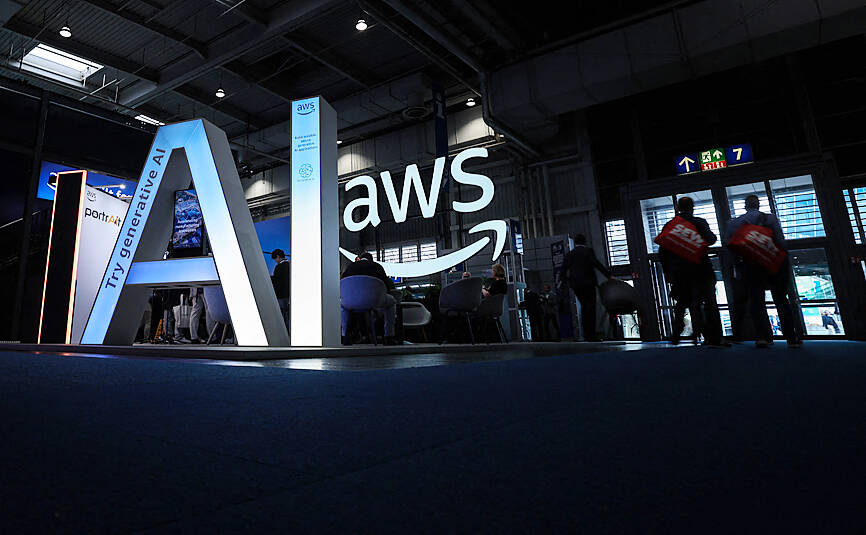
Photo: AFP
Microsoft Corp fell more than 4 percent in two days after revenue growth in its cloud-computing business failed to impress investors.
“We’re starting to see, in some cases, a discipline check that investors are putting on companies,” Charles Schwab & Co macro research and strategy director Kevin Gordon said. “At some point we will have to have some proof about what return can come from this investment.”
By contrast, investors were more sanguine about big spending at Amazon.com Inc and Alphabet Inc. Accelerating growth at Amazon Web Services helped send the company’s stock up clost to 10 percent on Friday, despite a big jump in capital expenditures.
Google’s parent company Alphabet rallied 2.5 percent on Thursday, fueled by surging demand for its cloud and AI services.
AI spending alone is unlikely to satisfy investors, who are laser-focused on revenue growth, analysts said.
“This is the first quarter we’ve seen where more [capital expenditure] wasn’t uniformly rewarded,” Jensen Investment Management Inc portfolio manager Allen Bond said. “There’s more focus on return on invested capital.”
“Big Tech” companies as a whole delivered earnings growth that beat Wall Street estimates, providing a measure of comfort for investors who had grown nervous over a richly valued stock market.
With earnings reports now in from six of the so-called Magnificent Seven, which includes Tesla Inc, quarterly profit growth is tracking at about 27 percent for the group, compared with the 15 percent expansion anticipated before the reporting season started, according to data compiled by Bloomberg Intelligence.
“Tech estimates were rising ahead of these results, and they’re still beating the higher bar,” Gordon said. “That’s a very healthy support for the market.”
While the earnings reports provided a lot to like for the AI trade, investors have to wait three more weeks to hear from what is the industry’s biggest bellwether — Nvidia Corp, whose chips dominate the market for AI computing. Its shares surged almost 9 percent last week, making it the first company to reach a market value of US$5 trillion.
Nvidia is scheduled to report on Nov. 19 and expectations are high — especially after chief executive officer Jensen Huang (黃仁勳) gave a strong outlook for growth at an event in Washington last week. Given the company’s central role in the industry, any disappointments in its results could ripple widely.
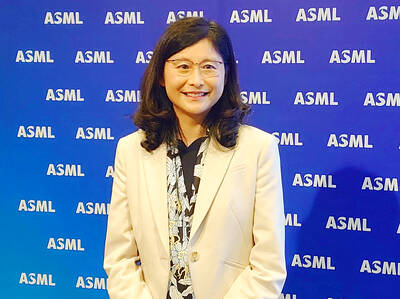
Netherlands-based semiconductor equipment supplier ASML Holding NV yesterday said that it is planning to hire an additional 1,000 people in Taiwan this year in response to growing demand from clients. ASML had previously planned to recruit 600 people this year, but that the plan has been adjusted upward, ASML vice president and ASML Taiwan general manager Grace Wang (汪佳慧) told reporters. ASML has a workforce of more than 4,500 in Taiwan, accounting for about 10 percent of its global total, Wang said. This year’s recruitment campaign would focus on adding people in the customer support, manufacturing and supply chain domains to assist ASML
UNDER MICROSCOPE: Taiwan detained three people who allegedly conspired to buy servers in Taiwan and export them using fraudulent documentation, prosecutors said Nvidia Corp chief executive officer Jensen Huang (黃仁勳) on Saturday urged Super Micro Computer Inc to tighten up on compliance after Taiwan detained three people this week for allegedly making fraudulent declarations about artificial intelligence (AI) servers made by its US partner. The development marked the nation’s first crackdown on semiconductor smuggling, which grew after the US slapped restrictions on exports of high-end chips such as Nvidia AI accelerators to China. Nvidia is “rigorous” in explaining regulations to all of its partners, Huang told reporters after arriving in Taipei. “Ultimately Super Micro has to run their own company,” he said in response to

Nvidia Corp yesterday announced that CEO Jensen Huang (黃仁勳) would attend an employee meeting in Taipei tomorrow to celebrate the launch of the company’s Taiwan headquarters project. Huang would attend a gathering at the site of Nvidia’s planned headquarters in Beitou Shilin Technology Park (北投士林科技園區), the company said in a statement. After arriving in Taiwan on Saturday last week, Huang told reporters that he plans to meet with Quanta Computer Inc (廣達) chairman Barry Lam (林百里) and Taiwan Semiconductor Manufacturing Co (TSMC, 台積電) chairman C.C. Wei (魏哲家), and would attend the groundbreaking ceremony for Nvidia’s Taiwan headquarters tomorrow. Nvidia has not yet applied
Huawei Technologies Co (華為) said it has come up with a new pathway to shorten its gap with industry leader Taiwan Semiconductor Manufacturing Co (TSMC, 台積電), potentially achieving a breakthrough in making advanced semiconductors without cutting-edge equipment. Right now there is about a five-year gap between what TSMC is capable of and what Huawei, together with its manufacturing partner Semiconductor Manufacturing International Corp (中芯), can produce. Huawei is to start making 1.4-nanometer chips by 2031 with its own “LogicFolding” technology, Huawei semiconductor chief He Tingbo (何庭波) said in a rare public appearance during a chip conference yesterday, while TSMC has


 RSS
RSS