


The global server market is expected to surge 80 percent to US$455.41 billion this year, up from US$253.02 billion last year, driven by accelerated infrastructure expansion among cloud service providers (CSPs), International Data Corp (IDC) said in a report on Tuesday.
Non-x86 server systems are expected to grow 169.5 percent year-on-year, while x86 systems are expected to expand 57.9 percent, the US-based market researcher said.
IDC projects a further 24.3 percent growth next year, bringing total market value to US$565.9 billion.
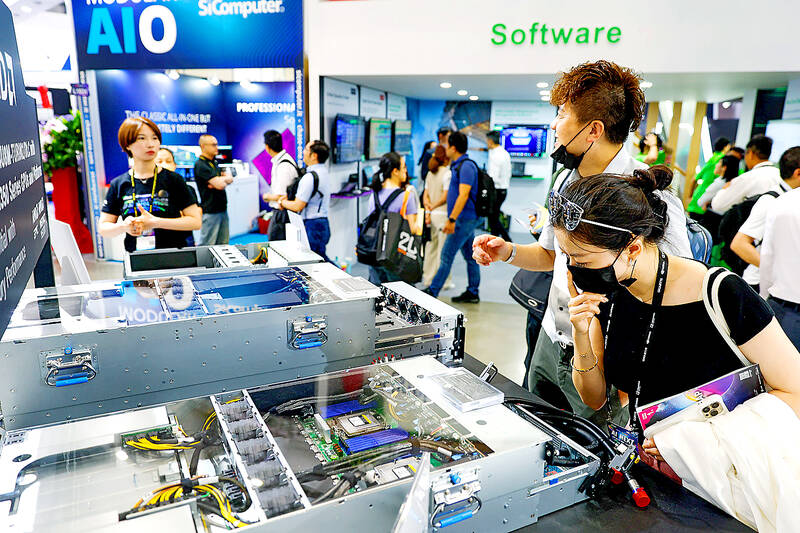
Photo: RITCHIE B. TONGO, EPA-EFE
Despite macro challenges such as slowing economic activity, supply chain disruptions, geopolitical conflicts and rising tariffs, rapid advances in artificial intelligence (AI) continue to fuel demand for high-performance servers, it said.
Large CSPs are expected to continue their accelerated infrastructure build-outs over the next five years, while other enterprises are expected to balance between on-premises deployments and cloud-based AI investments, it said.
That trend is expected to support a compound annual growth rate of 28.7 percent in the server market through 2029, it added.
The combined capital expenditure of the world’s eight largest CSPs is forecast to jump 61 percent year-on-year to US$420 billion this year, as they ramp up investments in server racks powered by Nvidia Corp’s graphics processing units and boost spending on data centers and in-house application-specific integrated circuit design, Taipei-based market researcher TrendForce Corp (集邦科技) said earlier this month.
The eight CSPs are: Google, Amazon Web Services, Meta Platforms Inc, Microsoft Corp, Oracle Corp, Tencent Holdings Ltd (騰訊), Alibaba Group Holding Ltd (阿里巴巴) and Baidu Inc (百度), TrendForce said.
This year, servers powered by Nvidia’s GB200 and GB300 chips are expected to be the main targets for CSPs, driven by higher-than-expected demand, it said.
Next year, their total capital expenditure is projected to rise a further 24 percent to more than US$520 billion and reach a new record high, as server shipments such as Nvidia’s GB and Vera Rubin series are expected to increase, TrendForce said.

NEW IDENTITY: Known for its software, India has expanded into hardware, with its semiconductor industry growing from US$38bn in 2023 to US$45bn to US$50bn India on Saturday inaugurated its first semiconductor assembly and test facility, a milestone in the government’s push to reduce dependence on foreign chipmakers and stake a claim in a sector dominated by China. Indian Prime Minister Narendra Modi opened US firm Micron Technology Inc’s semiconductor assembly, test and packaging unit in his home state of Gujarat, hailing the “dawn of a new era” for India’s technology ambitions. “When young Indians look back in the future, they will see this decade as the turning point in our tech future,” Modi told the event, which was broadcast on his YouTube channel. The plant would convert

Nanya Technology Corp (南亞科技) yesterday said the DRAM supply crunch could extend through 2028, as the artificial intelligence (AI) boom has led the world’s major memory makers to dramatically reduce production of standard DRAM and allocate a significant portion of their capacity for high-bandwidth memory (HBM) chips. The most severe supply constraints would stretch to the first half of next year due to “very limited” increases in new DRAM capacity worldwide, Nanya Technology president Lee Pei-ing (李培瑛) told a news briefing. The company plans to increase monthly 12-inch wafer capacity to 20,000 in the first half of 2028 after a
Property transactions in the nation’s six special municipalities plunged last month, as a lengthy Lunar New Year holiday combined with ongoing credit tightening dampened housing market activity, data compiled by local land administration offices released on Monday showed. The six cities recorded a total of 10,480 property transfers last month, down 42.5 percent from January and marking the second-lowest monthly level on record, the data showed. “The sharp drop largely reflected seasonal factors and tighter credit conditions,” Evertrust Rehouse Co (永慶房屋) deputy research manager Chen Chin-ping (陳金萍) said. The nine-day Lunar New Year holiday fell in February this year, reducing

Zimbabwe’s ban on raw lithium exports is forcing Chinese miners to rethink their strategy, speeding up plans to process the metal locally instead of shipping it to China’s vast rechargeable battery industry. The country is Africa’s largest lithium producer and has one of the world’s largest reserves, according to the US Geological Survey (USGS). Zimbabwe already banned the export of lithium ore in 2022 and last year announced it would halt exports of lithium concentrates from January next year. However, on Wednesday it imposed the ban with immediate effect, leaving unclear what the lithium mining sector would do in the


 RSS
RSS