


It is a grey morning in Shadwell, east London, but inside the old shell of Tobacco Dock, the gloom gives way to pulsating neon lights, flashy cars and cryptocurrency chatter.
Evangelists for Web3, a vision for the next era of the Internet, have descended on the old trading dock to network for two days. For many, the main event is one man: Reform Party leader and British MP Nigel Farage.
“Whether you like me or don’t like me is irrelevant, I’m actually a champion for this space,” Farage tells the audience of largely male crypto fanatics at the Zebu Live conference.
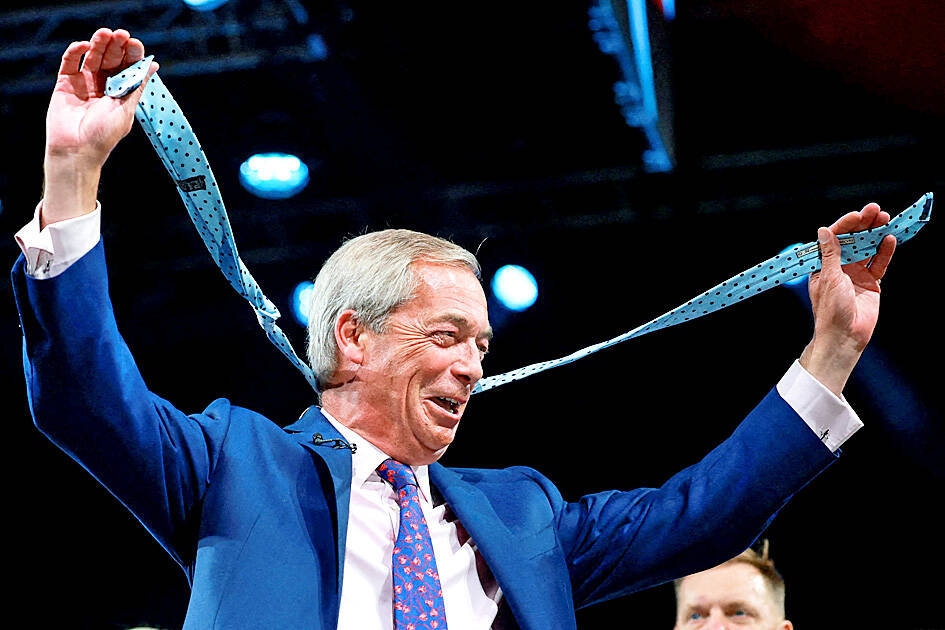
Photo: Reuters
“Either I’m here to support your community, or your community is here to support me, but either way, this is a trade that works for both of us,” he said.
It is a transactional relationship that Farage is trying to nurture, aping US President Donald Trump’s playbook in the hope that it could grow into a funding base for his next election campaign.
Reform this year became the first major party in the UK to accept donations through bitcoin and other cryptocurrencies.
Farage is now hitting the circuit, attenders at the conference say. A week ago, he appeared at the Digital Assets Summit in nearby Old Billingsgate.
“I want to bring digital assets and crypto in from the cold in London,” he told the Zebu event.
“I realized after being debanked, [cryptocurrency] is the ultimate freedom: being in control securely of your own money, making your own decisions, free from authoritarian government,” he said.
It is an idea that strikes a chord with the libertarian streak among crypto fans, who value the digital currencies for their anonymity and independence from traditional finance.
Many of them became even more anti-establishment following Farage’s dispute with British bank NatWest after it closed his accounts — and they are cheering the Reform leader on, tweeting selfies as he speaks.
It helps that Farage’s hustler shtick is tailor-made for crypto: He said he would have been a crypto trader in the 1980s, adding that he likes to dabble.
His message also seems to chime with many young entrepreneurs, who advocate an anonymized Internet that permeates every aspect of life, while allowing them to get rich quick.
The flashier the better, it seems: at the entrance to the conference, a black Rolls-Royce Wraith convertible advertises CryptoAutos, a platform that allows people to buy or rent cars with cryptocurrency.
The conference is full of new tech, freebies and toys. In one corner, Sam Altman’s start-up Worldcoin displays its silver orbs, inviting passersby to have their eyeballs scanned as part of a project to use biometric verification to distinguish humans from artificial intelligence systems.
It starts deceptively quietly. A panel on how to manage crypto taxation, “HMRC [His Majesty’s Revenue and Customs] and the Ledger of Secrets,” attracts no more than 40 people in a room that could easily seat 200. It is only in the afternoon, when Farage’s keynote speech nears, that the event begins to liven up.
“I don’t like him,” one attender said, “but if he can make people’s daily lives in this industry easier, then people will want to listen to what he has to say ... even if they may not agree with his politics.”
Farage is the only major political leader in the UK who has made his stance on cryptocurrency clear — and, in a move that would probably win over much of this crowd in east London, has said he would introduce a bill to cut capital gains tax on crypto assets from 24 percent to 10 percent.
British Prime Minister Keir Starmer’s government has said it wants the UK to become a leader in the tokenization of securities, but neither Starmer nor Conservative leader Kemi Badenoch have been vocal on the topic. For Farage, this small, but well-funded group of crypto fans could be ripe for the taking.
However, there are grumblings of discontent about his cozying up to the sector. Simon Jones, an investor in the open finance startup Baanx, pulled out of the event after Farage’s attendance was announced, saying the conference had turned into a “political festival.”
“He’s just there on a campaign platform, even though it is an industry event, and there is no real scrutiny of him,” Jones said.
“He is taking out of Donald Trump’s playbook and enacting it here. Trump went pro in this sector and raised a lot of money,” he said.
The US president has raised millions of US dollars in political donations from cryptocurrency billionaires alongside other big tech companies, and his family’s crypto ventures have soared in value, boosting the Trumps’ fortunes.
Crypto donations in the UK are falling under more scrutiny amid worries they could obscure the sources of party funding and open the door to hostile foreign actors.
Academics at the UK-based Centre for Finance and Security and the Royal United Services Institute have launched a study on the possible democratic, security and transparency risks posed by these donations.
However, as the conference crowd spills into the nightclub on the other side of the road for the after-party, many seem unfazed that they could hold the key to Farage’s route to power.
“Nigel Farage is one of the only politicians who likes crypto,” one conference-goer said. “It’s smart for him to be here. If crypto people like him, then there’s a lot he can get.”

HORMUZ ISSUE: The US president said he expected crude prices to drop at the end of the war, which he called a ‘minor excursion’ that could continue ‘for a little while’ The United Arab Emirates (UAE) and Kuwait started reducing oil production, as the near-closure of the crucial Strait of Hormuz ripples through energy markets and affects global supply. Abu Dhabi National Oil Co (ADNOC) is “managing offshore production levels to address storage requirements,” the company said in a statement, without giving details. Kuwait Petroleum Corp said it was lowering production at its oil fields and refineries after “Iranian threats against safe passage of ships through the Strait of Hormuz.” The war in the Middle East has all but closed Hormuz, the narrow waterway linking the Persian Gulf to the open seas,

Apple Inc increased iPhone production in India by about 53 percent last year and now makes a quarter of its marquee devices there, reflecting the US company’s efforts to avoid tariffs on China. The company assembled about 55 million iPhones in India last year, up from 36 million a year earlier, people familiar with the matter said, asking not to be named because the numbers aren’t public. Apple makes about 220 million to 230 million iPhones a year globally, with India’s share of the total increasing rapidly. Apple has accelerated its expansion in the world’s most populous country in recent years, bolstered
HEADWINDS: The company said it expects its computer business, as well as consumer electronics and communications segments to see revenue declines due to seasonality Pegatron Corp (和碩) yesterday said it aims to grow its artificial intelligence (AI) server revenue more than 10-fold this year from last year, driven by orders from neocloud solutions clients and large cloud service providers. The electronics manufacturing service provider said AI server revenue growth would be driven primarily by the Nvidia Corp GB300 server platform. Server shipments are expected to increase each quarter this year, with the second half likely to outperform the first half, it said. The AI server market is expected to broaden this year as more inference applications emerge, which would drive demand for system-on-chip, application-specific integrated circuits
PROJECTION: TSMC said it expects strong growth this year, with revenue in US dollars projected to grow by about 30 percent, outperforming the industry Taiwan Semiconductor Manufacturing Co (TSMC, 台積電) yesterday reported consolidated sales last month reached NT$317.66 billion (US$9.98 billion), the highest ever for the month of February, driven by robust demand for chips built using the company’s advanced 3-nanometer (3nm) process. Last month’s figure was up 22.2 percent from a year earlier, but fell 20.8 percent from January, the world’s largest contract chipmaker said in a statement. For the first two months of the year, TSMC posted cumulative sales of NT$718.91 billion, up 29.9 percent from a year earlier. Analysts attributed the growth to sustained global demand for artificial intelligence (AI) products


 RSS
RSS