


ASRock Rack Inc (永擎), which produces server motherboards and rackmount servers, yesterday said it expects fourth-quarter revenue to rise about 5 percent from the previous quarter, driven by demand for artificial intelligence (AI) products, including Nvidia Corp’s HGX B200 servers.
Although shipment volumes are likely to remain flat, the average selling price of its products is projected to increase, supporting overall revenue growth, ASRock Rack vice president Hunter Chen (陳式仁) said on the sidelines of a business presentation in Taipei, ahead of the company’s main board debut next month.
The company — a subsidiary of iPhone assembler Pegatron Corp (和碩) — earlier this month reported third-quarter revenue of NT$6.63 billion (US$216.3 million), up 193 percent from a year earlier.
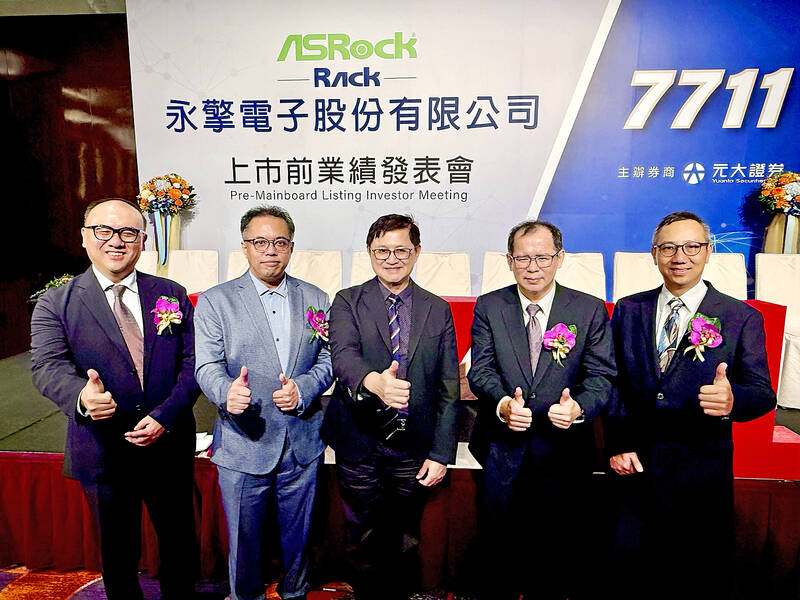
Photo: Fang Wei-chieh, Taipei Times
Revenue for the first nine months totaled NT$17.51 billion, a 266.2 percent annual increase.
AI server-related products, which include servers such as the B200 and B300 platforms, accounted for 80 percent of the company’s sales during the period, followed by general-purpose server motherboards at 10 percent and general-purpose server systems at another 10 percent, the company said.
The company has been shipping small volumes of Nvidia’s RTX Pro 6000 servers since the previous quarter, which are expected to contribute to revenue in the second quarter of next year, in line with its previous guidance, Chen said.
The company has order visibility across its three main product lines through the first quarter of next year, he said.
The company’s general-purpose server business this quarter is likely to surpass the previous quarter’s performance, supported by rising demand from tier-2 and tier-3 cloud service providers (CSPs), chairman L.L. Shiu (許隆倫) said.
Tier-2 CSPs refer to smaller or regional cloud infrastructure operators that provide data storage, computing and AI services, but operate on a smaller scale than hyperscalers, Shiu said.
The outlook for AI server-related products also remains strong, with clients’ forecasts staying positive, he said.
However, the supply of key materials — including those for Nvidia’s B200 and B300 platforms — has tightened since the end of last month, delaying deliveries by two to three weeks, he added.
The company said its clients are mainly global AI start-ups, such as computing power rental suppliers.
It also counts US data center infrastructure operators and tier-2 CSPs, as well as European automation developers and Asian system integrators, among its clients, it added.
Headquartered in Taipei, the firm operates warehousing and after-sales service centers in California and the Netherlands, with production sites in Taoyuan, China’s Shenzhen and Vietnam.
Its motherboards and graphics cards are manufactured in China, Vietnam and Taiwan, and can be shipped from Taiwan to US customers upon request for specific production sites, with overall capacity remaining sufficient, Shiu said.
While system assembly capacity remains tight at this stage, it is expected to stabilize next month, he said.
If customers request production in the US, the company would consider working with existing partners, but has no plans to build its own production lines, he added.
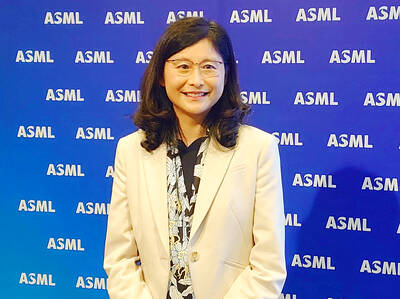
Netherlands-based semiconductor equipment supplier ASML Holding NV yesterday said that it is planning to hire an additional 1,000 people in Taiwan this year in response to growing demand from clients. ASML had previously planned to recruit 600 people this year, but that the plan has been adjusted upward, ASML vice president and ASML Taiwan general manager Grace Wang (汪佳慧) told reporters. ASML has a workforce of more than 4,500 in Taiwan, accounting for about 10 percent of its global total, Wang said. This year’s recruitment campaign would focus on adding people in the customer support, manufacturing and supply chain domains to assist ASML
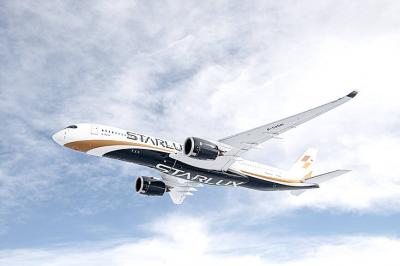
Starlux Airlines Co (星宇航空) today unveiled a long-haul network expansion plan at a shareholders’ meeting in Taipei, including direct flights to Barcelona, Spain, and Zurich, Switzerland, as well as a service connecting Taipei, Sydney and New Zealand. Starlux is to become the first Taiwanese carrier to offer non-stop services to the two European cities, while the inaugural oceanic route is expected to expand transit opportunities within the Australia-New Zealand market, Starlux said. Flight services to Chicago, Dallas, Washington and New York are under evaluation, the airline added. Prior to the shareholders’ meeting, the airline earlier this year announced that it would be
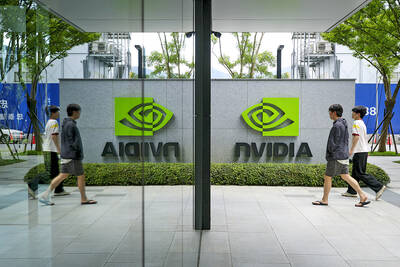
UNDER MICROSCOPE: Taiwan detained three people who allegedly conspired to buy servers in Taiwan and export them using fraudulent documentation, prosecutors said Nvidia Corp chief executive officer Jensen Huang (黃仁勳) on Saturday urged Super Micro Computer Inc to tighten up on compliance after Taiwan detained three people this week for allegedly making fraudulent declarations about artificial intelligence (AI) servers made by its US partner. The development marked the nation’s first crackdown on semiconductor smuggling, which grew after the US slapped restrictions on exports of high-end chips such as Nvidia AI accelerators to China. Nvidia is “rigorous” in explaining regulations to all of its partners, Huang told reporters after arriving in Taipei. “Ultimately Super Micro has to run their own company,” he said in response to

Nvidia Corp yesterday announced that CEO Jensen Huang (黃仁勳) would attend an employee meeting in Taipei tomorrow to celebrate the launch of the company’s Taiwan headquarters project. Huang would attend a gathering at the site of Nvidia’s planned headquarters in Beitou Shilin Technology Park (北投士林科技園區), the company said in a statement. After arriving in Taiwan on Saturday last week, Huang told reporters that he plans to meet with Quanta Computer Inc (廣達) chairman Barry Lam (林百里) and Taiwan Semiconductor Manufacturing Co (TSMC, 台積電) chairman C.C. Wei (魏哲家), and would attend the groundbreaking ceremony for Nvidia’s Taiwan headquarters tomorrow. Nvidia has not yet applied


 RSS
RSS