


OpenAI on Monday touted new partnerships to incorporate its artificial intelligence (AI) products across diverse industries at its developer conference, aiming to drive the strong momentum it has enjoyed among consumers to its enterprise business.
“You should expect a huge focus from us on really leaning into enterprise,” OpenAI CEO Sam Altman told journalists at a news conference following his keynote at San Francisco’s Fort Mason Center.
The company revealed a flurry of collaborations with companies including Spotify Technology SA, Zillow Group Inc and Mattel Inc, while debuting a set of fresh tools to help developers build new applications.
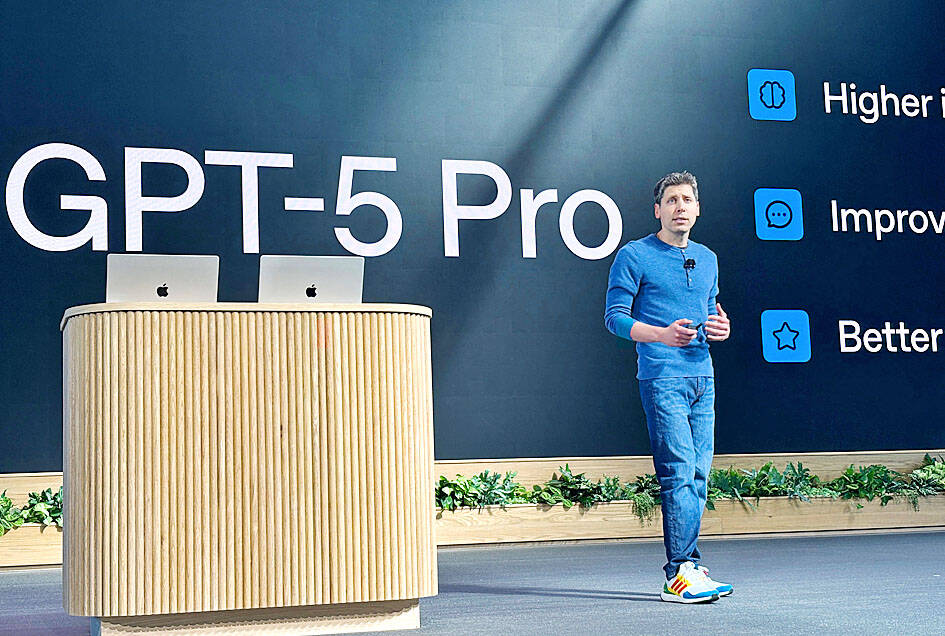
Photo: AFP
That included a way for other apps to plug into ChatGPT and allow a user to ask questions or perform tasks in the app. One engineer gave a live demonstration showing how someone could use ChatGPT to generate a readymade playlist in Spotify, or ask Zillow to narrow down a list of properties to just show those with three bedrooms and three bathrooms.
Executives said it was the start of a broader vision of transforming ChatGPT into a central portal where users can access a broader range of services.
“What you’re going to see over the next six months is an evolution of ChatGPT from an app that is really, really useful into something that feels a little bit more like an operating system,” ChatGPT head Nick Turley said.
OpenAI president Greg Brockman added that the company was “committed to building the best enterprise platform.”
Spotify said in a statement about its partnership that it would not share user data with OpenAI to train models.
Asked if the same policy applied to the other deals, Turley said it would abide by the preferences users selected in their data settings.
OpenAI had always planned to target the enterprise market, but its AI models were not previously ready for the higher demands of business-use cases, Altman said.
“We needed to let the models get better. The models are there now,” he said, adding that the company had selected “a few active early partnerships.”
The work that went into its models’ self-claimed gold medal performance at the International Mathematical Olympiad would generate benefits for enterprises in other ways, Brockman said.
OpenAI and other tech giants such as Alphabet Inc and Microsoft Corp have courted enterprise AI deals to help justify massive spikes in spending, although the returns across the industry have so far failed to match investment, surveys showed.
The ChatGPT-maker last month outlined ambitious plans to build US$1 trillion or more of computing capacity and launched a viral AI-video-generating app called Sora, which has shot to the top of Apple Inc’s app rankings.
All this has made OpenAI a massive money-losing operation to date.
Altman said it was “not in my top 10 concerns, but we obviously someday have to be very profitable.”
Monday’s moves are the latest in a stream of announcements for OpenAI. However, many of Altman’s ambitions are bold and expensive even by Silicon Valley standards, sparking some concerns among tech investors about whether or not AI investments are a bubble.
Altman said during the question-answer session that many areas of the AI industry are “kind of bubbly,” but that “real value will get created.”

ENERGY ISSUES: The TSIA urged the government to increase natural gas and helium reserves to reduce the impact of the Middle East war on semiconductor supply stability Chip testing and packaging service provider ASE Technology Holding Co (日月光投控) yesterday said it planned to invest more than NT$100 billion (US$3.15 billion) in building a new advanced chip testing facility in Kaohsiung to keep up with customer demand driven by the artificial intelligence (AI) boom. That would be included in the company’s capital expenditure budget next year, ASE said. There is also room to raise this year’s capital spending budget from a record-high US$7 billion estimated three months ago, it added. ASE would have six factories under construction this year, another record-breaking number, ASE chief operating officer Tien Wu

The EU and US are nearing an agreement to coordinate on producing and securing critical minerals, part of a push to break reliance on Chinese supplies. The potential deal would create incentives, such as minimum prices, that could advantage non-Chinese suppliers, according to a draft of an “action plan” seen by Bloomberg. The EU and US would also cooperate on standards, investments and joint projects, as well as coordinate on any supply disruptions by countries like China. The two sides are additionally seeking other “like-minded partners” to join a multicountry accord to help create these new critical mineral supply chains, which feed into

For weeks now, the global tech industry has been waiting for a major artificial intelligence (AI) launch from DeepSeek (深度求索), seen as a benchmark for China’s progress in the fast-moving field. More than a year has passed since the start-up put Chinese AI on the map in early last year with a low-cost chatbot that performed at a similar level to US rivals. However, despite reports and rumors about its imminent release, DeepSeek’s next-generation “V4” model is nowhere in sight. Speculation is also swirling over the geopolitical implications of which computer chips were chosen to train and power the new

TECH WINNERS: Taiwan and South Korea reported robust trade, which suggests that they have critical advantages in the rapidly expanding AI supply chain, an official said Exports last month surged to a new high, as booming demand tied to artificial intelligence (AI) infrastructure fueled shipments of advanced technology components, underscoring the nation’s pivotal role in the global semiconductor supply chain. Outbound shipments climbed to US$80.18 billion, the highest ever for a single month, rising 61.8 percent from a year earlier and marking the 29th consecutive month of growth, the Ministry of Finance said yesterday. “The surge was driven primarily by global investment in AI infrastructure,” Department of Statistics Director-General Beatrice Tsai (蔡美娜) said. The mass production of next-generation AI computing systems has accelerated procurement across the semiconductor supply


 RSS
RSS