


Cloud computing equipment supplier Wiwynn Corp (緯穎科技) yesterday said that order momentum for artificial intelligence (AI) servers is expected to extend into next year and beyond, driven by rising demand for graphics processing unit (GPU) and application-specific integrated circuit (ASIC) servers.
“We are very optimistic about next year’s business and confident that this year will see immense annual growth, as revenue has already expanded more than 200 percent at this stage,” Wiwynn chairwoman Emily Hong (洪麗甯) said on the sidelines of an event in Taipei.
Wiwynn’s revenue in the first eight months of this year was NT$571.9 billion (US$18.8 billion), up 171.8 percent from a year earlier.
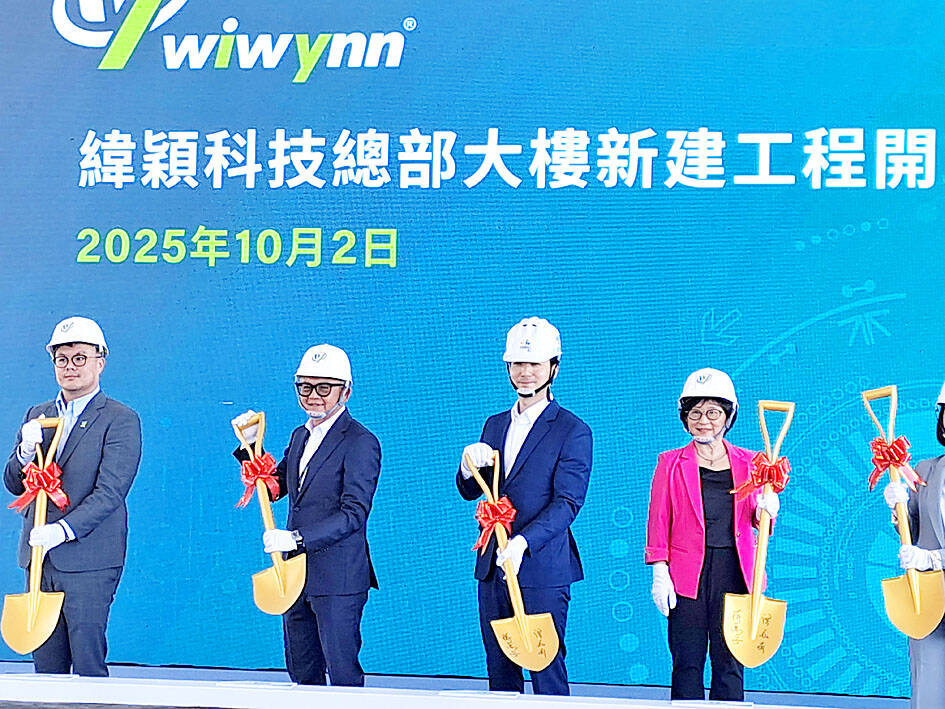
Photo: CNA
The company’s performance last quarter also exceeded expectations, Hong said, attributing it mainly to ASIC-powered servers.
Revenue contribution from Nvidia Corp’s GPU-powered servers is expected to increase next year, she said.
As companies such as Nvidia, OpenAI and Oracle Corp expand investment in AI, demand for the company’s products is expected to continue rising next year, Wiwynn CEO and president William Lin (林威遠) said.
To cope with the strong order momentum for its AI servers, the company has also been building plants in the Southern Taiwan Science Park (南部科學園區) in Tainan, as well as in Mexico and the US, Lin said.
Wiwynn acquired land and facilities in Texas in May. It bought another plant there for US$72.8 million, which it had previously leased, the company said in a regulatory filing on Wednesday.
Both plants are scheduled to begin operations later this year or next year, but the company is still on the lookout for new sites to expand its manufacturing capacity, he said.
Wiwynn has also increased capacity in Mexico, as the Mexican plant is not subject to tariffs under the US-Mexico-Canada Agreement and has maintained stable production, Hong said.
About 70 percent of its servers exported to North America are made there, the company said earlier.
With power supply in northern Taiwan remaining tight, Wiwynn has relocated energy-intensive equipment to Tainan and is seeking plant sites without such issues, she said.
Regarding media reports that Washington hopes Taiwanese firms would help build high-tech parks in the US, Lin said it would benefit supply chain manufacturers to stay close to one another.
Wiwynn yesterday held a groundbreaking ceremony for the construction of a new headquarters in Taipei’s Neihu District (內湖), with construction slated for completion in 2029.
The center is to serve as Wiwynn’s operations, and research and development hub, with eight above-ground floors, four basement levels and a total floor area of 8160.01m2, it said.
The company last year signed a lease with the Taipei City Government to secure five plots of land and superficies for 60 years for the center’s construction.

After several years flying high as Asia’s best Nvidia Corp proxy, Taiwan Semiconductor Manufacturing Co (TSMC, 台積電) is increasingly vying with other artificial intelligence (AI) stocks for investor attention. Stock traders are chasing a wider array of beneficiaries as mainstream usage of AI creates demand for hardware beyond the most-advanced chips TSMC makes for Nvidia. Subthemes from the deepening memory crunch to advances in robotics are also luring bids. At the same time, investment caps on single stocks are pushing funds to diversify, while retail investors long familiar with TSMC through its US depositary receipts are being offered a broader set of

Netherlands-based semiconductor equipment supplier ASML Holding NV yesterday said that it is planning to hire an additional 1,000 people in Taiwan this year in response to growing demand from clients. ASML had previously planned to recruit 600 people this year, but that the plan has been adjusted upward, ASML vice president and ASML Taiwan general manager Grace Wang (汪佳慧) told reporters. ASML has a workforce of more than 4,500 in Taiwan, accounting for about 10 percent of its global total, Wang said. This year’s recruitment campaign would focus on adding people in the customer support, manufacturing and supply chain domains to assist ASML

UNDER MICROSCOPE: Taiwan detained three people who allegedly conspired to buy servers in Taiwan and export them using fraudulent documentation, prosecutors said Nvidia Corp chief executive officer Jensen Huang (黃仁勳) on Saturday urged Super Micro Computer Inc to tighten up on compliance after Taiwan detained three people this week for allegedly making fraudulent declarations about artificial intelligence (AI) servers made by its US partner. The development marked the nation’s first crackdown on semiconductor smuggling, which grew after the US slapped restrictions on exports of high-end chips such as Nvidia AI accelerators to China. Nvidia is “rigorous” in explaining regulations to all of its partners, Huang told reporters after arriving in Taipei. “Ultimately Super Micro has to run their own company,” he said in response to

Nvidia Corp yesterday announced that CEO Jensen Huang (黃仁勳) would attend an employee meeting in Taipei tomorrow to celebrate the launch of the company’s Taiwan headquarters project. Huang would attend a gathering at the site of Nvidia’s planned headquarters in Beitou Shilin Technology Park (北投士林科技園區), the company said in a statement. After arriving in Taiwan on Saturday last week, Huang told reporters that he plans to meet with Quanta Computer Inc (廣達) chairman Barry Lam (林百里) and Taiwan Semiconductor Manufacturing Co (TSMC, 台積電) chairman C.C. Wei (魏哲家), and would attend the groundbreaking ceremony for Nvidia’s Taiwan headquarters tomorrow. Nvidia has not yet applied


 RSS
RSS