


In China’s “Furniture Kingdom” of Lecong, home to a strip of cavernous malls, vendors shrugged off the latest round of tariffs from Washington, saying they have long given up on the US market.
As part of his latest tariff onslaught, US President Donald Trump on Thursday announced a 50 percent levy on imported kitchen cabinets and bathroom vanities, as well as a 30 percent tariff on upholstered furniture, to take effect on Wednesday.
However, in one of dozens of malls along the strip in southern China, Feng Junyuan, a sales manager at Hansen Outdoor Furniture, which makes upholstered chairs, said her company had already reduced its reliance on the once lucrative US market.
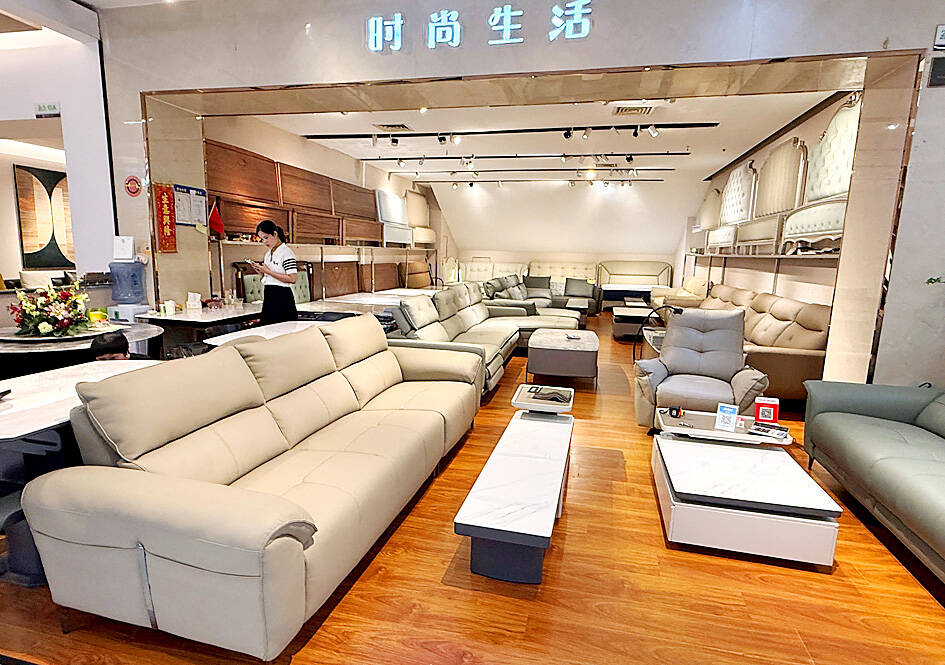
Photo: Reuters
“We haven’t really bothered with the US market since last November, when it was clear the tariffs were coming in. No one visits us from there, and we don’t try to sell. It’s just too expensive,” she said.
Lecong, like other factory towns in China’s “workshop of the world” in the Pearl River Delta with large manufacturing clusters, features more than 180 furniture malls crammed with retailers, wholesalers and distributors selling products from plywood tables to plush leather sofas.
The Web site of the Lecong Chamber of Commerce says the town became the earliest furniture market in China more than 30 years ago, when it catered to international customers, including those in the more lucrative and higher margin European and North American markets.
However, in recent years, geopolitical tensions, tariffs and rising labor and production costs have hurt Chinese manufacturers who have had to adapt to survive.
Meanwhile, the domestic Chinese market has also been hurt by weak consumption amid an economic downturn and property market slump.
Feng has downsized her workforce to 10 to 20 workers, about one-quarter of its peak. She now sells about 60 percent of her products domestically and 40 percent abroad, mostly to India and Africa.
Jin Yun, owner of Hanfei Furniture, a mid to high-end sofa maker in a mall featuring slogans such as “your one-stop home furniture partner,” said business this year had been average, with most of his customers in the Middle East and Southeast Asia.
“Last year’s tariff increase had a big impact. We still had two American customers at that time, but they ended up cancelling an order when the tariffs came and there was no sale,” he said.
“There are a lot of problems for manufacturers in every industry, not just furniture. The market is smaller and there’s a lot of competition, but we’ll survive,” he added.
The latest tariffs come after Trump last month promised to help “bring the furniture business back” to North Carolina, South Carolina and Michigan.
Furniture and wood products manufacturing employment in the US has halved since 2000 to about 340,000 today, according to US government data.
Trump has made tariffs a core policy of his second term, with sweeping duties levied on dozens of trading partners, including China and Vietnam — two major furniture makers — that have then been sometimes adjusted amid a flurry of negotiations.
“It’s not that we don’t sell to America, we’d be happy to,” said Ling, a sales manager who was sitting in her nearly deserted showroom scrolling on her phone.
“It’s just I haven’t seen an American customer here since the [COVID-19] pandemic,” Ling said.
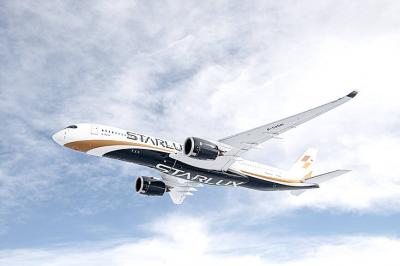
Starlux Airlines Co (星宇航空) today unveiled a long-haul network expansion plan at a shareholders’ meeting in Taipei, including direct flights to Barcelona, Spain, and Zurich, Switzerland, as well as a service connecting Taipei, Sydney and New Zealand. Starlux is to become the first Taiwanese carrier to offer non-stop services to the two European cities, while the inaugural oceanic route is expected to expand transit opportunities within the Australia-New Zealand market, Starlux said. Flight services to Chicago, Dallas, Washington and New York are under evaluation, the airline added. Prior to the shareholders’ meeting, the airline earlier this year announced that it would be

Netherlands-based semiconductor equipment supplier ASML Holding NV yesterday said that it is planning to hire an additional 1,000 people in Taiwan this year in response to growing demand from clients. ASML had previously planned to recruit 600 people this year, but that the plan has been adjusted upward, ASML vice president and ASML Taiwan general manager Grace Wang (汪佳慧) told reporters. ASML has a workforce of more than 4,500 in Taiwan, accounting for about 10 percent of its global total, Wang said. This year’s recruitment campaign would focus on adding people in the customer support, manufacturing and supply chain domains to assist ASML

UNDER MICROSCOPE: Taiwan detained three people who allegedly conspired to buy servers in Taiwan and export them using fraudulent documentation, prosecutors said Nvidia Corp chief executive officer Jensen Huang (黃仁勳) on Saturday urged Super Micro Computer Inc to tighten up on compliance after Taiwan detained three people this week for allegedly making fraudulent declarations about artificial intelligence (AI) servers made by its US partner. The development marked the nation’s first crackdown on semiconductor smuggling, which grew after the US slapped restrictions on exports of high-end chips such as Nvidia AI accelerators to China. Nvidia is “rigorous” in explaining regulations to all of its partners, Huang told reporters after arriving in Taipei. “Ultimately Super Micro has to run their own company,” he said in response to

Nvidia Corp yesterday announced that CEO Jensen Huang (黃仁勳) would attend an employee meeting in Taipei tomorrow to celebrate the launch of the company’s Taiwan headquarters project. Huang would attend a gathering at the site of Nvidia’s planned headquarters in Beitou Shilin Technology Park (北投士林科技園區), the company said in a statement. After arriving in Taiwan on Saturday last week, Huang told reporters that he plans to meet with Quanta Computer Inc (廣達) chairman Barry Lam (林百里) and Taiwan Semiconductor Manufacturing Co (TSMC, 台積電) chairman C.C. Wei (魏哲家), and would attend the groundbreaking ceremony for Nvidia’s Taiwan headquarters tomorrow. Nvidia has not yet applied


 RSS
RSS