


The US and China are close to reaching an agreement on social media platform TikTok, but a deal could hinge on Chinese demands for trade concessions, US Secretary of the Treasury Scott Bessent said yesterday before entering a second day of talks in Madrid.
The US and China delegations are discussing the divestment from TikTok by Chinese owner ByteDance Ltd (字節跳動) as part of broader talks on tariffs and economic policy.
“Our Chinese counterparts have come with a very aggressive ask,” Bessent told reporters alongside US Trade Representative Jamieson Greer.
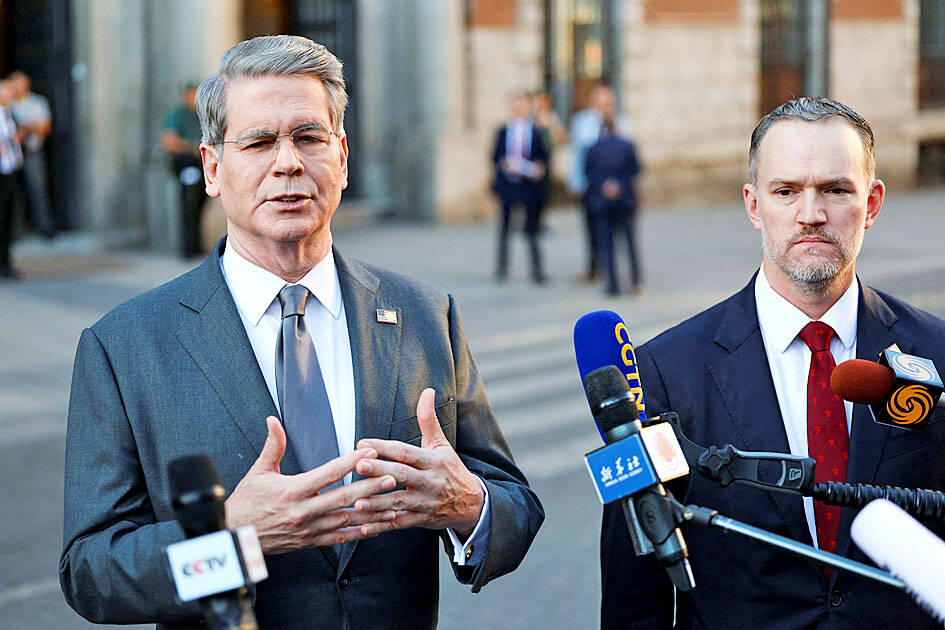
Photo: Reuters
“We will see if we can get there at present. We are not willing to sacrifice national security for a social media app,” he said.
US and Chinese officials, led by Chinese Vice Premier He Lifeng (何立峰), concluded a first day of talks in Madrid on Sunday on their strained trade ties, a looming divestiture deadline for TikTok, amid Washington’s demands that its allies place tariffs on imports from China over its purchases of Russian oil.
TikTok faces a potential ban in the US unless it moves to US ownership. The most likely result of the Madrid talks is seen as another extension of a deadline for TikTok owner ByteDance to divest its US operations by Sept. 17 or face a US shutdown.
The latest round of US-China negotiations —taking place in the baroque Palacio de Santa Cruz, home to Spain’s foreign ministry — is the fourth in four months.
Bessent said both sides had made good progress on technical details, but reaching a deal on other issues would be challenging.
Extending the TikTok divestment deadline would depend largely on how talks go this week, he said.
“From the Chinese perspective, they view as part and parcel of the potential TikTok deal a variety of matters, whether it’s tariffs or other measures that have been taken over years,” Greer said.
However, the US was not in a position to simply eliminate every measure it had ever taken to try to resolve the issue, he added. “We still have to grind through negotiations and discussions of the common understanding, and I don’t think this is the moment to just pull all those things.”
Chinese Ministry of Foreign Affairs spokesman Lin Jian (林劍) said China had no new information to give.
“Regarding TikTok, China has repeatedly stated its position,” Lin said at a news conference in Beijing yesterday.
China’s embassy in Madrid notified reporters of a potential concluding news conference in the afternoon, indicating the talks could wrap up quickly.
Bessent is due to be in London today to meet British Chancellor of the Exchequer Rachel Reeves ahead of US President Donald Trump’s state visit to the UK, which starts tomorrow.
Even if a deal over Chinese divestment from TikTok was not reached, it would not affect relations, Bessent added.
“It’s still very good at the highest levels,” he said. “Ambassador Greer and myself have great respect for all counterparts.”

HORMUZ ISSUE: The US president said he expected crude prices to drop at the end of the war, which he called a ‘minor excursion’ that could continue ‘for a little while’ The United Arab Emirates (UAE) and Kuwait started reducing oil production, as the near-closure of the crucial Strait of Hormuz ripples through energy markets and affects global supply. Abu Dhabi National Oil Co (ADNOC) is “managing offshore production levels to address storage requirements,” the company said in a statement, without giving details. Kuwait Petroleum Corp said it was lowering production at its oil fields and refineries after “Iranian threats against safe passage of ships through the Strait of Hormuz.” The war in the Middle East has all but closed Hormuz, the narrow waterway linking the Persian Gulf to the open seas,

Apple Inc increased iPhone production in India by about 53 percent last year and now makes a quarter of its marquee devices there, reflecting the US company’s efforts to avoid tariffs on China. The company assembled about 55 million iPhones in India last year, up from 36 million a year earlier, people familiar with the matter said, asking not to be named because the numbers aren’t public. Apple makes about 220 million to 230 million iPhones a year globally, with India’s share of the total increasing rapidly. Apple has accelerated its expansion in the world’s most populous country in recent years, bolstered

RATIONING: The proposal would give the Trump administration ample leverage to negotiate investments in the US as it decides how many chips to give each country US officials are debating a new regulatory framework for exporting artificial intelligence (AI) chips and are considering requiring foreign nations to invest in US AI data centers or security guarantees as a condition for granting exports of 200,000 chips or more, according to a document seen by Reuters. The rules are not yet final and could change. They would be the first attempt to regulate the flow of AI chips to US allies and partners since US President Donald Trump’s administration said it rescinded its predecessor’s so-called AI diffusion rules. Those rules sought to keep a significant amount of AI

HEADWINDS: The company said it expects its computer business, as well as consumer electronics and communications segments to see revenue declines due to seasonality Pegatron Corp (和碩) yesterday said it aims to grow its artificial intelligence (AI) server revenue more than 10-fold this year from last year, driven by orders from neocloud solutions clients and large cloud service providers. The electronics manufacturing service provider said AI server revenue growth would be driven primarily by the Nvidia Corp GB300 server platform. Server shipments are expected to increase each quarter this year, with the second half likely to outperform the first half, it said. The AI server market is expected to broaden this year as more inference applications emerge, which would drive demand for system-on-chip, application-specific integrated circuits


 RSS
RSS