


Hypermarket chain Carrefour Taiwan and upscale supermarket chain Mia C’bon on Saturday announced the suspension of their partnership with Jkopay Co (街口支付), one of Taiwan’s largest digital payment providers, amid a lawsuit involving its parent company.
Carrefour and Mia C’bon said they would notify customers once Jkopay services are reinstated.
The two retailers joined an array of other firms in suspending their partnerships with Jkopay.
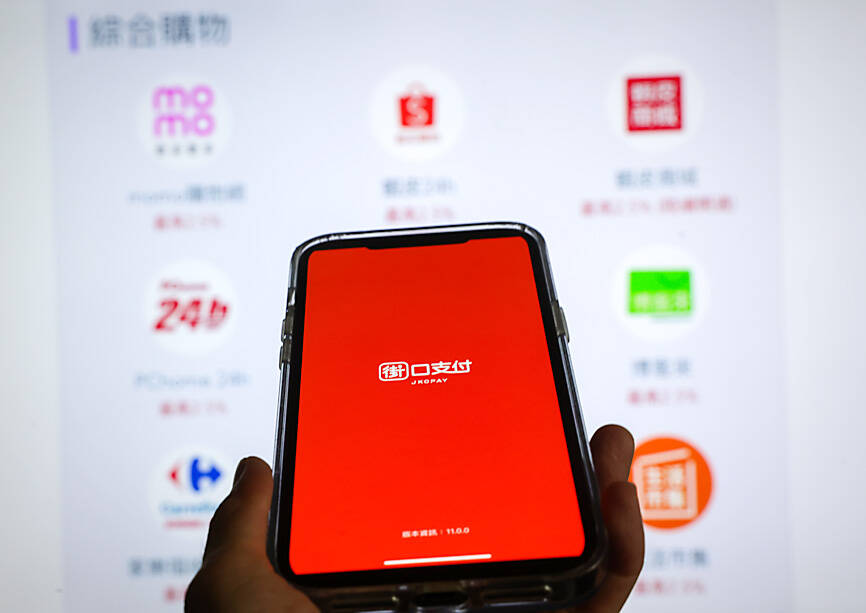
Photo: CNA
On Friday night, popular beverage chain TP Tea (茶湯會) also suspended its use of the platform, urging customers to opt for alternative payment methods.
Another drinks brand, Guiji (龜記), on Friday said that it is up to individual outlets to make their own decision about whether to continue their association with Jkopay.
Jkopay, which serves more than 6.5 million users in Taiwan, told the Central News Agency on Saturday that user withdrawals have stabilized, with daily balances returning to a normal level of NT$4 billion (US$137 million) after Jkopay chairman Jacob Mei (梅驊) said a day earlier that the company operates independently from its parent company and all funds involved in its services are held in trust.
The company said there was no run on its users’ accounts.
The wave of suspensions began on Friday, when E-Life Mall Corp (全國電子), a major 3C distributor in Taiwan, became the first Jkopay partner to cut ties. That came just one day after police executed a court-ordered seizure of assets belonging to Jkopay’s parent firm, Jko Fintech Co (街口金融科技), in connection with a NT$3.6 billion claim filed by food conglomerate Taisun Enterprise Co (泰山企業).
Other retailers, including e-commerce platforms PChome Online Inc (網路家庭), Shopee and Momo.com Inc (富邦媒體), quickly followed suit. However, Momo and PChome resumed Jkopay services later that day at about 11pm.
The asset seizure stems from a ruling by the Taipei District Court in May, which found a 2023 deal for Taisun to acquire a 40 percent stake in Jko Fintech to be invalid. The court ordered Jko Fintech to return the NT$3.6 billion paid by Taisun, along with 5 percent interest.
Jko Fintech has contested the ruling, maintaining the deal was legitimate and attributing the dispute to internal infighting among the company’s management, and refused to return the money.
The court-ordered seizure of assets followed a petition filed by Taisun.
The Financial Supervisory Commission said that Jkopay’s assets are under the agency’s supervision and would not be affected by the district court’s ruling against Jko Fintech.
As of Saturday, fast food chains McDonald’s Taiwan and Burger King, both partners of Jkopay, said the digital payment service provider remained operational at their restaurants.
McDonald’s Taiwan said all third-party payment services at its restaurants are available as usual, while Burger King said it has not received any notice of any digital payment changes.


Taiwanese firms have increased investment in the Philippines in recent years as Manila’s ties with Washington deepen and global supply chains continue to shift away from China, an expert at the Chung-Hua Institution for Economic Research (CIER, 中華經濟研究院) said yesterday. The Philippines had not been among Taiwanese investors’ top choices in Southeast Asia, CIER Taiwan ASEAN Studies Center director Kristy Hsu (徐遵慈) said at a seminar in Taipei. However, Taiwan’s investment in the country has grown significantly since the COVID-19 pandemic, reaching US $257 million last year, a high in recent years, she said. Although Taiwan’s total investment in the Philippines still lags
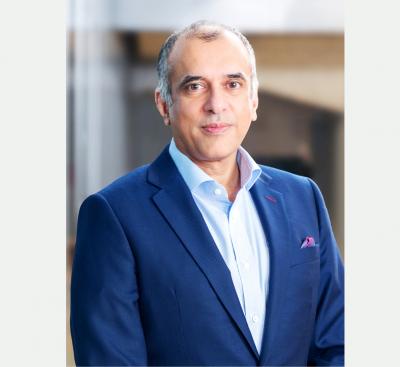
HSBC Holdings PLC is deepening its commitment to Taiwan as the economy emerges as one of the bank’s fastest-growing markets globally, driven by an artificial intelligence (AI) investment boom, expanding cross-border trade, and rising wealth creation. “The advantage that Taiwan has is a growth story linked to the semiconductor and broader AI industries, strong underlying corporate performance, and wealth creation,” said Surendra Rosha, HSBC’s co-chief executive for Asia and the Middle East, in an exclusive interview with the Taipei Times on June 2, during this year’s HSBC Taiwan Conference. That combination has helped HSBC cement its position as the most profitable international

Intel Corp regards Taiwan Semiconductor Manufacturing Co (TSMC, 台積電) as a longstanding partner, as the US chipmaker would continue outsourcing production of advanced chips to TSMC, Intel chief executive officer Lip-Bu Tan (陳立武) said yesterday. “I don’t look at people as competitors. I look at the collaboration... Nvidia is also, you know, a good friend,” Tan told a news conference following his keynote speech at the Computex trade show in Taipei. “It’s a very trusted partnership for us... We are a big, top customer for them, and we’re going to continue doing that,” he said, referring to TSMC, the world’s largest foundry

Hon Hai Precision Industry Co (鴻海精密) yesterday said it would work with US chipmaker Intel Corp to jointly develop and deploy next-generation artificial intelligence (AI) infrastructure and intelligent computing platforms in a move to capture booming demand for AI computing systems. Hon Hai, also known as Foxconn Technology Group (富士康), said in a statement that the partnership would combine its global manufacturing scale, system integration expertise and AI data center deployment capabilities with Intel’s strengths in processor architecture, silicon technologies and software ecosystem. The companies said they plan to work on equipment used in AI data centers, including server racks powered by


 RSS
RSS