


Chicony Electronics Co (群光電子) said on Saturday that it did not import power bank models from Anker Innovations Co (安克創新) that were voluntarily recalled by the Chinese manufacturer due to fire hazard concerns.
Chicony, one of Anker’s two agents in Taiwan, said that it did not import any of the seven recalled power bank models.
However, Anker’s other Taiwan agent, Weblink International Inc (展碁國際), has not made any statements regarding whether it had introduced the devices to the market.
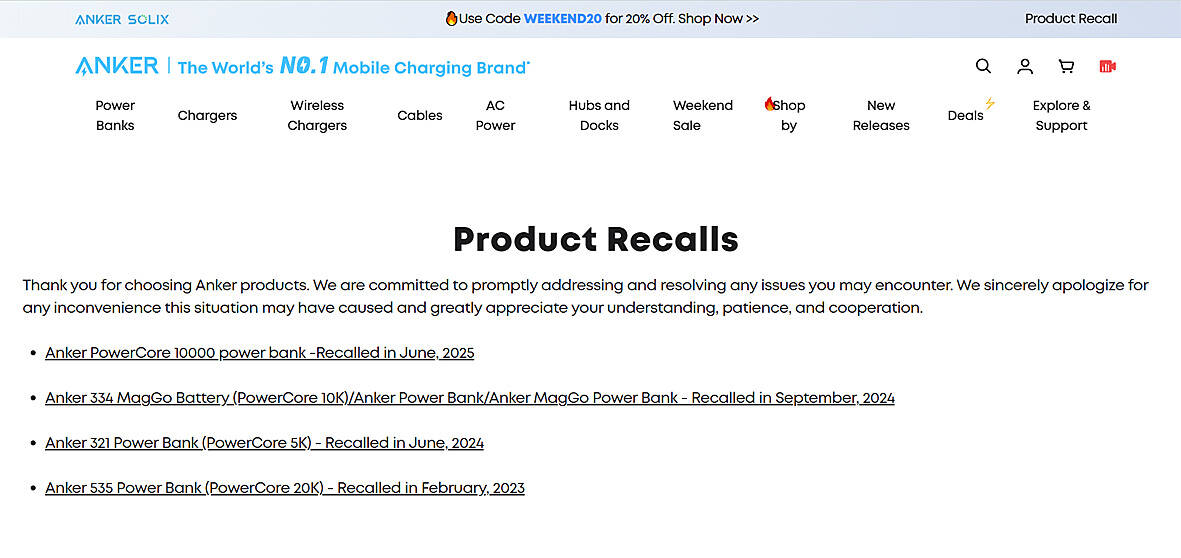
Photo: Screen grab from Anker Innovations Co’s US Web site
On Friday, Anker issued a notice on its Chinese Web site saying it was recalling power banks from the A1642, A1647, A1652, A1680, A1681, A1689 and A1257 series. The recall would result in the return of 712,964 units globally, after its power banks have recently been at the center of fire hazards and accidents.
A notice released by the US Consumer Product Safety Commission (CPSC) on June 12 said that the commission requested the recall of 1.158 million power banks from Anker’s A1263 series and urged consumers to stop using the products immediately due to the high risk of combustion and burns.
The CPSC notice indicated that Anker had received 19 reports from consumers that its power banks were causing fires or explosions.
Two incidents had resulted in minor injuries that did not need medical attention, while 11 caused property damage totaling US$60,000.
Anker offered customers three recall options: a full refund, a free upgrade to a newer model or a shopping voucher equal to the original purchase price plus an additional 50 yuan (US$6.96).
The recall decision was made after its safety inspections found that one of its suppliers had changed the materials used to manufacture the battery cells without obtaining Anker’s approval.
The change could lead to a loss in the effectiveness of separator insulators in some products and cause the device to overheat, which results in safety concerns, Anker said.
Anker’s power bank failures mark the second time a Chinese brand has reported defective issues over the past few months.
Romoss Technology Co (羅馬仕科技), a Shenzhen-based charging solution provider, also issued a recall for 491,745 units from three of its power bank models on April 14, after the brand was found to have caused fire hazards across China.
Aside from prompting Chinese to post videos online of Romoss power banks catching fire, one of the company’s devices also caused an accident midair on March 20 during a flight between China and Hong Kong when it caught fire.
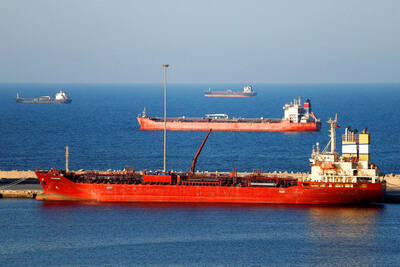
HORMUZ ISSUE: The US president said he expected crude prices to drop at the end of the war, which he called a ‘minor excursion’ that could continue ‘for a little while’ The United Arab Emirates (UAE) and Kuwait started reducing oil production, as the near-closure of the crucial Strait of Hormuz ripples through energy markets and affects global supply. Abu Dhabi National Oil Co (ADNOC) is “managing offshore production levels to address storage requirements,” the company said in a statement, without giving details. Kuwait Petroleum Corp said it was lowering production at its oil fields and refineries after “Iranian threats against safe passage of ships through the Strait of Hormuz.” The war in the Middle East has all but closed Hormuz, the narrow waterway linking the Persian Gulf to the open seas,

Apple Inc increased iPhone production in India by about 53 percent last year and now makes a quarter of its marquee devices there, reflecting the US company’s efforts to avoid tariffs on China. The company assembled about 55 million iPhones in India last year, up from 36 million a year earlier, people familiar with the matter said, asking not to be named because the numbers aren’t public. Apple makes about 220 million to 230 million iPhones a year globally, with India’s share of the total increasing rapidly. Apple has accelerated its expansion in the world’s most populous country in recent years, bolstered
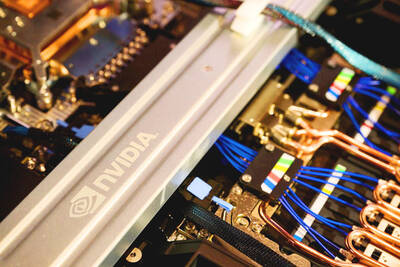
RATIONING: The proposal would give the Trump administration ample leverage to negotiate investments in the US as it decides how many chips to give each country US officials are debating a new regulatory framework for exporting artificial intelligence (AI) chips and are considering requiring foreign nations to invest in US AI data centers or security guarantees as a condition for granting exports of 200,000 chips or more, according to a document seen by Reuters. The rules are not yet final and could change. They would be the first attempt to regulate the flow of AI chips to US allies and partners since US President Donald Trump’s administration said it rescinded its predecessor’s so-called AI diffusion rules. Those rules sought to keep a significant amount of AI
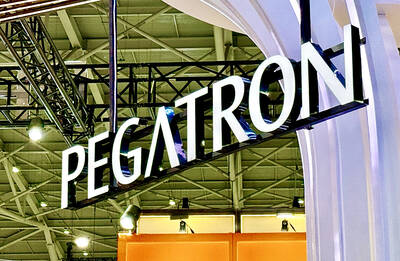
HEADWINDS: The company said it expects its computer business, as well as consumer electronics and communications segments to see revenue declines due to seasonality Pegatron Corp (和碩) yesterday said it aims to grow its artificial intelligence (AI) server revenue more than 10-fold this year from last year, driven by orders from neocloud solutions clients and large cloud service providers. The electronics manufacturing service provider said AI server revenue growth would be driven primarily by the Nvidia Corp GB300 server platform. Server shipments are expected to increase each quarter this year, with the second half likely to outperform the first half, it said. The AI server market is expected to broaden this year as more inference applications emerge, which would drive demand for system-on-chip, application-specific integrated circuits


 RSS
RSS