


Hon Hai Research Institute, the research arm of Hon Hai Precision Industry Co (鴻海精密), unveiled critical artificial intelligence (AI) server-related single-chip integrated circuit technology as well as high-performance power management solutions early this month in Japan, the company said yesterday.
In a statement, iPhone assembler and AI server maker Hon Hai, also known as Foxconn Technology Group (富士康科技集團), said these technologies have been recognized by the 37th International Symposium on Power Semiconductor Devices and ICs held in Kumamoto from June 1 to 5.
Hon Hai said the single chip integrated circuit technology was jointly developed by the research institute’s Semiconductor Research Center director Kuo Hao-chung (郭浩中) and his colleague Hsiao Yi-kai (蕭逸楷), National Yang Ming Chiao Tung University associate professor Wu Tien-li (吳添立) and professor Chen Po-hung (陳柏宏) and National Central University associate professor Tu Chang-ching (杜長慶).
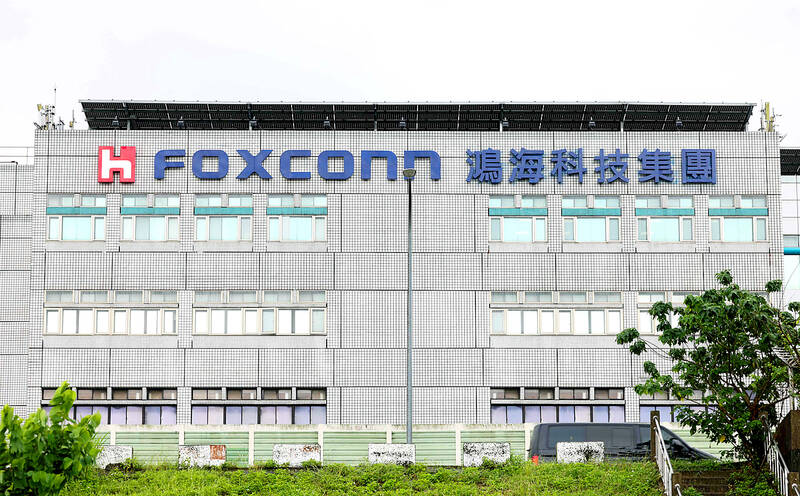
Photo: I-Hwa Cheng, AFP
The single-chip integrated circuit technology, developed based on the silicon carbide process platform by Hon Young Semiconductor Co (鴻揚半導體), is able to go beyond the performance attenuation limitations of traditional silicon-based circuits at high temperatures of more than 150 degrees Celsius, Hon Hai said.
Hon Hai said the latest single-chip integrated circuit technology is compatible with the existing silicon carbide component process and able to achieve more accurate analog signal processing in high-temperature environments, which is good for sensing and control systems functioning in extreme environments.
The recognized power management technology is jointly developed by the research institute’s semiconductor team and Chen’s and Tu’s research teams, Hon Hai said.
Their research efforts yielded to an LLC (inductor, capacitor, and capacitor) resonant converter controller by integrating Burst Mode control and Soft-Start functions, which can lower light load power consumption and improve system startup stability.
Hon Hai said a novel Burst Mode control solution for LLC resonant converters is aimed at achieving higher power efficiency and smaller output voltage ripple, while the new Soft-Start system can be started smoothly to avoid large current impact on components.


Taiwanese firms have increased investment in the Philippines in recent years as Manila’s ties with Washington deepen and global supply chains continue to shift away from China, an expert at the Chung-Hua Institution for Economic Research (CIER, 中華經濟研究院) said yesterday. The Philippines had not been among Taiwanese investors’ top choices in Southeast Asia, CIER Taiwan ASEAN Studies Center director Kristy Hsu (徐遵慈) said at a seminar in Taipei. However, Taiwan’s investment in the country has grown significantly since the COVID-19 pandemic, reaching US $257 million last year, a high in recent years, she said. Although Taiwan’s total investment in the Philippines still lags

Intel Corp regards Taiwan Semiconductor Manufacturing Co (TSMC, 台積電) as a longstanding partner, as the US chipmaker would continue outsourcing production of advanced chips to TSMC, Intel chief executive officer Lip-Bu Tan (陳立武) said yesterday. “I don’t look at people as competitors. I look at the collaboration... Nvidia is also, you know, a good friend,” Tan told a news conference following his keynote speech at the Computex trade show in Taipei. “It’s a very trusted partnership for us... We are a big, top customer for them, and we’re going to continue doing that,” he said, referring to TSMC, the world’s largest foundry

Hon Hai Precision Industry Co (鴻海精密) yesterday said it would work with US chipmaker Intel Corp to jointly develop and deploy next-generation artificial intelligence (AI) infrastructure and intelligent computing platforms in a move to capture booming demand for AI computing systems. Hon Hai, also known as Foxconn Technology Group (富士康), said in a statement that the partnership would combine its global manufacturing scale, system integration expertise and AI data center deployment capabilities with Intel’s strengths in processor architecture, silicon technologies and software ecosystem. The companies said they plan to work on equipment used in AI data centers, including server racks powered by

Artificial intelligence (AI) agents would supplant smartphones as the center of people’s digital lives, fundamentally reshaping personal devices and driving a major computing upgrade cycle, Qualcomm Inc CEO Cristiano Amon said yesterday. In his keynote speech for this year’s Computex trade show in Taipei, Amon said that the rise of "agentic AI" — AI systems capable of reasoning, planning and carrying out tasks autonomously — would transform how people interact with technology across phones, PCs, vehicles and wearable devices. Describing the technology as the next major evolution in computing, Amon said that "2026 is the year of agents.” For decades, smartphones have sat


 RSS
RSS