


The nation’s major financial conglomerates yesterday told their shareholders that the New Taiwan dollar’s rapid appreciation is taking a toll on their US-dollar based assets, but that the impact is manageable.
Shareholders gave their go-ahead to Fubon Financial Holding Co’s (富邦金) plan to distribute a NT$4.25 cash dividend and a NT$0.25 stock dividend per share from last year’s net income of NT$150.8 billion (US$5.08 billion), or earnings per shares of NT$10.77.
That represented a conservative payout ratio of 41.8 percent and came after the group incurred NT$5.79 billion of losses last month when the NT dollar gained 7 percent against the US dollar and caused NT$9.1 billion of losses at its main subsidiary, Fubon Life Insurance Co (富邦人壽).
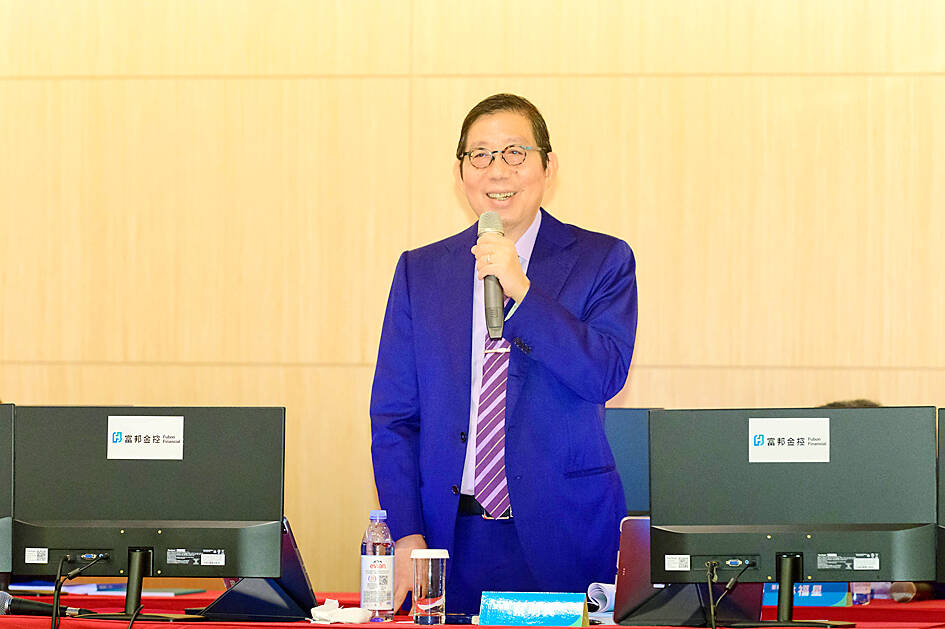
Photo: CNA
Combined losses at the six major life insurance companies amounted to NT$34.891 billion last month, company data showed.
The Financial Supervisory Commission on Thursday announced temporary relief measures to help insurers cope with mounting capital strain and sharp declines in the valuations of US Treasuries.
Life insurers would be permitted to use an average exchange rate — mirroring the six-month average approach applied to equities — when calculating regulatory capital, excluding foreign currency and deposits, the commission said.
The regulator is also offering greater flexibility in liability reserve calculations, allowing a one-notch increase in interest rate assumptions for certain products and permitting full use of the latest mortality table if reserves remain above minimum policy values.
However, insurers must boost provisions for foreign exchange price fluctuation risk, the commission said.
Under the old system monthly reserve rates would rise from 0.06 percent to 0.085 percent, while the new system’s rate would increase from 0.1 percent to 0.125 percent, it said.
Insurers are also required to earmark 30 percent of this year’s pretax profit toward those reserves, it added.
Fubon Life said the relief measures would substantially mitigate its losses and that it is increasing its hedging ratio to maintain its financial health.
Meanwhile, Cathay Financial Holding Co (國泰金) shareholders approved a proposal to issue a NT$3.5 cash dividend per share from last year’s net income of NT$111.23 billion, or earnings per share of NT$7.29.
Cathay Financial chairman Tsai Hong-tu (蔡宏圖) said the local currency’s appreciation was quite shocking and the company delivered an acceptable performance despite room for improvement.
Flagship subsidiary Cathay Life Insurance Co (國泰人壽) managed to post a small gain of NT$440 million last month, company data showed.
State-run Hua Nan Financial Holdings Co (華南金控) told its shareholders that for every NT$1 appreciation against the US dollar, Hua Nan Commercial Bank (華南銀行) would post NT$120 million less profit.
A strong NT dollar also would affect exports and the broader economy, the company said, adding that the foreign exchange market appears relatively calm this month compared with last month.
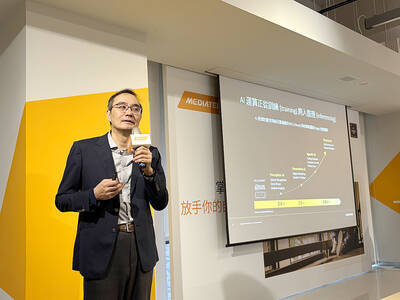
MediaTek Inc (聯發科), the world’s biggest smartphone chip supplier, yesterday said it plans to double investment in data center-related technologies, including advanced packaging and high-speed interconnect technologies, to broaden the new business’ customer and service portfolios. The chip designer is redirecting its resources to data centers, mainly designing application-specific integrated circuits (ASIC) with artificial intelligence (AI) capabilities for cloud service providers. The data center business is forecast to lead growth in the next three years and become the company’s second-biggest revenue source, replacing chips used in smart devices, MediaTek president Joe Chen (陳冠州) told a media event in Taipei. “Three or four years
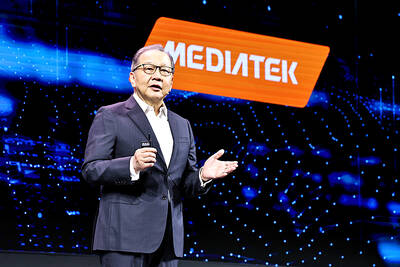
CHIP HANG-UP: Surging memorychip prices would deal a blow to smartphone sales this year, potentially hindering one of MediaTek’s biggest sources of revenue MediaTek Inc (聯發科), the world’s biggest smartphone chip designer, yesterday said its new artificial intelligence (AI) chips used in data centers are to account for 20 percent of its total revenue next year, as cloud service providers race to deploy AI infrastructure to meet voracious demand. MediaTek is believed to be developing tensor processing units for Google, which are used in AI applications. While it did not confirm such reports, MediaTek said its new application-specific IC (ASIC) business would be a new growth engine for the company. It again hiked its forecast for the addressable ASIC market to US$70 billion by 2028, compared

Until US President Donald Trump’s return a year ago, when the EU talked about cutting economic dependency on foreign powers — it was understood to mean China, but now Brussels has US tech in its sights. As Trump ramps up his threats — from strong-arming Europe on trade to pushing to seize Greenland — concern has grown that the unpredictable leader could, should he so wish, plunge the bloc into digital darkness. Since Trump’s Greenland climbdown, top officials have stepped up warnings that the EU is dangerously exposed to geopolitical shocks and must work toward strategic independence — in defense, energy and

Motorists ride past a mural along a street in Varanasi, India, yesterday.


 RSS
RSS