


An Indonesian animated movie is smashing regional box office records and could be set for wider success as it prepares to open beyond the Southeast Asian archipelago’s silver screens.
Jumbo — a film based on the adventures of main character, Don, a large orphaned Indonesian boy facing bullying at school — last month became the highest-grossing Southeast Asian animated film, raking in more than US$8 million.
Released at the end of March to coincide with the Eid holidays after the Islamic fasting month of Ramadan, the movie has hit 8 million ticket sales, the third-highest in Indonesian cinema history, Film Indonesia said.
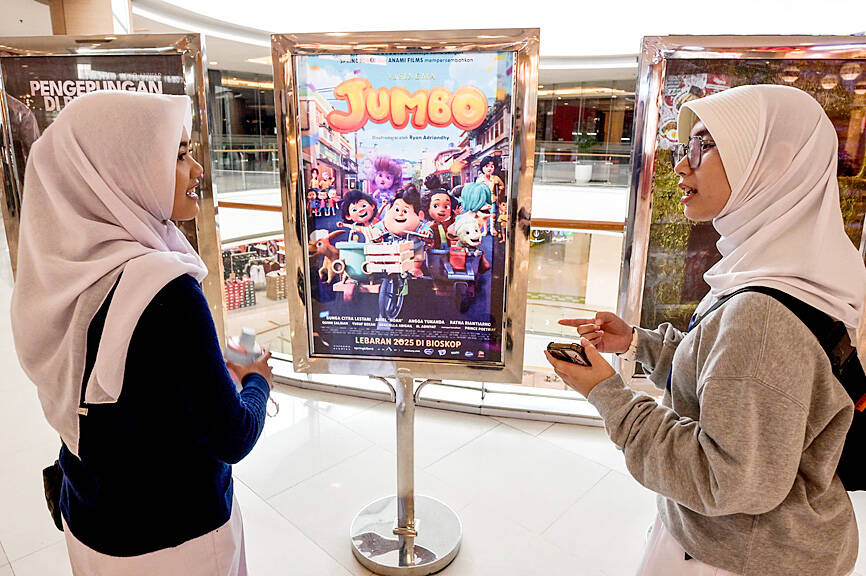
Photo: AFP
The film explores “what we’ve lost in life and the strength we need to overcome it,” director Ryan Adriandhy Halim said.
“We hope to encourage a change, it is for people to treat [each other] more kindly, and we want Jumbo to be a reminder that everyone deserves respect, no matter what is your background, whatever age group you are,” Ryan said.
In the film, Don has a storybook filled with magical tales — including a meeting with a fairy who wants him to help her reconnect with her family.
“This film is for us, for our children and for the child within us,” Ryan said.
For weeks after its release, Jumbo kept theaters packed across Indonesia.
The movie — which began production five years ago and called on the help of 400 local creators — surpassed the regional record set by Malaysia’s Mechamato Movie in 2022.
Its success has caught many in the Indonesian film industry by surprise.
“I predicted the film would be popular — but not this much,” said Petrus Kristianto Prayitno Santoso, film programming supervisor for operator Flix Cinema.
However, the film’s wider appeal would be tested when it opens in more than 17 countries next month, including Malaysia, Singapore, Turkey and Mongolia, said Anggia Kharisma, chief content officer at Visinema Studios, the film’s production house.
The company says other release dates are still in discussion, meaning it could be set for a global rollout.
In an industry flooded with Hollywood blockbusters and local horror movies, Jumbo has stood out.
“It’s been a long time since we’ve had an Indonesian family film,” said Adi, 38, who watched the movie with his wife Ria and their two young children.
However, he added that “in Southeast Asia, it will work, because the culture is similar, but I’m not sure about regions beyond that.”
The film has given hope to Indonesian audiences that their local productions could see more global success.
Cinemagoer Dika, 27, said she believes “the film could rival Disney productions.”
Ryan himself has more modest ambitions, hoping simply that his debut feature would become “a stepping stone and a benchmark for Indonesian animation.”

Netherlands-based semiconductor equipment supplier ASML Holding NV yesterday said that it is planning to hire an additional 1,000 people in Taiwan this year in response to growing demand from clients. ASML had previously planned to recruit 600 people this year, but that the plan has been adjusted upward, ASML vice president and ASML Taiwan general manager Grace Wang (汪佳慧) told reporters. ASML has a workforce of more than 4,500 in Taiwan, accounting for about 10 percent of its global total, Wang said. This year’s recruitment campaign would focus on adding people in the customer support, manufacturing and supply chain domains to assist ASML

UNDER MICROSCOPE: Taiwan detained three people who allegedly conspired to buy servers in Taiwan and export them using fraudulent documentation, prosecutors said Nvidia Corp chief executive officer Jensen Huang (黃仁勳) on Saturday urged Super Micro Computer Inc to tighten up on compliance after Taiwan detained three people this week for allegedly making fraudulent declarations about artificial intelligence (AI) servers made by its US partner. The development marked the nation’s first crackdown on semiconductor smuggling, which grew after the US slapped restrictions on exports of high-end chips such as Nvidia AI accelerators to China. Nvidia is “rigorous” in explaining regulations to all of its partners, Huang told reporters after arriving in Taipei. “Ultimately Super Micro has to run their own company,” he said in response to

Nvidia Corp yesterday announced that CEO Jensen Huang (黃仁勳) would attend an employee meeting in Taipei tomorrow to celebrate the launch of the company’s Taiwan headquarters project. Huang would attend a gathering at the site of Nvidia’s planned headquarters in Beitou Shilin Technology Park (北投士林科技園區), the company said in a statement. After arriving in Taiwan on Saturday last week, Huang told reporters that he plans to meet with Quanta Computer Inc (廣達) chairman Barry Lam (林百里) and Taiwan Semiconductor Manufacturing Co (TSMC, 台積電) chairman C.C. Wei (魏哲家), and would attend the groundbreaking ceremony for Nvidia’s Taiwan headquarters tomorrow. Nvidia has not yet applied

Huawei Technologies Co (華為) said it has come up with a new pathway to shorten its gap with industry leader Taiwan Semiconductor Manufacturing Co (TSMC, 台積電), potentially achieving a breakthrough in making advanced semiconductors without cutting-edge equipment. Right now there is about a five-year gap between what TSMC is capable of and what Huawei, together with its manufacturing partner Semiconductor Manufacturing International Corp (中芯), can produce. Huawei is to start making 1.4-nanometer chips by 2031 with its own “LogicFolding” technology, Huawei semiconductor chief He Tingbo (何庭波) said in a rare public appearance during a chip conference yesterday, while TSMC has


 RSS
RSS