


European Central Bank (ECB) President Christine Lagarde yesterday said that Europe should move toward economic independence as US President Donald Trump prepares to unleash a new wave of tariffs.
Trump has vowed to impose reciprocal tariffs on a wide range of trade partners tomorrow, which he has coined “liberation day,” saying the world’s top economy has been “ripped off by every country in the world.”
Lagarde told France Inter radio that Europe faces an “existential moment.”
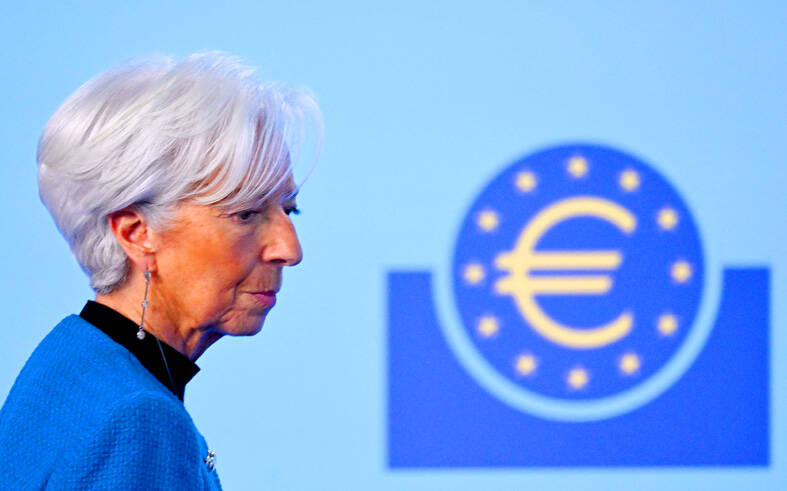
Photo: AFP
“He calls it ‘liberation day’ in the United States. I see it as a moment when we must collectively decide to take greater control of our destiny and I think it is a step towards independence,” she said.
“To put ourselves in a position to negotiate effectively, we have to show that we won’t just roll over,” Lagarde said, as the EU readies its response to the tariffs.
The ECB estimates that Trump’s trade war could slash the eurozone’s economy by 0.3 percent in its first year — and by 0.5 percent if the EU retaliates.
“A trade war creates only losers,” Lagarde said.
Trump on Sunday said that the reciprocal tariffs he plans to impose would include “all countries,” not just those with the largest trade imbalances with the US.
The US president has already slapped tariffs on steel and aluminum imports and additional levies on imports from China.
Tariffs on imported autos are also due to take effect on Thursday.
The aggressive tariff scenario prompted Goldman Sachs Group Inc to lower its US and euro area GDP forecasts, as well as forecast that the US Federal Reserve and ECB would cut interest rates three times this year.
The investment bank now sees the Fed cutting rates in July, September and November, versus earlier bets on two cuts this year and one in 2026.
In a separate note, Goldman said lower EU growth forecasts reinforce expectations the ECB would cut rates this month and June, with a further quarter-percentage-point reduction now seen for July.
Additional reporting by Bloomberg


ENERGY ISSUES: The TSIA urged the government to increase natural gas and helium reserves to reduce the impact of the Middle East war on semiconductor supply stability Chip testing and packaging service provider ASE Technology Holding Co (日月光投控) yesterday said it planned to invest more than NT$100 billion (US$3.15 billion) in building a new advanced chip testing facility in Kaohsiung to keep up with customer demand driven by the artificial intelligence (AI) boom. That would be included in the company’s capital expenditure budget next year, ASE said. There is also room to raise this year’s capital spending budget from a record-high US$7 billion estimated three months ago, it added. ASE would have six factories under construction this year, another record-breaking number, ASE chief operating officer Tien Wu

The EU and US are nearing an agreement to coordinate on producing and securing critical minerals, part of a push to break reliance on Chinese supplies. The potential deal would create incentives, such as minimum prices, that could advantage non-Chinese suppliers, according to a draft of an “action plan” seen by Bloomberg. The EU and US would also cooperate on standards, investments and joint projects, as well as coordinate on any supply disruptions by countries like China. The two sides are additionally seeking other “like-minded partners” to join a multicountry accord to help create these new critical mineral supply chains, which feed into

For weeks now, the global tech industry has been waiting for a major artificial intelligence (AI) launch from DeepSeek (深度求索), seen as a benchmark for China’s progress in the fast-moving field. More than a year has passed since the start-up put Chinese AI on the map in early last year with a low-cost chatbot that performed at a similar level to US rivals. However, despite reports and rumors about its imminent release, DeepSeek’s next-generation “V4” model is nowhere in sight. Speculation is also swirling over the geopolitical implications of which computer chips were chosen to train and power the new
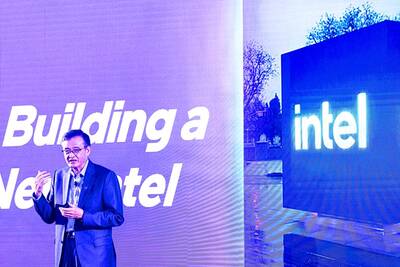
Intel Corp is joining Elon Musk’s long-shot effort to develop semiconductors for Tesla Inc, Space Exploration Technologies Corp and xAI, marking a surprising twist in the chipmaker’s comeback bid. Intel would help the Terafab project “refactor” the technology in a chip factory, the company said on Tuesday in a post on X, Musk’s social media platform. That is a stage in the development process that typically helps make chips more powerful or reliable. The chipmaker’s shares jumped 4.2 percent to US$52.91 in New York trading on Tuesday. The Terafab project is a grand plan by Musk to eventually manufacture his own chips for


 RSS
RSS